










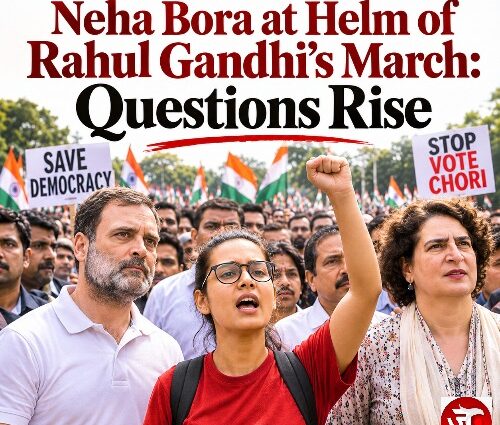
AISA President, Neha Bora at the Front of Rahul Gandhi’s March triggers questions from Congress, the Left and the CJP
October 24, 2026
When All India Students’ Association (AISA) president Neha Bora walked alongside Rahul Gandhi and Priyanka Gandhi Vadra during the INDIA bloc’s March for Democracy towards the Supreme Court on October 12, it was more than a striking political photograph. Her prominent position at the front of the march triggered a debate within Congress itself: was the party opening its doors to a wider youth movement, or was it trying to reclaim the political space occupied by the emerging Cockroach Janata Party (CJP)?
The march, organised amid opposition protests over alleged electoral irregularities and demands for Chief Election Commissioner Gyanesh Kumar’s resignation, brought together opposition leaders seeking to raise concerns about electoral integrity. After their request for an appointment with the Chief Justice of India did not materialise, Rahul Gandhi and other opposition leaders proceeded with the march towards the Supreme Court. Bora’s presence alongside the Gandhi siblings became one of the most discussed aspects of the mobilisation.
Why Neha Bora’s presence mattered
Bora is the national president of AISA, the student organisation affiliated with the Communist Party of India (Marxist-Leninist) Liberation. A Jawaharlal Nehru University (JNU) PhD scholar, she rose to wider prominence through student activism, including protests over alleged irregularities in the NEET-UG examination and participation in hunger-strike actions earlier this year.
Her association with the CJP-linked protest movement had already made her a recognisable face among young demonstrators. The CJP, associated with Abhijeet Dipke and other activists, has mobilised around education-related grievances and subsequently expanded its campaign to alleged voter-roll irregularities, the Special Intensive Revision (SIR) process and demands for accountability from the Election Commission.
Her appearance at the front of the INDIA bloc march nevertheless created a powerful political image: a Left student leader, previously visible in youth-led street protests, now walking alongside the Congress leadership.
Congress’s own student wing raises questions
The episode reportedly caused unease within the National Students’ Union of India (NSUI), Congress’s student wing. According to The Indian Express, some NSUI members questioned why Bora was receiving such prominence when Congress had its own student activists participating in the mobilisation. Some felt that their organisation had been pushed into the background.
But other Congress leaders reportedly viewed the move differently. One party leader, quoted anonymously by the newspaper, argued that Bora’s presence helped prevent the CJP from presenting itself as the central force behind the protests. The strategy, in this interpretation, was to demonstrate that Congress and the INDIA bloc were at the forefront of a wider democratic mobilisation.
That interpretation raises an important question: can a national political party build a broader coalition by giving independent activists and leaders from other ideological backgrounds a prominent platform, even if its own cadre feel overlooked?
For Congress, the potential advantage is clear. A movement involving students, young activists and civil society groups can reach beyond the party’s traditional organisational base. Yet the risks are equally apparent. Existing cadres may resent the prominence given to outsiders, while independent movements may resist being absorbed into the political identity of a larger party.
Is Congress trying to bring the CJP movement into its orbit?
This is the central political question, but it must be approached carefully: India Today examined whether Rahul Gandhi’s decision to march alongside Bora could help Congress occupy political space previously associated with the CJP-led agitation. The report noted that the protests had overlapping concerns, even as the groups maintained separate identities and organised activities.
The Indian Express also reported that some Congress leaders saw Bora’s inclusion as a way to broaden the INDIA bloc’s reach while preventing a rival protest platform from claiming exclusive ownership of the agitation.
These are reported political interpretations, not proof of a coordinated plan to take over the CJP movement. There is no established evidence that Bora’s position in the march resulted from a formal agreement between AISA and CJP, or that the march marked an organisational merger.
The protests continue, and so does the legal battle
Bora’s subsequent participation in protests brought her into conflict with the Delhi Police. She was detained on October 16 while on her way to the CJP-associated “Lehra Do Tiranga” march at Connaught Place and was released the following day.
She later challenged a notice requiring her to explain why she should not furnish a personal bond of ₹10,000, with a surety, to maintain peace during an inquiry. Her lawyers argued that the proceedings were an attempt to suppress peaceful dissent. Bora also told the Delhi High Court that she had not been involved in the CJP’s separate protest call at Connaught Place.
On October 23, the Delhi High Court rejected her challenge to the notice. The court said there was sufficient material for the preventive proceedings to have been initiated and directed that the material relied upon be provided to her before further action. The court’s decision concerned the legality of the notice and the preventive proceedings; it did not establish that Bora had committed a criminal offence.
Neha Bora’s statement on refusing the peace bond
“Whose ‘peace’ am I being asked to keep?”
She argued that peace-bond proceedings were being used to curb democratic protests and questioned how raising slogans or challenging the government could be treated as a threat to public peace.
Her clearest declaration was:
“We don’t have any conditions. We are not going to sign the bond.”
She also said:
“The peace cannot be only for the government, but also for the people.”
The New Indian Express
Her position: Bora maintains that peaceful protest and the right to dissent are fundamental democratic rights, and says she will continue challenging the peace-bond proceedings.
Legal update: The Delhi High Court dismissed her challenge to the show-cause notice but directed authorities to disclose the material relied upon and ensure procedural fairness. The matter was scheduled for further consideration before the Special Executive Magistrate on October 29, 2026.
The developments have placed Bora at the intersection of three increasingly visible strands of opposition mobilisation: Left student activism, Congress-led electoral protests and the newer youth-led CJP campaign.
A wider struggle over the face of dissent
The significance of Bora’s appearance alongside Rahul and Priyanka Gandhi extends beyond one march. It highlights a contest over who represents the growing discontent among students and young protesters, how separate groups coordinate around shared grievances, and whether established political parties can work with independent movements without overshadowing them.
Congress may see Bora’s prominence as a way to demonstrate that the INDIA bloc can bring together activists beyond its formal membership. The CJP, meanwhile, has its own leadership and public identity, and its campaigns cannot automatically be treated as extensions of Congress. AISA, too, has its own ideological commitments and organisational structure.
The larger question is whether the opposition can sustain a common campaign around electoral integrity while allowing its constituent groups to retain their independence.
Neha Bora’s march alongside Rahul Gandhi has made that question impossible to ignore. But the photograph alone cannot settle the answer. What it has done is expose the negotiations, rivalries and competing ambitions, that accompany any attempt to turn scattered protests into a broader political movement.
JANPATH NEWS NETWORK (JNN)
Independent. Fearless. On the People’s Path.