








Israel Votes For Change? Eisenkot Declares The Netanyahu Era Over High Turnout, Weakened Ruling Bloc and Potential Kingpin For Arab Parties
October 28, 2026: As Israel awaited the election verdict, Tel Aviv was gripped by political fervour. Reports of jubilant crowds and chants for change captured the mounting pressure on Benjamin Netanyahu, whose leadership faced a defining electoral test.
At the centre of the opposition surge stood Gadi Eisenkot, the former IDF chief of staff challenging Netanyahu for the country’s leadership.
Just days earlier, thousands had rallied in Tel Aviv, cheering Eisenkot and chanting, “Who’s coming? The next prime minister!” The demonstrations demanded accountability for the October 7 security failures and a change of government. Now, with exit polls pointing to a fractured verdict and no clear parliamentary majority, the political battle was far from over.
Israel’s October 27, 2026, election was widely seen as a defining test of Benjamin Netanyahu’s leadership, the first national parliamentary vote since the Hamas attacks of October 7, 2023, and the wars that followed.
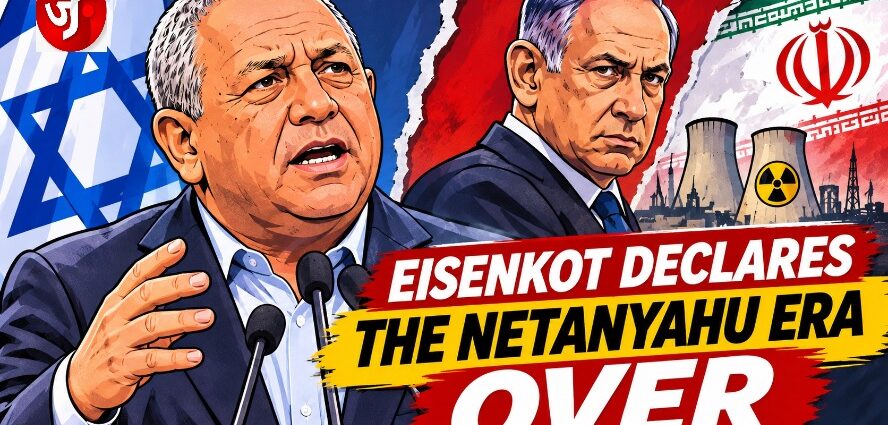
As preliminary exit polls pointed to a deeply divided electorate, opposition leader Gadi Eisenkot declared that Israelis had chosen change and that Netanyahu’s era was over.
Addressing supporters, Eisenkot, a former chief of staff of the Israel Defense Forces (IDF) and leader of the centrist Yashar party, called on Netanyahu to accept the preliminary projections. He promised a government capable of bringing Israelis together, confronting the country’s security and economic challenges, and ending the divisions that have dominated its politics.
His message was unmistakable: Israel could not simply return to business as usual.
Eisenkot also urged law enforcement authorities to stand firm, warning against the possible use of national security concerns for political purposes. These were his allegations and political arguments, not established findings.
A fractured verdict at the ballot box
The exit polls suggested a major challenge for Netanyahu’s governing coalition, which had held 64 of the Knesset’s 120 seats. Yet they offered no clear path to a majority for either side.
The opposition and change-oriented parties were projected to win approximately 50–53 seats, while Netanyahu’s right-wing and religious bloc was estimated at around 50. Arab parties were projected to secure 17–18 seats, potentially giving them considerable influence over the negotiations to form the next government.
Neither major bloc appeared close to the 61 seats required for a parliamentary majority.
Likud, Netanyahu’s party, was projected to remain the largest single party in several exit polls, with roughly 24–25 seats. Eisenkot’s Yashar was projected to win approximately 19–23.
Turnout was reported at around 77.7%, its highest level in more than two decades, signalling intense public engagement in a contest with enormous consequences for Israel’s political future.
But exit polls are not final results. Official counting was still under way, and the projections differed across broadcasters, including Channel 14, which showed a stronger performance for Netanyahu’s bloc in some updates.
The issues that brought Israel to this crossroads
The election unfolded against the backdrop of the October 7 attacks, the subsequent wars involving Gaza and Lebanon, confrontations involving Iran, and fierce domestic disputes over judicial reform and exemptions from military service for ultra-Orthodox Jews.
For Netanyahu, the central argument was continuity and security in a region still facing serious threats.
For Eisenkot, the pitch was different: a security-focused, centrist leadership that could rebuild public trust and address the divisions confronting Israeli society.
His personal history gave that message added weight. Eisenkot lost his son and nephews during the Gaza war. He has presented himself as a figure capable of bridging political divides, although the practical limits of that promise remain significant.
He has generally ruled out a full coalition with Arab parties, while leaving open the possibility of arrangements such as a minority government relying on their support from outside the coalition.
That distinction could prove crucial. The Arab parties’ projected gains might give them greater leverage in parliamentary negotiations, even if they do not join a governing coalition.
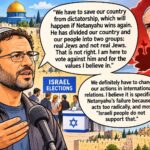
In July 2026, Eisenkot said at the Herzliya Conference:
“Iran never obtained nuclear weapons. I’m well aware of all the intelligence.”
He went on to accuse Netanyahu of “inventing a reality” and manufacturing threats to frighten the Israeli public. The remarks were reported by The Times of Israel and Anadolu Agency. The Times of Israel+1
He repeated the accusation on 21 October, days before the election, telling Israel’s public broadcaster KAN that Netanyahu’s claim about destroying Iranian nuclear bombs was an “outright lie.” Eisenkot also said he saw no immediate threat justifying another attack on Iran ahead of the election.
ISRAEL VOTES FOR CHANGE?
High turnout, a weakened ruling bloc and a potential kingmaker role for Arab parties leave Israel facing a difficult political reckoning.
The immediate question is no longer simply which party wins the most seats. It is whether any combination of parties can assemble a stable government.
Coalition negotiations are likely to be difficult, with ideological disagreements, military-service policy, security priorities and the role of Arab representatives all complicating the arithmetic.
The final seat distribution will determine who has the strongest claim to form a government and whether Netanyahu can remain in power despite the apparent weakening of his bloc.
Eisenkot has declared a political turning point. Whether that declaration becomes a change of government will depend on the final count, which will take some days, and the negotiations that follow.
The election has exposed a country deeply divided over its leadership, its security and the direction of its future. The ballot box has delivered an inconclusive verdict, and Israel’s next government will emerge from the difficult arithmetic of coalition politics.
Sources: Al Jazeera and preliminary exit-poll projections. Seat estimates and political claims.
JANPATH NEWS NETWORK (JNN)
Independent. Fearless. On the People’s Path.