










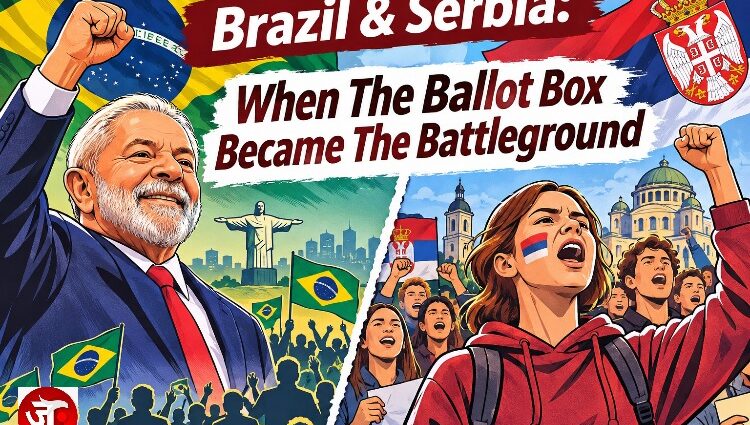
Two Countries, Two Political Earthquakes: Lula Wins Again In Brazil As Student Movement Topples Serbia’S Ruling Establishment
Brazil / Serbia
October 26, 2026: From Brazil to the Balkans, two dramatic election results have reshaped the political landscape, delivering a fourth presidential term to Luiz Inácio Lula da Silva and a historic parliamentary victory to Serbia’s student-backed movement.
Brazil’s Luiz Inácio Lula da Silva has secured a fourth, non-consecutive presidential term, defeating far-right challenger Flávio Bolsonaro in Sunday’s runoff election and overturning the advantage his rival had established in the first round.
Lula won 51.79% of the vote against Bolsonaro’s 48.21%, a margin of approximately 4.4 million votes. At 80, the veteran politician has once again demonstrated his ability to mobilise a broad electoral coalition in Latin America’s largest country.
The victory is particularly significant because Lula had trailed Bolsonaro in the first round earlier this month. His comeback followed an intense campaign in a deeply polarised country, where voters confronted competing visions of economic policy, social welfare, environmental protection and Brazil’s role in the world.
For Lula’s supporters, the result represents a renewed mandate for his political programme and a rejection of the Bolsonaro family’s bid to return to power. His government will face the challenge of governing a country where nearly half the electorate backed his opponent.
The election, however, has already entered a contentious aftermath. Flávio Bolsonaro has refused to concede defeat and announced that he would seek to have the result annulled, citing a last-minute decision to extend voting hours by two hours. Yet the extension had been sought by both campaigns in different areas, amid concerns about transport disruptions and heavy rain. Legal experts cited by ABC News questioned whether the unusual decision, by itself, provided sufficient grounds to invalidate the election.
The dispute threatens to prolong political tensions even after the electorate has delivered its verdict.
SERBIA: STUDENTS DEFEAT A LONGTIME POWERHOUSE
In Serbia, a student-backed electoral list has secured a landmark victory over the political establishment associated with Aleksandar Vučić, ending his long period of dominance in national politics.
With almost 99% of votes counted, the Student List had received approximately 52.7% of the vote, compared with 39.2% for the alliance led by Vučić’s Serbian Progressive Party. Preliminary projections put the student-backed bloc at around 139 seats in the 250-member parliament, giving it a commanding majority. Vučić conceded defeat on Sunday.
The victory follows nearly two years of student-led demonstrations that grew out of public anger over corruption and accountability after the collapse of a railway station canopy in Novi Sad in November 2024 killed 16 people.
What began as outrage over a deadly tragedy evolved into a wider movement demanding greater transparency, institutional accountability and political change.
Students, joined by citizens from different backgrounds, sustained protests that challenged a governing establishment widely criticised by demonstrators for its concentration of power and alleged corruption.
The election has now carried that protest movement from the streets into parliament. Celebrations erupted in Belgrade and other cities after the result became clear.
However, victory at the ballot box is only the beginning. The student-backed movement must now demonstrate that it can translate its demands into effective government, tackle corruption and strengthen public institutions. Its leadership and governing programme remain important questions as Serbia enters a new political chapter.
THE BIGGER PICTURE: THE BALLOT BOX BECAME THE BATTLEGROUND
Brazil and Serbia have followed different political paths, but their election results highlight a shared democratic challenge: how political systems respond when voters demand change, and whether those who lose power accept the outcome.
In Brazil, Lula’s narrow but clear victory has been followed by a challenge from his defeated opponent. In Serbia, a student-led movement has converted prolonged street protests into a parliamentary majority, while the outgoing political leadership has conceded defeat.
Neither result guarantees an easy road ahead. Brazil remains deeply divided, while Serbia’s incoming parliamentary majority faces the difficult task of turning a broad protest coalition into a functioning government.
But both elections demonstrate that political dominance does not make any leader invulnerable to the electorate.
JANPATH NEWS NETWORK (JNN)
Independent. Fearless. On the People’s Path.