









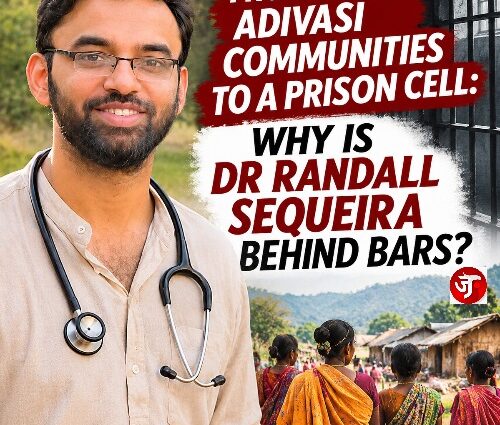
From Healing Adivasi Communities To A Prison Cell: Why Is Dr Randall Sequeira Behind Bars? His arrest sparks sharp questions.
October 27, 2026: Randall Sequeira, the doctor who moved to Odisha to serve the poor was arrested amid resistance to Vedanta’s Sijimali bauxite mine; police allege instigation of violence, while human rights groups question the case and raise concerns over criminalisation of dissent.
Randall Sequeira is trained as a doctor. He left the city where he grew up and moved to a remote part of Odisha, where access to healthcare remains a daily struggle for many Adivasi communities. He treated patients in underserved villages and became involved in a movement opposing bauxite mining in the Sijimali hills.
Now, Dr Randall Sequeira, 39, is in judicial custody in Rayagada, facing serious criminal charges arising from a violent confrontation between police and villagers during anti-mining protests in April.
His arrest has sparked protests, statements of solidarity from civil society organisations and questions about the relationship between industrial development, tribal rights and the freedom to dissent.
Here is an excerpt from a letter from his distraught mother: She writes:
“As parents, our hearts are deeply pained to see our beloved son, Randall, in judicial custody. We firmly believe that he is not involved in any criminal activities. He is a doctor who has dedicated his life to serving the poor, the oppressed, the downtrodden, and the Adivasi communities who desperately need his care, compassion, and medical services.
Randall has stood beside the Adivasi people because he is deeply concerned about their lives, their health, their ancestral lands, and their future. He fears that mining activities could expose these vulnerable communities to serious health problems and deprive them of the environment and livelihoods on which they depend.
The poor and oppressed need Randall. They need their doctor, their compassionate healer, and someone who cares about their suffering. His place should be among the people he has dedicated his life to serving.
He is facing grave charges, including murder, dacoity, and offences relating to arms. As his parents, we believe these charges are false, and we pray that the truth will emerge and justice will prevail.”
The doctor who chose a different path
Randall Sequeira grew up in Mumbai and completed his medical studies at St John’s Medical College in Bengaluru. In 2017, he decided to settle in Odisha’s Kalahandi district, according to The Indian Express.
Rather than pursue a conventional medical career in a major city, he worked among communities facing barriers to healthcare in remote parts of Kalahandi and neighbouring Rayagada.
Randall Sequeira’s work brought him into contact with Adivasi families whose concerns extended beyond illness and treatment to land, livelihoods, displacement and the effects of proposed mining projects.
Over time, Randall Sequeira also became involved in opposition to bauxite mining in the region. Supporters describe his medical work and his solidarity with local communities as inseparable from the wider struggle over the conditions in which people live.
Police, however, have offered a sharply different assessment of his role, alleging that he was mobilising residents against the government rather than concentrating on medical services. Those competing accounts now sit at the centre of a case that has drawn attention well beyond Odisha.
The Sijimali hills: what is at stake?
The controversy centres on the Sijimali bauxite deposit, a mineral-rich area spanning parts of Kalahandi and Rayagada districts in Odisha’s Eastern Ghats.
Vedanta Limited secured the mining block in 2023. The proposed project covers approximately 1,549 hectares, with an estimated 311 million tonnes of bauxite reserves, according to reporting by The Indian Express. The project is intended to supply bauxite to Vedanta’s alumina operations in Lanjigarh, Kalahandi.
For the company and the state, the project represents a major industrial resource. For many Adivasi residents opposing it, the stakes are fundamentally different: access to land, forests, water, farming, traditional livelihoods and the future of their communities.
Adivasi residents have raised concerns about environmental damage and the potential consequences of mining and associated infrastructure. Some have also challenged the validity of Gram Sabha resolutions associated with the project, alleging that the required community consent and forest-rights processes have not been properly followed.
The Union Environment Ministry’s expert appraisal committee recommended environmental clearance for the mine in May 2026, subject to conditions, including the requirement for final forest clearance before mining in the relevant forest area. Forest diversion for the access road has also been contested.
These are not peripheral disputes. They concern how a major industrial project proceeds in a region inhabited by Adivasi communities whose rights are protected under Indian law.
April 6-7: the confrontation that preceded the arrests
The immediate case against Randall Sequeira relates to a confrontation in Kantamal village during the night of April 6 and the early hours of April 7.
The dispute had escalated over construction of an approximately three-kilometre access road intended to connect the Sijimali mining area with State Highway 44. Residents opposing the project had attempted to stop the roadwork.
According to local accounts published by The Wire and other outlets, police entered the village during a pre-dawn operation. Residents alleged that electricity was cut, homes were entered and villagers were subjected to force.
Police gave a different account, saying officers had gone to the village to execute a non-bailable warrant against a resident and that protesters attacked personnel with stones and other objects. Police used tear gas and batons to disperse the crowd.
Reports said nearly 58 people, including police personnel, were injured in the confrontation, although accounts differ on the details and numbers.
The incident resulted in multiple criminal cases and arrests. The dispute over the road, and the larger mining project behind it, remains central to understanding why tensions escalated.
October 16: the late-night arrest
On October 16, police arrested Randall Sequeira and fellow anti-mining activist Laxman Naik at Sequeira’s residence in Bhawanipatna, Kalahandi district. They were subsequently taken to Rayagada and remanded to judicial custody.
Police have linked the arrests to Kashipur Police Station Case No. 85/2026, concerning the April confrontation.
The charges reported by news outlets include attempted murder, rioting and offences under the Arms Act. Other reports have listed additional charges, including dacoity and criminal intimidation.
Police allege that Randall Sequeira and Naik instigated villagers to attack law-enforcement personnel. South Western Range DIG Akhileshvar Singh has also questioned whether Sequeira was providing medical services or instead mobilising Adivasi residents against government initiatives.
Randall Sequeira and Naik have not been convicted of these offences. The allegations must be tested through the legal process.
A key issue raised by activists is that neither man was among the 26 individuals named in the original FIR, according to reports citing the case and statements by supporters. Police have maintained that their alleged involvement emerged during the subsequent investigation.
Why rights groups are demanding answers
The arrests have prompted criticism from civil liberties organisations, health workers and political figures.
Jan Swasthya Abhiyan, a nationwide people’s health movement, condemned the arrests and argued that supporting communities facing displacement and the social consequences of mining should not itself be treated as a criminal act.
The People’s Union for Civil Liberties has also criticised the arrests of activists opposing the Sijimali project, describing them as part of a wider pattern of action against Dalit and Adivasi voices.
Opposition politicians have questioned the timing and circumstances of the arrests, while supporters have called for the men’s release and an independent examination of the April events.
Police have rejected the suggestion that the arrests are simply a response to anti-mining activism and have defended their action as part of an investigation into alleged criminal conduct.
These competing claims call for transparent scrutiny of the evidence, the arrest procedures and the case against each accused person.
A significant legal background
There is another important detail in Randall Sequeira’s history with the authorities.
In July 2025, the Orissa High Court quashed an order that had barred Randall Sequeira from entering Rayagada district for two months. The order had been issued ahead of a planned anti-mining demonstration on World Environment Day.
The court examined whether the restrictions were necessary and proportionate, whether an imminent threat to public order had been established, and whether due process had been followed. It ruled in Randall Sequeira’s favour and directed authorities to facilitate his right to participate in peaceful protests, subject to lawful conditions.
That judgment did not decide the merits of the separate criminal allegations arising from the April 2026 confrontation. It does, however, provide relevant context when examining the state’s previous restrictions on his participation in anti-mining demonstrations.
The question Odisha must answer
At the heart of this controversy lies a difficult question: how can a state pursue industrial development while protecting the rights of communities whose land, forests and livelihoods may be affected?
Mining projects can bring investment, employment and revenue. They must also comply with environmental requirements, land laws and applicable protections for Adivasi communities. Residents must have meaningful opportunities to raise objections, and allegations of unlawful conduct must be investigated fairly, whether they concern protesters or police.
Randall Sequeira’s case must ultimately be decided on evidence.
For Adivasi communities in the Sijimali hills, the dispute concerns more than one arrest. It concerns their land, their access to natural resources, the future of their villages and their ability to participate meaningfully in decisions affecting their lives.
A mine may be measured in tonnes of bauxite and the value of its output. The cost to a community must also be measured in land, water, health, livelihoods and the rights people are able to exercise.
The demand now is for a fair legal process, transparency over the evidence, accountability for any unlawful conduct and protection of the constitutional right to peaceful protest.
Development and justice should not be competing objectives. The test of a democratic state is whether it can pursue both. Have people forgotten Father Stany Swamy, and how he was jailed under false allegations. Randall Sequeira‘s story should not have the same end.
JANPATH NEWS NETWORK (JNN)
Independent. Fearless. On the People’s Path.