









Students in Uttar Pradesh Sell Their Blood 2-4 Times monthly to Pay for Education: Dainik Bhaskar’s Undercover Investigation
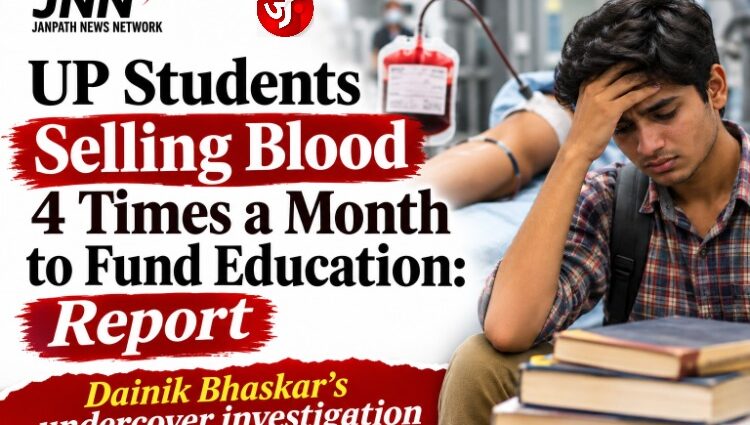
October 27, 2026: Prayagraj: Students from poor families in several cities across Uttar Pradesh are reportedly being driven to sell their blood to pay for expensive coaching classes, hostel accommodation and mess fees. An undercover investigation by Dainik Bhaskar has revealed that several students preparing for NEET and SSC examinations sell their blood two to four times a month. Some have reportedly had their blood drawn twice within just ten days.
What does the report say?
The Bhaskar team sent undercover reporters outside the Allahabad Medical Association (AMA) Blood Bank, located at Rajapur Crossing in Prayagraj. Posing as relatives of patients, the reporters spoke to students. Several were reportedly willing to sell their blood in exchange for money.
One student preparing for the SSC examination said he had been unable to pay his hostel fees for two months. He is the only son in his family. His mother has died, and his two younger sisters live in their village. His father is a farmer, and the family earns just enough from farming to afford basic meals.
He said:
“Blood will be produced again, but if I cannot complete my education, I will remain unemployed.”
He offered to provide blood for ₹8,000.
Another student, Anand, had sold his blood at a different blood bank just ten days earlier to pay his mess bill. He had now returned because he needed money for his coaching fees. He, too, demanded ₹8,000.
Vivek, who is preparing for NEET, said his father had mortgaged two bighas of farmland to finance his education and had fallen deeply into debt. Vivek is now on his final attempt at the examination and must pay his coaching fees before Diwali.
Several students, including Ashish, said that hundreds of students who come from outside the city resort to similar methods to arrange money.
How much does education cost?
The cost of preparing for competitive examinations places a heavy financial burden on students from low-income families.
- Annual coaching fees: ₹1.20 lakh to ₹1.80 lakh at institutes such as Aakash, Allen and Narayana, often payable in a lump sum.
- Hostel accommodation: ₹3,500 to ₹5,000 per month.
- Additional expenses: Study materials, food and other living costs.
The government’s Abhyudaya Scheme provides free coaching, but eligibility requirements and limited seats mean that not every student can access the programme.
How does the racket operate?
According to the report, students negotiate directly with patients or arrange transactions through agents.
Agents identified as Sonu and Rajesh reportedly claim they can arrange more than 12 units of blood in a single day. They allegedly keep fake demand letters, hospital stamps and forged medical prescriptions ready for use.
Students pay a processing fee of approximately ₹1,500 themselves. Consequently, someone who sells blood for ₹5,000 may receive only ₹3,500 after the fee is deducted.
The report suggests that blood banks are not directly involved in these transactions, although they are reportedly aware of activities taking place outside their premises. Authorities generally take action only after receiving complaints.
These allegations require investigation by the relevant authorities.
The legal and health implications
The commercial sale of human blood is prohibited under India’s blood-bank regulatory framework. The Supreme Court has previously addressed the issue of commercial blood donation, and India’s regulations require blood collection to be based on voluntary, non-remunerated donation, subject to applicable rules.
The report states that commercial blood transactions can attract imprisonment of two to seven years and fines. The precise penalties depend on the applicable legal provisions and the offences established.
Repeated blood donation without adequate recovery can also pose serious health risks, including iron deficiency and anaemia. Blood donation must follow medical screening and prescribed intervals to protect the donor’s health.
The students’ anguish
Most of the students interviewed reportedly come from farming families. Their parents struggle to meet household expenses, let alone the rising cost of competitive-examination preparation.
One student explained:
“My father is a farmer, but we do not have enough land to cover all our household expenses. Sometimes, we even send the money we earn from selling blood back to our village.”
One student’s statement captures the desperation behind these accounts:
“Blood will keep being produced, but I may never get another opportunity to study.”
A crisis that demands attention
This is not merely a story about students in Prayagraj. The report suggests that similar cases are emerging in several cities across Uttar Pradesh.
When the cost of education rises beyond the reach of poor families, students can be pushed into desperate and potentially dangerous ways of financing their futures. Young people who should be concentrating on examinations and building careers are instead risking their health to pay for coaching, accommodation and food.
The government, educational institutions and society must confront this reality. Affordable coaching, accessible public education, adequate scholarships and stronger oversight of blood banks are essential to ensure that financial hardship does not force students into unsafe practices.
No student should have to risk their health to afford an education.
JANPATH NEWS NETWORK (JNN)
Independent. Fearless. On the People’s Path.
Source: Dainik Bhaskar’s undercover investigation, October 2026. The allegations and figures above are attributed to the supplied report.