









SIR controversy intensifies as protests spread, millions face verification and questions mount over electoral roll deletions.
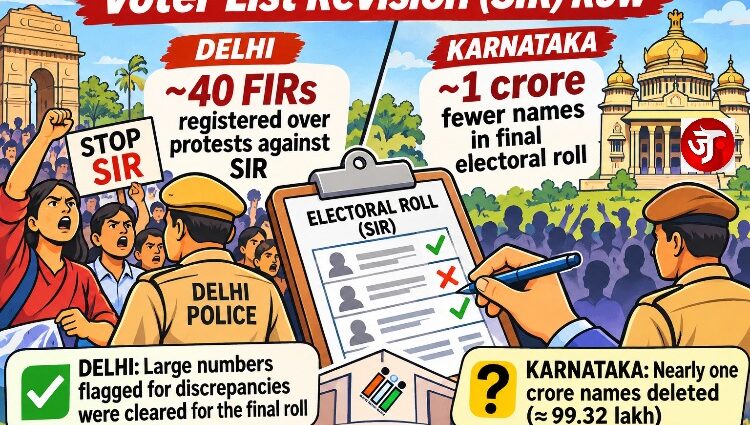
India’s voter-list controversy has entered a critical phase. In Delhi, police have registered around 40 FIRs linked to protests against the Special Intensive Revision (SIR) of electoral rolls since October 10. In Karnataka, the final electoral roll published on October 27 showed nearly one crore fewer electors than before the revision.
Together, these developments have intensified the debate over a fundamental democratic question: how can India ensure that every eligible citizen retains the right to vote while removing genuinely ineligible entries?
Delhi: 40 FIRs as protests continue
According to a report published by The Hindu on October 28, Delhi Police registered at least 40 FIRs in connection with demonstrations opposing SIR. Investigators are examining CCTV footage to identify protesters and people alleged to have organised the demonstrations.
The cases reportedly involve alleged violations of prohibitory orders under Section 163 of the Bharatiya Nagarik Suraksha Sanhita, vandalism and obstruction of public servants. The allegations remain subject to investigation.
The protests have brought student organisations, youth groups and political activists onto the streets. Demonstrators have demanded a rollback of the revision exercise and the resignation of Chief Election Commissioner Gyanesh Kumar.
The controversy has become part of a broader confrontation over the Election Commission’s handling of voter verification and the potential consequences for citizens whose names are missing or whose records have been flagged.
Delhi: Millions flagged, most cleared for inclusion
The figures from Delhi tell a significant story. According to Hindustan Times, approximately 3.31 million electors were flagged for logical discrepancies or because their names could not be linked to the 2002 electoral roll. By October 27, more than 3.12 million cases had been resolved and marked for inclusion in the final roll, representing approximately 94.34% of the cases.
The remaining cases are to be dealt with by November 30, while publication of Delhi’s final electoral roll is scheduled for December 4.
The discrepancies included spelling mismatches, differences in ages recorded for family members and difficulties establishing links with the older electoral roll.
The figures raise two important issues. The large number of cases resolved for inclusion shows that being flagged did not necessarily mean a voter was ineligible. At the same time, the scale of the verification exercise highlights the administrative burden placed on election officials and affected electors.
For citizens, the consequences can be serious. A clerical error or a missing document must not become an insurmountable barrier to exercising a constitutional right.
Karnataka: Nearly one crore fewer electors
Karnataka’s final electoral roll, released on October 27, contained approximately 4.55 crore electors, compared with 5.54 crore before SIR began. That represents a reduction of roughly 99.32 lakh names, or about 17.9% of the earlier electorate.
The Election Commission’s figures, however, require careful interpretation. The reduction is not proof that nearly one crore eligible voters were unlawfully deleted.
During the exercise, officials classified entries under categories including absent, shifted, deceased and duplicate. The draft roll had already excluded approximately 1.08 crore names before the claims-and-objections process.
Subsequently, around 43.2 lakh electors who received verification notices were included in the final roll, while approximately 61,867 were found ineligible following the prescribed process. More than 10 lakh new voters were also added during the revision.
The Election Commission has maintained that the exercise was conducted according to the law. Critics, however, have raised concerns about the scale of the deletions, the verification process and the risk of eligible voters being left out.
The key question is not simply how many names disappeared. It is whether every deletion was justified, whether affected citizens received a fair opportunity to establish their eligibility, and whether anyone entitled to vote has been excluded.
The democratic test
Electoral roll revision is a legitimate administrative responsibility. Accurate voter lists are essential to conducting credible elections. But the process must also be transparent, accessible and fair.
Three safeguards are particularly important:
- Due process: Eligible electors must receive a meaningful opportunity to correct errors and challenge proposed deletions.
- Transparency: Election authorities must publish clear, verifiable data explaining additions, deletions and the reasons behind them.
- Accountability: Allegations of wrongful exclusion must be investigated, while allegations of unlawful conduct during protests must be established through evidence.
The FIRs registered in Delhi concern alleged offences connected with demonstrations.
A voter list is not merely a government database. It is the gateway through which citizens exercise political power.
The Election Commission must demonstrate that its revision process protects the integrity of elections without depriving eligible citizens of their voice. And those protesting the process must be heard on the strength of evidence, not dismissed simply because their demands are politically contentious.
In a democracy of India’s size, electoral accuracy and universal access to the ballot must go hand in hand.
Sources: The Hindu, October 28, 2026; Hindustan Times, October 28, 2026; India Today and The Indian Express, October 27–28, 2026. Figures reflect reported electoral roll data and remain subject to the applicable claims, objections and correction procedures.
JANPATH NEWS NETWORK (JNN)
Independent. Fearless. On the People’s Path.