










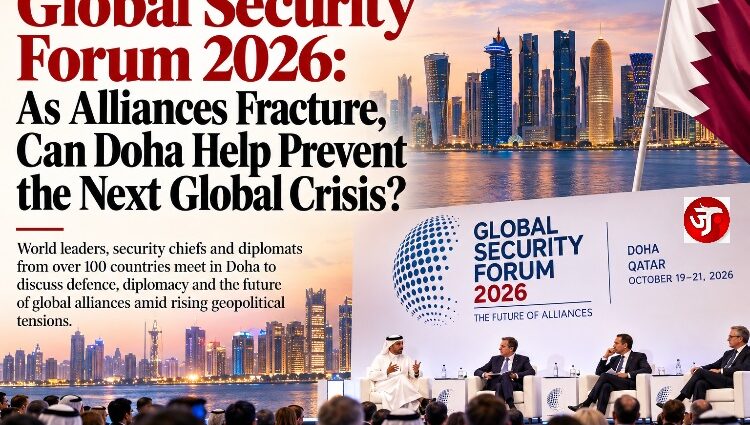
Wars, regional rivalries and growing uncertainty over traditional security partnerships are reshaping the world.
The Global Security Forum 2026 opens in Doha with an urgent question: who can the world rely on when alliances are put to the test?
October 19, 2026: The Global Security Forum 2026 opened in Doha on Monday, bringing together senior government officials, intelligence and military leaders, diplomats, academics and journalists from more than 100 countries for three days of discussions on the future of international alliances. Running until October 21, the eighth edition of the forum is being held under the theme “The Future of Alliances”, at a time when geopolitical tensions and regional conflicts are testing the foundations of international cooperation.
Hosted by the Qatar International Academy for Security Studies (QIASS) and The Soufan Center, under the patronage of Qatar’s Prime Minister and Minister of Foreign Affairs, Sheikh Mohammed bin Abdulrahman Al-Thani, the invitation-only gathering comes amid mounting questions about the reliability of security partnerships, the effectiveness of multilateral institutions and the ability of diplomacy to prevent conflicts from spiralling out of control.
The question confronting the Global Security Forum is no longer simply whether nations need alliances. It is whether those alliances can withstand a world in which strategic interests are shifting, regional wars have international consequences, and military strength increasingly shapes diplomatic calculations.
It’s a world where old alliances face new tests! For decades, international security has rested on military partnerships, intelligence-sharing arrangements, collective defence commitments and institutions designed to prevent local conflicts from becoming global crises.
Today, those arrangements face growing pressure. Regional conflicts, competition between major powers, cyber threats, irregular migration, emerging military technologies and the influence of non-state actors are complicating the security calculations of governments across continents. Even established partnerships must contend with changing political priorities and questions about how far allies are prepared to go to defend one another.
The Global Security Forum 2026 seeks to address these challenges through high-level plenary sessions, strategic dialogues, moderated discussions and closed-door roundtables.
According to the forum’s organisers, the discussions will examine the future of multilateral cooperation and collective defence, the growing influence of emerging powers and non-state actors, and the pressures confronting international institutions.
The stakes extend well beyond diplomatic conference rooms. Decisions about military preparedness, intelligence cooperation, energy security and regional stability can affect global trade, food prices, investment and the safety of civilian populations.
Qatar seeks to strengthen its role as a diplomatic bridge as Qatar’s position as host gives the forum particular significance. The Gulf state has sought to maintain diplomatic channels across difficult regional and international divides, presenting dialogue and mediation as essential tools for managing crises.
The country’s approach reflects a difficult reality: diplomacy often requires maintaining communication with parties whose interests and policies sharply conflict.
On the eve of the forum, Qatar reiterated its commitment to international peace efforts and called for stronger regional security cooperation. Qatar’s Foreign Ministry spokesperson, Dr Majed bin Mohammed Al Ansari, warned that unresolved crises could have consequences extending far beyond individual conflicts, while stressing that military action cannot be the world’s only response.
That position places mediation at the heart of Doha’s diplomatic message. Yet mediation alone cannot guarantee peace. Negotiations require credible commitments, sustained engagement and a willingness among opposing sides to accept political solutions.
For Qatar, the challenge is to translate its diplomatic role into practical cooperation while navigating the competing security interests of regional powers and their international partners.
Gulf security moves beyond conventional warfare: The discussions in Doha also come at a time when Gulf countries are reassessing their defence priorities.
Modern security threats are no longer confined to conventional military confrontation. Drones, missile attacks, cyber operations, maritime disruptions and threats to critical infrastructure have made national security an increasingly complex undertaking.
Air defence, counter-drone systems, cybersecurity, maritime protection and water security are among the capabilities highlighted in the material surrounding the forum.
These priorities reflect the vulnerability of strategically important infrastructure, particularly in a region central to global energy supplies and international shipping.
The implications are global. Any prolonged disruption to Gulf energy exports or maritime routes could affect oil and gas markets, shipping costs, supply chains and the economies of countries far removed from the immediate conflict zone. The lesson is stark: a security crisis in one region can rapidly become an economic crisis elsewhere.
Defence cooperation and the search for greater self-reliance brings up another issue under discussion about the future of defence partnerships and domestic defence production. Countries increasingly want to strengthen their own manufacturing capacity, diversify suppliers and reduce dependence on external partners for essential military equipment and technology.
The reported discussions around regional defence cooperation and local defence production point to a broader strategic shift: governments want alliances that provide not only political assurances but also practical capabilities.
For Gulf countries, cooperation with international partners remains important. At the same time, regional governments face pressure to develop stronger indigenous capabilities in areas ranging from air defence to advanced surveillance and cybersecurity.
However, greater military preparedness carries its own risks if it accelerates regional arms competition without parallel diplomatic efforts to reduce tensions. The central challenge is to build deterrence without making confrontation inevitable.
The question lies: Can regional dialogue prevent another cycle of conflict? One of the most consequential questions for the Global Security Forum 2026 is whether regional security can be strengthened through dialogue involving countries that have often found themselves on opposing sides.
The Gulf’s long-term stability cannot be separated from the wider security environment involving Iran, the Gulf Cooperation Council states, Pakistan, Türkiye and international powers with military and economic interests in the region.
Dialogue among these actors would not erase their differences. But sustained communication could help reduce miscalculation, establish channels for crisis management and create opportunities for cooperation on shared concerns.
Energy security, maritime navigation, water resources, counterterrorism and economic development offer potential areas for engagement even where political disagreements remain unresolved.
The alternative is a region in which every security concern produces another military response, every military response generates fresh suspicion, and diplomacy is reduced to managing the consequences.
Such a cycle would carry costs far beyond the Middle East. The future of alliances also raises difficult questions about the role of the United States and other major powers in maintaining international security.
American security partnerships remain significant to Gulf defence arrangements, while European countries and other international actors contribute to wider diplomatic, intelligence and military cooperation.
The forum’s programme includes perspectives on NATO and the Five Eyes intelligence partnership, alongside discussions involving national security advisers from Poland, Switzerland, Austria and Greece.
These conversations reflect the breadth of the challenge. Alliances must adapt to new threats, changing political priorities and disagreements over the distribution of responsibility.
The durability of any partnership depends not only on formal commitments but also on trust, consultation and the credibility of its members. When countries begin to doubt whether their partners will honour commitments during a crisis, even longstanding alliances can become sources of uncertainty rather than reassurance.
So the global security forum has to go from declarations to decisions which offers an opportunity for decision-makers to examine these questions in a setting designed to encourage strategic discussion and international engagement.
But the real measure of its success will not be the number of dignitaries attending or the strength of the statements issued.
It will be whether the discussions produce practical steps: stronger crisis communication, more effective intelligence-sharing, clearer security commitments, meaningful regional dialogue and a renewed commitment to resolving disputes peacefully.
The forum also faces a wider institutional challenge. International cooperation cannot depend entirely on the interests of powerful states or the temporary alignment of governments. Sustainable security requires institutions that countries consider credible, rules that are applied consistently and diplomatic processes that give smaller nations a meaningful voice.
Without those foundations, alliances risk becoming instruments of competing power blocs rather than mechanisms for collective stability.
As the Global Security Forum 2026 continues through October 21, its theme captures one of the defining questions of contemporary geopolitics. In a world marked by competing interests, regional conflicts and growing uncertainty, alliances remain essential. But their value depends on whether they can prevent crises rather than merely respond to them.
Qatar is seeking to use Doha as a platform for that conversation, bringing together officials and experts who may disagree on fundamental questions but share an interest in avoiding wider instability.
The challenge is formidable. Military preparedness may deter aggression, intelligence cooperation may expose threats, and alliances may provide strategic reassurance. None, however, can substitute entirely for diplomacy.
The ultimate test of global security is not how effectively countries prepare for the next war, but whether they can build partnerships with global security at their focus, strong enough to prevent wars.
For Doha, the task is to turn the principle of global security into a practical agenda. For the international community, the question is whether the future of alliances will be defined by deeper cooperation or by a world increasingly divided into competing camps. The answer will matter far beyond the conference halls of Qatar.
JANPATH NEWS NETWORK (JNN)
Independent. Fearless. On the People’s Path.