





As RSS chief Mohan Bhagwat criticises protesters, the fundamental issue driving the agitation remains unresolved: Voter rights!
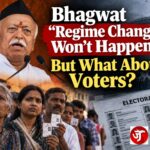
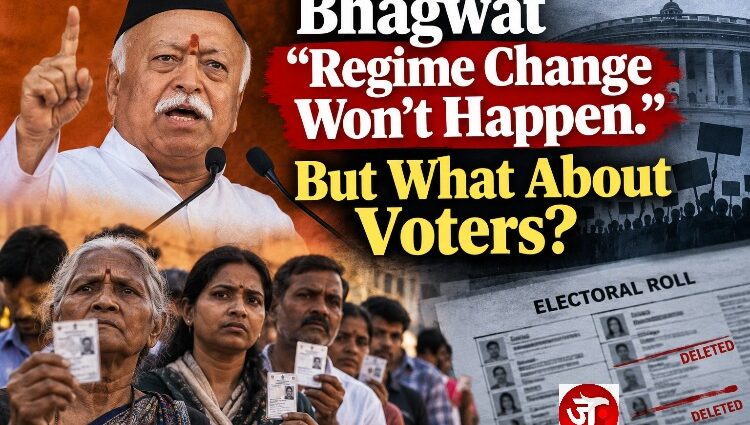
On October 20, 2026, Rashtriya Swayamsevak Sangh (RSS) chief Mohan Bhagwat stated during his annual Vijayadashami address in Nagpur on October 20, 2026:
They claim that changing a regime will change the situation, but that has never really happened. It did not happen earlier, and will not happen now
He also remarked:
“A storm has swept in from the West to destroy all that is decent, auspicious, and rooted in cultural and human values. Even the developed nations are afflicted by this storm. See what is happening in France, Albania, Bangladesh, and Nepal. All this has been done by them. They say that a regime change will change the situation, but that has never happened; not now, not ever. India too is their target. Such attempts are being made in India as well.”
Here, Bhagwat dismissed the heart of the protests. The wave of youth-driven protests which intensified in mid-to-late October 2026, over Brazil, India, Albania, and multiple European countries cite shared grievances over rising living costs, strained education systems, scarce jobs, housing pressures, corruption, and perceived government failures. While many marches remain peaceful, fringe violence, including arson, looting, and clashes with police, has drawn global attention, particularly in France, Albania, and Italy.
India’s democracy is facing a question that cannot be answered by downplaying the concerns of protesters, criticising the Opposition or declaring that a change of government will not happen. The question is far more fundamental: what happens when citizens fear that their names are being removed from the very electoral rolls that determine their right to vote?
According to The Indian Express, the Special Intensive Revision (SIR) had resulted in approximately 130 million names being removed from draft electoral rolls across 30 states and Union Territories by September 2026.
An important nuance is Bhagwat said protests are inevitable in a democracy and urged governments to respect citizens’ dignity and constitutional limits. He did not explicitly name the Election Commission or SIR in his address, according to The Times of India.
But in focusing on political agitation and the possibility of regime change, is Bhagwat addressing the actual grievance that has brought people onto the streets? Or is the debate being shifted away from the issue at its heart: the voter rolls?
The protests are about more than political power
The controversy surrounding the Special Intensive Revision (SIR) of electoral rolls has raised serious questions about how voters are identified, how names are deleted, what safeguards protect eligible citizens and how people can challenge errors.
For protesters and Opposition parties, the concern is not merely whether the present government will remain in office. It is whether the electoral process is fair, transparent and accessible to every eligible voter.
A democracy cannot be judged solely by whether a government completes its term or whether an Opposition party succeeds in bringing it down. It must also be judged by the integrity of the process through which governments are elected.
If an eligible voter is wrongly excluded from an electoral roll, that person’s democratic rights are affected regardless of political affiliation. The issue demands answers, transparent procedures and effective remedies, not simply a debate about who may eventually govern India.
The uncomfortable question Bhagwat must confront
Bhagwat’s criticism of protesters and the Opposition raises an obvious question: where is the same urgency in addressing the allegations and anxieties surrounding voter-list revisions?
It is legitimate to question political tactics, condemn violence where it occurs and demand evidence for allegations. But none of those positions removes the obligation to investigate genuine complaints about electoral registration.
Nor does the possibility of political exploitation automatically invalidate a grievance. Political parties may have their own calculations, but citizens’ concerns about their voting rights must be assessed on the evidence.
The distinction matters. A protest can be politically inconvenient and still raise a legitimate democratic question. An Opposition party can pursue electoral advantage while also drawing attention to a problem that deserves scrutiny. Neither circumstance settles the underlying issue.
Who protects the ordinary voter?
Electoral-roll revision is a legitimate administrative exercise. Accurate voter lists matter, and removing duplicate or ineligible entries can be necessary. But accuracy must operate in both directions: ineligible entries should be addressed, and eligible citizens must not be wrongly deprived of registration.
That requires clear reasons for deletions, accessible procedures for appeals, timely decisions and independent scrutiny where serious concerns arise.
The burden should not fall disproportionately on ordinary citizens to prove their existence, navigate complicated bureaucracy and fight to recover a right they were entitled to exercise in the first place.
The Election Commission’s responsibility is therefore central. Public confidence depends not only on whether officials believe the process is correct, but also on whether citizens can examine the process, challenge mistakes and obtain meaningful remedies.
Regime change is not the central issue
Bhagwat may believe that the protests will not bring about regime change. But that prediction does not answer the question being raised by those protesting.
The issue is not whether a government can be forced from office through street demonstrations. It is whether the electoral system that determines who holds office commands public confidence.
A government can remain in power and still face legitimate demands for accountability. Equally, an Opposition can lose an election and still have the right to question the electoral process through lawful and evidence-based means.
Democracy cannot be reduced to the survival of a regime. Nor can every challenge to an institution automatically be treated as an attempt to destabilise the country.
The right to protest, the right to question public authorities and the right to vote are not privileges granted at the convenience of those in power. They are essential elements of democratic life.
The real test of democracy
The question before India is not simply whether the government will change. It is whether citizens can trust that their names will remain on the electoral rolls if they are eligible, that errors will be corrected and that complaints will receive fair consideration.
If the allegations are unfounded, transparent evidence and credible procedures can demonstrate that. If errors have occurred, they must be corrected. Either way, the public deserves answers grounded in facts.
Bhagwat’s remarks may strengthen the political debate over protests and the Opposition, but they cannot substitute for answers about electoral registration.
Before condemning the protests, address the voter rolls, protect the right that determines who governs, and prior to asking citizens to trust democracy, ensure that every eligible citizen has a fair opportunity to participate in it.
The Cockroach Janta Party in one of their earlier speeches said, “It is only through voting for the right government to come into power that true change can happen, or everything we do is in vain.” The citizens vote is their power, and regime change only happens at the ballot box. That issue needs to be fixed first.
JANPATH NEWS NETWORK (JNN)
Independent. Fearless. On the People’s Path.