






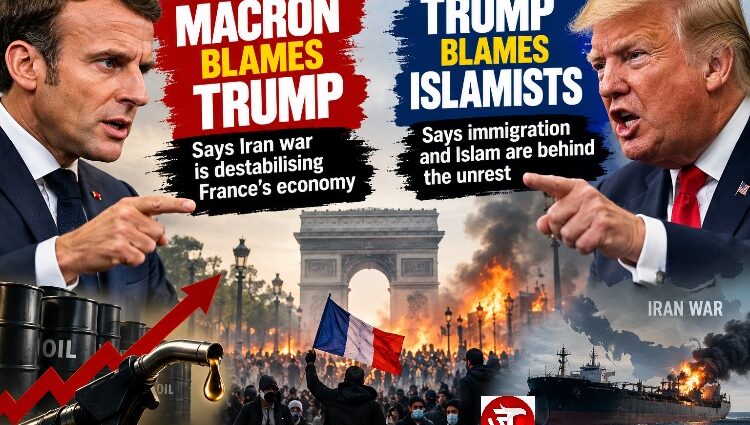
Macron and Trump clash over the roots of crisis in France: The Iran war has also become a political battleground between the two.
Macron says France is paying the price of a war it did not choose, while Trump blames immigration for the unrest sweeping French cities, exposing a fierce political divide over the roots of Europe’s growing crisis.
French President Emmanuel Macron and US President Donald Trump are offering sharply contrasting explanations for the unrest gripping France, turning a domestic crisis into a wider geopolitical confrontation over war, immigration, economic hardship and political accountability.
Macron has pointed to the economic consequences of the Iran war, arguing that France did not choose to participate in the conflict but is nevertheless suffering its consequences. In remarks reported by international media, the French president highlighted soaring fuel prices, mounting pressure on household budgets and growing anxiety over energy costs as the conflict in the Persian Gulf continues to disrupt supplies and global markets.
Trump, meanwhile, has taken a radically different position. The US president has blamed immigration and Islam for France’s unrest, arguing that Macron should have closed the country’s borders years ago. Trump went so far as to claim that Paris would soon become a “Muslim city”, remarks that have intensified the political controversy surrounding his intervention in French affairs.
The economic pain behind the protests
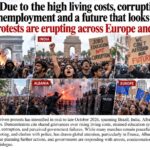
The unrest in France has been fuelled by a combination of grievances, including rising living costs, concerns over underfunded schools, inadequate public services and declining purchasing power. The economic fallout from the Iran conflict has added another layer of pressure, particularly through higher fuel prices and uncertainty over energy supplies.
For ordinary families, the consequences of geopolitical conflict are painfully tangible. When energy becomes more expensive, transport costs rise, businesses face higher operating expenses and household budgets come under further strain. People who have little influence over decisions made in distant capitals can end up paying a substantial part of the bill.
Macron has distinguished between citizens expressing legitimate grievances and those responsible for looting, vandalism and attacks on public property. He has condemned the violence while acknowledging the public’s concerns about living costs and fuel prices.
Trump’s immigration argument intensifies the political divide
Trump’s response has shifted the debate towards migration, national identity and border controls. By attributing the unrest primarily to immigration, he has placed himself firmly alongside the arguments advanced by Europe’s nationalist and far-right political movements.
However, the reported grievances behind the demonstrations extend well beyond immigration. School conditions, fuel prices, economic insecurity and concerns about public services have all featured in the protests. Reducing such a complex crisis to a single issue risks overlooking the pressures that have brought demonstrators onto the streets.
A war’s consequences reach far beyond the battlefield
The confrontation between Macron and Trump illustrates a broader dilemma facing governments across Europe. International conflicts can produce domestic economic shocks even in countries that have not directly participated in the fighting. Disrupted shipping routes, higher energy costs and uncertainty in global markets can quickly translate into anger at home.
The political question is who should bear responsibility: the leaders whose decisions shape international conflicts, the governments managing the resulting economic fallout, or the domestic policies that have left many households vulnerable to rising costs.
France’s unrest cannot be explained by one cause alone. But the clash between Macron and Trump reveals how economic hardship can become a battleground for competing political narratives.
For millions of ordinary people in France, the immediate concern is simpler than the arguments unfolding between presidents: the cost of living keeps rising, financial security feels increasingly fragile, and the promise of a better future appears more distant.
When the consequences of a crisis reach the kitchen table, political blame becomes inevitable.
JANPATH NEWS NETWORK (JNN)
Independent. Fearless. On the People’s Path.