










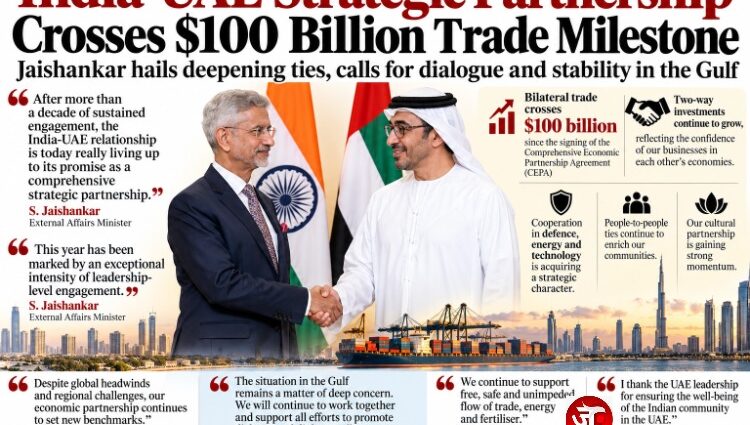
India-UAE ties enter a decisive phase as S. Jaishankar and Sheikh Abdullah bin Zayed Al Nahyan hold high-level talks in Mumbai
October 20, 2026: India-UAE strategic relations are gathering fresh momentum, with External Affairs Minister S. Jaishankar declaring that more than a decade of sustained engagement is finally delivering on the promise of a comprehensive strategic partnership. Yet, alongside the celebrations over expanding trade and investment, his remarks carried a serious warning about the continuing instability in the Gulf, a region vital to India’s energy supplies, trade routes and millions of citizens living and working abroad.
Speaking during his meeting with UAE Deputy Prime Minister and Foreign Minister Sheikh Abdullah bin Zayed Al Nahyan in Mumbai on Tuesday, Jaishankar underlined the extraordinary intensity of high-level engagement between the two countries this year, describing the relationship as one that has steadily evolved into a far-reaching strategic partnership.
“After more than a decade of sustained engagement, the India-UAE relationship is today really living up to its promise as a comprehensive strategic partnership,” Jaishankar said.
He added that the year had been marked by “an exceptional intensity of leadership-level engagement”, reflecting the growing political commitment on both sides to deepen cooperation across economic, diplomatic and security interests.
The diplomatic engagement follows a series of high-profile visits, including UAE President Sheikh Mohamed bin Zayed Al Nahyan’s visit to India in January, the participation of Crown Prince Sheikh Khaled bin Mohamed bin Zayed Al Nahyan in major international engagements in India, and Prime Minister Narendra Modi’s eighth visit to the UAE.
$100-billion trade milestone strengthens economic partnership
At the heart of the India-UAE relationship lies an economic partnership that has expanded significantly under the Comprehensive Economic Partnership Agreement (CEPA). Jaishankar said bilateral trade had crossed the $100-billion mark since the agreement was signed, while investments in both directions continued to grow.
“Despite global headwinds and regional challenges, our economic partnership continues to set new benchmarks,” the External Affairs Minister said.
He added that the expansion of two-way investments reflected “the confidence of our businesses in each other’s economies.”
The milestone highlights the importance of the UAE as one of India’s key economic partners, connecting Indian businesses to markets across the Gulf, Africa and beyond. For the UAE, India offers a major market, a large consumer base, investment opportunities and an increasingly important partner in technology, manufacturing and services.
The partnership extends well beyond the movement of goods. Cooperation in defence, energy and technology is acquiring what Jaishankar described as “a strategic character”, indicating that both countries increasingly view their relationship through the lens of long-term security and economic resilience.
People-to-people connections remain another important pillar, supported by the substantial Indian community in the UAE and longstanding cultural and commercial links between the two societies.
Gulf tensions cast a shadow over growing ties and despite the upbeat assessment of bilateral relations, Jaishankar’s remarks on the regional situation underscored the challenges facing both countries.
“The situation in the Gulf remains a matter of deep concern,” he said, making clear that regional stability remains a priority for New Delhi and Abu Dhabi.
“We will continue to work together and support all efforts to promote dialogue and diplomacy,” he added.
The emphasis on diplomacy is significant. India has substantial interests in Gulf stability, from energy imports and maritime commerce to the safety of Indian nationals working across the region. Any prolonged escalation could threaten shipping, disrupt supplies, raise transportation and insurance costs, and place additional pressure on energy prices.
Jaishankar also stressed the need to protect the movement of essential commodities, declaring: “We continue to support free, safe and unimpeded flow of trade, energy and fertiliser.”
That reference to fertiliser is particularly important for India, where agricultural production and food security depend on reliable access to essential inputs. Disruptions to Gulf shipping routes could therefore have consequences extending far beyond the immediate conflict zone, affecting businesses, farmers and consumers.
For both India and the UAE, keeping trade corridors open is not simply a diplomatic talking point. It is an economic and strategic necessity.
Indian community remains central to the relationship: Jaishankar also expressed gratitude to the UAE leadership for ensuring the well-being of the Indian community in the Emirates.
The Indian diaspora is one of the most significant human links between the two countries, contributing to the UAE’s economy while maintaining close family, cultural and commercial connections with India.
For New Delhi, the safety and welfare of Indian nationals abroad remain a major diplomatic priority, particularly during periods of heightened regional tension. Jaishankar’s acknowledgement of the UAE leadership therefore highlighted a dimension of the relationship that cannot be measured through trade figures alone.
The Mumbai meeting reflects the widening scope of India-UAE cooperation at a time when geopolitical uncertainty is placing pressure on international trade, energy security and diplomatic relationships.
The two countries are seeking to deepen commercial ties while expanding cooperation in defence, technology and energy. At the same time, their shared interest in regional stability gives diplomatic dialogue added urgency.
Jaishankar’s message was ultimately twofold: the India-UAE partnership has matured into a relationship with substantial economic and strategic weight, but its future prosperity is closely tied to peace and stability across the Gulf.
The crossing of the $100-billion trade milestone signals the scale of the opportunity. The continuing regional tensions serve as a reminder of how quickly that progress could be threatened by instability.
For India and the UAE, the challenge now is to turn their growing strategic partnership into a source of economic resilience, regional cooperation and sustained stability in an increasingly uncertain world.
JANPATH NEWS NETWORK (JNN)
Independent. Fearless. On the People’s Path.