






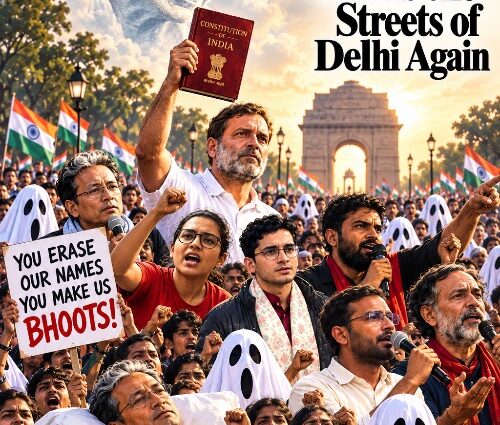
Gandhi’s Ghost walks in India again in people that uphold satyagraha, not violence, but the State answers with force
October 21, 2026: Across France, Italy and Albania, Portugal, Greece, Argentina, from Europe to Latin America, people are protesting economic hardship, political decisions and a future they fear is slipping beyond their reach. Their protests have erupted into clashes, arson, looting and burning vehicles; in France, flames engulfed the historic city hall in Limoges, while unrest in Albania saw buildings targeted and petrol bombs hurled at police. Spain and Portugal, too, are witnessing mounting anger over housing, living costs and a future increasingly out of reach for ordinary people. Yet amid this turbulence, India’s protest movement presents a striking contrast: its most powerful weapon is not the burning vehicle, but the raised Constitution; a tiranga march, and not throwing petrol bombs, but satyagraha; not destruction, but the refusal to surrender democratic rights. Despite this, the State uses force on peaceful protestors!
Why does Gandhi’s method still resonate in a country where young people are fighting alleged examination fraud, demanding transparency in electoral rolls and questioning the conduct of powerful institutions? Why have students, activists and opposition leaders returned to non-violent resistance even as confrontations with the police intensify? The answer lies in what they believe is at stake: the Constitution.
Gandhi’s ghost walks the streets of Delhi again. Here is why.
Gandhi’s ghost is walking the streets of Delhi again which is not in a procession of statues or a government-sponsored ceremony, but among students, activists and opposition leaders who believe that the foundations of Indian democracy are under threat, but they also know their struggle cannot be fought without evoking Gandhi’s principles.
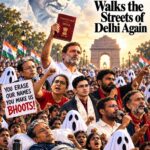
They invoke satyagraha, while marching to Raj Ghat, and sit on the streets, raising the Constitution books, refusing to be bogged down and do not surrender their demands. In this fierce nonviolent protest, creativity has rung through the streets. Some Youth Congress workers had dressed as ghosts, declaring that the Special Intensive Revision (SIR) of electoral rolls has turned legitimate voters into bhoots by erasing their names. Tushar Gandhi, the Mahatma’s great-grandson, has joined the agitation, calling for individual satyagraha. This is not mournful nostalgia, but a struggle over who gets to participate in democracy.
The protests did not begin with the Election Commission. Earlier in June 2026, students and young people rallied behind the Cockroach Janta Party (CJP), demanding accountability over examination paper leaks and failures in the competitive examination system. Their anger was rooted in a simple injustice: when examinations determine careers and futures, alleged cheating can destroy years of preparation and sacrifice.
The movement grew, police clashes intensified, and on July 25, Union Education Minister Dharmendra Pradhan resigned after weeks of protests. The resignation demonstrated that sustained public pressure could produce political consequences.
The next wave of agitations started with a stunning article released by The Indian Express revealing the removal of more than 130 million names, or 13 crore entries, from electoral rolls. The Election Commission maintains that the revision is intended to eliminate duplicate, deceased and otherwise ineligible entries. Critics, however, are aware that legitimate citizens have also been excluded and demand transparent verification, restoration of eligible voters and accountability.
The big question is no longer simply whether a list has been revised. It is whether every eligible citizen can establish their right to vote without being lost in an administrative maze.
When opposition MPs and activists marched against Chief Election Commissioner Gyanesh Kumar, faced barricades and detentions, and turned to Raj Ghat, the symbolism was unmistakable. Rahul Gandhi invoked satyagraha, while the wider protest movement drew on the Mahatma’s language of non-violent resistance.
Sonam Wangchuk, Neha Bora and other students adopted a Gandhian style hunger strike during the earlier student agitation, alongside the determination of young activists: This brought the human cost of protest into sharp focus. A hunger strike is not merely a dramatic gesture but places the protester’s own body at risk to make an appeal that authorities cannot easily dismiss as drama, but deep sincerity.
The image of Rahul Gandhi holding the Constitution has become part of this larger struggle. The message is that power must operate within constitutional limits, not above them.
Abhijeet Dipke, founder of the Cockroach Janta Party (CJP), frequently holds a copy of the Constitution of India, often alongside Dr. B.R. Ambedkar, during youth and political protests in New Delhi, such as demonstrations regarding examination controversies and voter roll issues.
These actions carry a message: the fight is not simply about removing a minister or demanding the resignation of a Chief Election Commissioner. It is about transparency, accountability and the right of ordinary citizens to be heard.
The heavy police presence, barricades, detentions and allegations of brutal baton charges, attacks on women have sharpened the confrontation. Protesters have alleged that police violence was intended to frighten them into abandoning demonstrations. Such allegations require investigation, but they raise a fundamental question: why should peaceful dissent be treated as a threat to public order rather than an essential part of democracy?
Gandhi understood the political power of this contradiction. Satyagraha was not passive surrender. It was the deliberate refusal to retaliate, exposing injustice by forcing authority to confront the consequences of its own actions. A government can clear a street. It cannot, through force alone, settle a question of public trust.
The same principle explains why young Indians are embracing a method often dismissed as belonging to another age. Social media, viral videos, unconventional masks and street theatre have changed the appearance of protest, but its moral argument remains recognisably Gandhian.
The ghost is asking a difficult question
Did Gandhi and his fellow freedom fighters break the chains of British rule only for the freedoms they won with their blood, sacrifice and satyagraha to be shackled again under an Indian government?
There are political calculations in this movement, as there are in every major agitation. Opposition parties have their own ambitions, and the government disputes the allegations against it. But dismissing the entire movement as political theatre would evade the central issue and wipe out the legitimate fear of millions of Indians.
Gandhi’s legacy has never been free of contradiction, and invoking him does not automatically make a movement right. Its legitimacy must be judged by its methods, its demands and its respect for others.
Freedom was never won so that a nation could be shackled again by fear, force and the denial of its people’s rights. Gandhi’s enduring lesson is that no government can manufacture genuine consent through intimidation; lasting change must come through truth, non-violence and respect for the people’s will. Gandhi’s ghost will not rest until the freedom fought for against British rule is protected from every attempt to put it in chains again.
JANPATH NEWS NETWORK (JNN)
Independent. Fearless. On the People’s Path.