










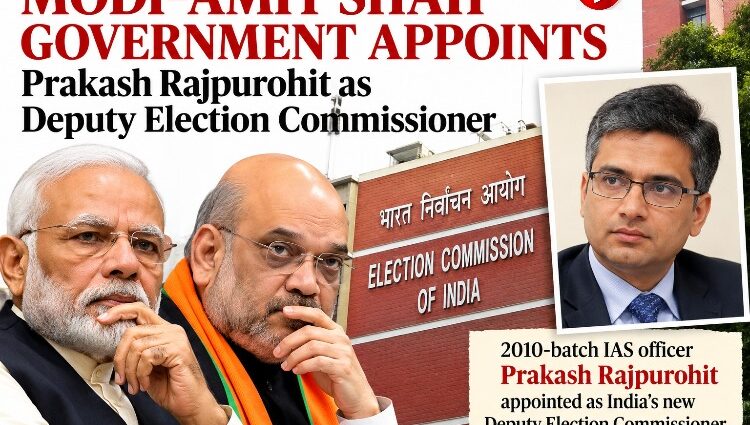
Prakash Rajpurohit, appointed by the Modi Government, through the Appointments Committee of the Cabinet (ACC), approved his appointment
Prakash Rajpurohit has been appointed India’s new Deputy Election Commissioner through the Appointments Committee of the Cabinet (ACC), chaired by Prime Minister Narendra Modi, with Union Home Minister Amit Shah as its other member.
The 2010-batch IAS officer of the Rajasthan cadre previously served as Joint Secretary in the Department of Defence Production, bringing administrative experience to the Election Commission of India (ECI).
The appointment was approved on October 10, 2026, with his tenure reportedly extending until April 8, 2030. He succeeds Sanjay Kumar in the key position.
The appointment comes amid growing scrutiny of electoral governance, voter-list revisions and election management under the Modi government. Debates over the Special Intensive Revision (SIR) of electoral rolls, allegations of voter exclusion and demands for greater transparency have placed the functioning and accountability of the Election Commission firmly in the national spotlight.
Deputy Election Commissioners play an important administrative role in supporting the Commission’s work, including election planning, coordination and the implementation of electoral processes.
Rajpurohit’s appointment is an administrative decision, and there is no evidence to suggest that it signals a change in the Commission’s policies. Nevertheless, the timing raises a broader question about institutional independence and public confidence in the electoral process.
The central concern is not simply who gets appointed, but who exercises influence over the institutions responsible for conducting elections. When the political establishment that contests elections also has a decisive role in selecting key officials involved in administering them, questions about impartiality and accountability are bound to arise.
Should the government of the day have such influence over appointments within the institutions responsible for overseeing the electoral process that determines whether it remains in power?
Can an election system command public confidence when the Modi government, which benefits from electoral outcomes, also exercises substantial influence over key appointments within the institutions administering those elections?
The credibility of Indian democracy ultimately rests on the public’s confidence that every eligible citizen can vote, every vote counts and the institutions entrusted with safeguarding that right operate transparently and impartially.
JANPATH NEWS NETWORK (JNN)
Independent. Fearless. On the People’s Path.


Thank you ffor thee auspicious writeup. It in fact waas a
amusement account it. Look advaned to more adxed agreeable from you!
However, how could we communicate? xnxx
Thank you for your response: Our email: newsnetworkjanpath@gmail.com