







After a 600-km march, hundreds of Swarn Samaj protestors confront police at Himachal Secretariat over UGC rules
After a 600-km march, protesters confront police at Himachal Secretariat, demanding withdrawal of UGC equity regulations and a separate legal framework for upper-caste communities. The Supreme Court has already stayed the 2026 regulations.
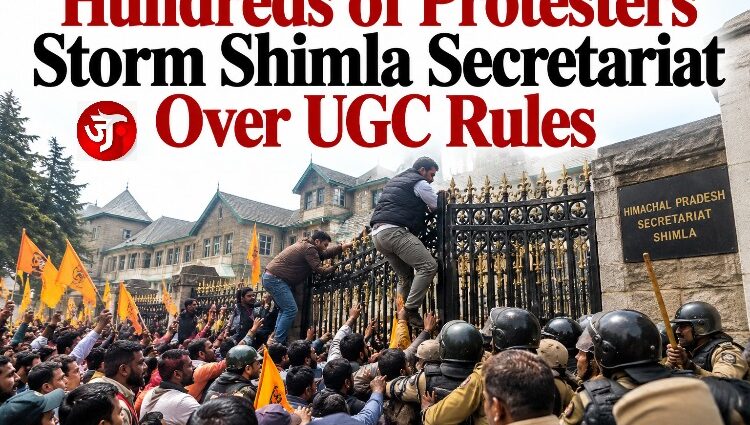
Hundreds of protesters associated with the Rashtriya Devbhoomi Party and the Rashtriya Rajput Karni Sena reached the Himachal Pradesh Secretariat in Shimla on Thursday, October 22, after a 21-day march across the state. The demonstration turned tense as protesters attempted to advance towards the Secretariat’s main gate, prompting police to deploy water cannons and use mild force to control the crowd, according to Divya Himachal.
The march was the culmination of the Swarn Samaj Ashwamedh Nyay Yatra, a roughly 600-km campaign launched from Manali on October 2. Led by Rashtriya Devbhoomi Party president Rumit Singh Thakur, with Rajput Karni Sena leader Mahipal Singh Makrana among those participating, the march passed through several parts of Himachal Pradesh before reaching the state capital. The organisers intended to submit a memorandum to Chief Minister Sukhvinder Singh Sukhu.
However, the attempt to reach the Secretariat escalated into a confrontation. Local reporting says protesters tried to open a barricaded gate and move towards the complex. Police responded with water cannons and mild force. Protesters subsequently continued their demonstration outside the main entrance.
A demand for a separate law
Beyond the confrontation, the protesters’ demands raise a wider question about caste, equality and the purpose of anti-discrimination protections in higher education.
The demonstrators want the 2026 University Grants Commission (UGC) Promotion of Equity in Higher Education Institutions Regulations withdrawn. They argue that the framework could leave general-category students vulnerable to complaints without adequate safeguards against false allegations. They have also sought a separate legal framework for the Swarn Samaj, a term used by the organisers for upper-caste communities, and demanded a Swarn Commission Act. These are the protesters’ stated concerns, not findings that the regulations would necessarily produce such outcomes.
The demand for a separate framework is politically significant. Should safeguards against discrimination be designed to protect everyone through common principles, or should different caste groups have distinct legal mechanisms? Any such proposal would need to be assessed against constitutional guarantees of equality and the need to address caste-based disadvantage.
The Supreme Court has already intervened
The legal background is crucial. On January 29, 2026, the Supreme Court stayed the 2026 UGC regulations and directed that the 2012 regulations remain in force until further orders.
The Bench led by Chief Justice Surya Kant and Justice Joymalya Bagchi raised concerns about ambiguities in the new framework and the possibility of misuse. The challenge centred in part on the definition of caste-based discrimination, which specifically referred to discrimination against members of Scheduled Castes, Scheduled Tribes and Other Backward Classes. Petitioners argued that general-category students were not adequately protected under that definition.
The Court’s intervention was an interim measure, not a final ruling that the regulations were unconstitutional. In August 2026, the Centre told the Court that it was reconsidering the regulations, according to The Indian Express.
This makes the demand for a complete rollback more complicated. The regulations are already on hold. The present dispute is therefore not simply about stopping their immediate implementation, but also about what framework should replace them and whether the government should abandon the 2026 provisions altogether.
In Shimla, a march that began in Manali ended in a confrontation at the gates of the state Secretariat. The immediate demands concern the UGC regulations and a separate legal framework for upper-caste communities. The larger challenge is whether policymakers can address those concerns without deepening the caste divisions that a system of equal rights is meant to overcome.
For now, the protesters have made their demands visible. The responsibility for resolving the legal and constitutional questions rests with the government and the courts.
JANPATH NEWS NETWORK (JNN)
Independent. Fearless. On the People’s Path.