








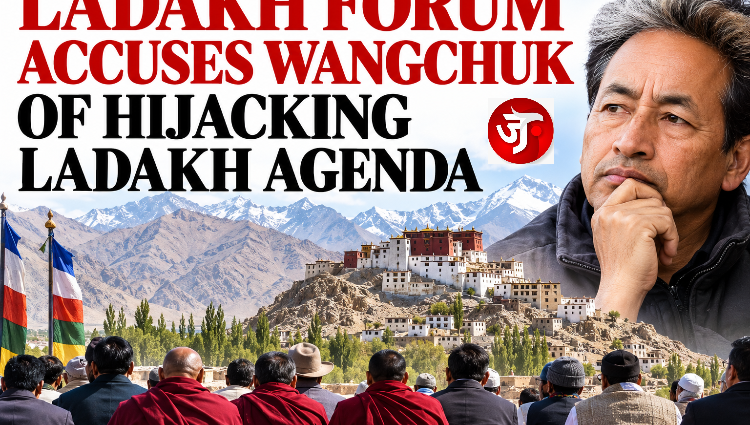
Ladakh Civil Society Forum sharply criticizes Sonam Wangchuk of Hijacking Agenda, Demands Fresh Representation
October 23, 2026: The Civil Society Forum of Ladakh has sharply criticised what it described as the hijacking of Ladakh’s original demands for land, jobs and cultural safeguards by Sonam Wangchuk, warning that confrontational politics and repeated delays are threatening to derail the dialogue process with the Union Ministry of Home Affairs (MHA).
At a meeting held in Leh on October 22, the Forum expressed deep concern over the prolonged impasse involving the MHA, the Leh Apex Body (LAB) and the Kargil Democratic Alliance (KDA). It argued that the core agenda of protecting Ladakh’s land, employment opportunities and cultural identity had been pushed aside, with the negotiations increasingly mired in confrontation and disagreement.
The meeting was attended by former Ladakh MP Thupstan Chhewang, former Chief Executive Councillor (CEC) Rigzen Spalbar, former MLC Tsering Samphel, representatives of Thiksey and Thuksey Rinpoche, monks from various monasteries, members of the Ladakh Buddhist Association and GCM, Nambardars, retired officers and other civil society representatives.
‘Dialogue cannot be held hostage to confrontation’
The Forum criticised what it described as the confrontational and delaying approach adopted by some participants in the negotiations. It maintained that dialogue must remain focused on securing constitutional and administrative safeguards for Ladakh rather than being derailed by political brinkmanship.
Thupstan Chhewang alleged that leaders of the LAB and KDA had rejected the MHA’s draft proposal without adequately examining the available options. He further alleged that accounts of earlier meetings had been misrepresented, creating confusion among the public and undermining the prospects of a negotiated settlement.
Chhewang also attributed the non-holding of the scheduled MHA meeting in New Delhi on October 22 to repeated delays, misinformation and what he described as disregard for earlier consensus. He expressed concern over the possible consequences for Leh, particularly its Buddhist community.
These allegations reflect the Forum’s position and have not been independently established.
Questions over who represents Ladakh
One of the Forum’s strongest assertions concerned the representativeness of the existing negotiating bodies. It argued that the Leh Apex Body and the Kargil Democratic Alliance could no longer be assumed to represent the voices and aspirations of every district in Ladakh.
The Forum called for the reconstitution of the LAB to include democratically elected representatives from all districts, arguing that any credible negotiating framework must reflect the region’s wider diversity and changing political realities.
The demand raises a fundamental question: can decisions concerning Ladakh’s political future be negotiated legitimately without ensuring that all its districts and communities have a meaningful voice?
Demand for early elections and stronger local councils
The Forum called for early Panchayat and Ladakh Autonomous Hill Development Council (LAHDC) elections across all districts, along with enhanced powers for elected councils.
It argued that strengthening democratic institutions at the grassroots level would help ensure that Ladakh’s demands are articulated through representative bodies rather than being confined to a limited circle of organisations and leaders.
The Forum also urged that negotiations with the MHA continue without further delays, insisting that the original agenda of land, jobs and cultural protection must remain central to the process.
A widening debate over Ladakh’s future
The meeting signals a difference of opinion within Ladakh’s civil society over the direction of the negotiations, the role of individual leaders and the legitimacy of the existing representative bodies.
While the Forum has accused Sonam Wangchuk of diverting attention from the original demands, the broader dispute concerns how Ladakh’s interests should be represented and how a meaningful settlement can be achieved.
For a region that has sought stronger constitutional safeguards and greater control over its land, employment and cultural identity, the immediate challenge is to prevent differences among its representatives from weakening the underlying demands.
The message from the Forum is clear: Ladakh’s future cannot be decided through endless confrontation, nor can negotiations claim legitimacy without broad-based representation. The dialogue must return to its core objectives, and every district must have a voice in shaping the outcome.
JANPATH NEWS NETWORK (JNN)
Independent. Fearless. On the People’s Path.

My pouse and I stumbled over here coming frim a diffrent webb
page annd thought I syould check things out.
I like whzt I see so now i’m following you. Look forward to
exploring your web pqge yet again. xnxx