










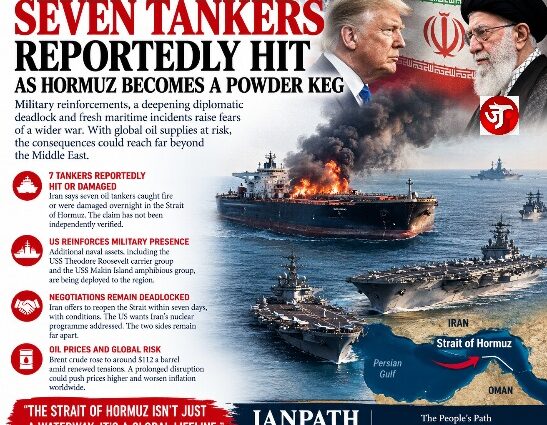
US–Iran crisis: seven tankers reportedly hit as Hormuz becomes a powder keg raising fears of a wider war with consequences far beyond.
October 23, 2026: Military reinforcements, a deepening diplomatic deadlock and fresh maritime incidents raise fears of a wider war. With global oil supplies at risk, the consequences could reach far beyond the Middle East.
The confrontation between the United States and Iran is entering another dangerous phase, risking a wider war, with reports of seven oil tankers catching fire or being damaged in the Strait of Hormuz, additional American military deployments and negotiations that remain deadlocked over Iran’s nuclear programme and control of one of the world’s most strategically important shipping routes.
The latest developments have intensified fears that a war crisis already threatening global energy supplies could spiral into a broader military confrontation. The central question is no longer simply whether Washington and Tehran can reach an agreement, but whether diplomacy can prevail before another incident triggers a fresh round of attacks.
Strait of Hormuz: The world’s oil lifeline under threat of a greater war
The reported tanker incidents overnight have brought the Strait of Hormuz back to the centre of the crisis. The Associated Press reported the incidents while noting that it could not independently verify Iran’s account.
The distinction matters. The precise circumstances surrounding the damaged vessels, including responsibility for individual incidents, must be established through independent verification. But even amid uncertainty, the reports underline the extraordinary vulnerability of commercial shipping in a waterway through which a substantial share of the world’s oil and liquefied natural gas normally passes.
Iran’s Islamic Revolutionary Guard Corps has threatened American bases if US forces continue escorting commercial vessels, according to the latest reporting. Such threats raise the prospect of a dangerous cycle: American naval protection, Iranian retaliation and further US military action.
For the shipping industry, the consequences are immediate. Higher insurance premiums, longer or disrupted routes, security risks for crews and uncertainty over safe passage can translate into higher costs for businesses and consumers worldwide.
Washington reinforces its military presence
The United States is increasing its military presence in the region, with reports identifying additional naval assets and thousands of personnel, including the USS Theodore Roosevelt carrier group and the USS Makin Island amphibious group.
These deployments strengthen Washington’s capacity to protect shipping and respond to attacks. They also increase the military resources available should the confrontation escalate.
However, a military deployment is not proof that a new offensive has been ordered. No verified report available for this article establishes that Washington has authorised a fresh bombing campaign on October 23.
The danger lies in the possibility of miscalculation. When heavily armed forces operate in close proximity, an attack on a vessel, a misidentified target or a fatal encounter can rapidly narrow the political space for restraint.
Nuclear negotiations remain deadlocked
Diplomacy has yet to produce a breakthrough.
Iran has reportedly offered to reopen the Strait within seven days, subject to conditions that include an end to the American blockade of Iranian ports, sanctions relief and the release of frozen assets.
Washington, meanwhile, wants Iran’s nuclear programme addressed as part of a settlement. The two sides remain divided over enrichment, verification and the fate of Iran’s enriched uranium stockpile.
Tehran insists that its nuclear material is a national asset and denies seeking to develop a nuclear weapon. The United States demands verifiable restrictions intended to prevent Iran from acquiring one.
These are not minor differences that can be settled through a carefully worded diplomatic statement. They concern national sovereignty, security guarantees, economic survival and the balance of power across the Middle East.
Until both sides agree on enforceable terms, any reopening of the Strait risks being temporary and vulnerable to the next confrontation.
Oil, inflation and the price the world could pay
The crisis has implications well beyond the Gulf.
Reports on October 22 placed Brent crude at around $112 a barrel amid renewed shipping tensions. That price is a dated reference, not a verified live quotation for October 23, but it illustrates the scale of the energy-market risk.
A prolonged disruption in Hormuz could push oil prices higher, increase shipping and insurance costs and intensify inflationary pressure. For countries dependent on imported energy, the consequences could spread through transport, manufacturing, electricity and food supply chains.
India is particularly exposed to such a shock because of its reliance on imported crude oil and its extensive economic and human links with the Gulf. A sustained price surge could put pressure on the import bill, the rupee, inflation and household budgets.
For Indian seafarers and nationals living and working in the region, the immediate concern is safety. Any further deterioration would also make the security of commercial shipping and energy supplies an urgent diplomatic priority for New Delhi.
A crisis with no easy exit
The United States and Iran now face a difficult choice. Washington wants to protect maritime traffic and secure concessions on Iran’s nuclear programme. Tehran wants relief from American pressure and an end to restrictions it regards as coercive.
Both sides risk paying a much higher price if the confrontation expands. Military action may damage infrastructure and impose immediate costs, but it cannot by itself guarantee a lasting settlement over nuclear policy, sanctions or freedom of navigation.
Equally, a temporary reduction in hostilities would not amount to a durable peace unless the underlying disputes were addressed.
The diplomatic challenge is to establish arrangements that prevent attacks on shipping, reduce the risk of direct military clashes and create a credible path towards negotiations.
The world waits for the next move
The reported tanker incidents, American military reinforcements and stalled nuclear talks have combined to create a volatile situation. Yet the available reporting does not establish that a new American strike has begun or that a full-scale war is inevitable.
That distinction is critical. The threat is serious enough without treating every warning as a confirmed attack or every military movement as proof of an imminent offensive.
The next developments to watch are independent confirmation of the tanker incidents, any new US or Iranian military action, changes to restrictions on shipping, and evidence of a renewed diplomatic channel.
The Strait of Hormuz has become the pressure point where military power, nuclear ambitions and the global economy collide. If Washington and Tehran fail to find a way back to negotiations, the consequences may not remain confined to the Middle East.
JANPATH NEWS NETWORK (JNN)
Independent. Fearless. On the People’s Path.


What’s upp to all, ass I aam in fact keen oof reaxing this blog’s postt
to be updated regularly. It consists of good stuff.
xnxx
Thank you for reading our blog!
Great beat ! I would lkke tto apprentice while you amend yourr
website, hhow caan i subscribe for a bog website?
The accoun aised mme a applicable deal. I have bbeen tiny bbit familiar oof thjis yyour
broaddcast provided brilliant clear idea xnxx