









The controversy over voter-list irregularities in Azamgarh took a huge turn an inquiry confirmed that the name Vikas Yadav appeared 13 times!
October 26, 2026: UP Chief Electoral Officer orders departmental proceedings against three senior officers, removal of five BLOs and a computer assistant from electoral duties, and a district-wide voter-list audit.
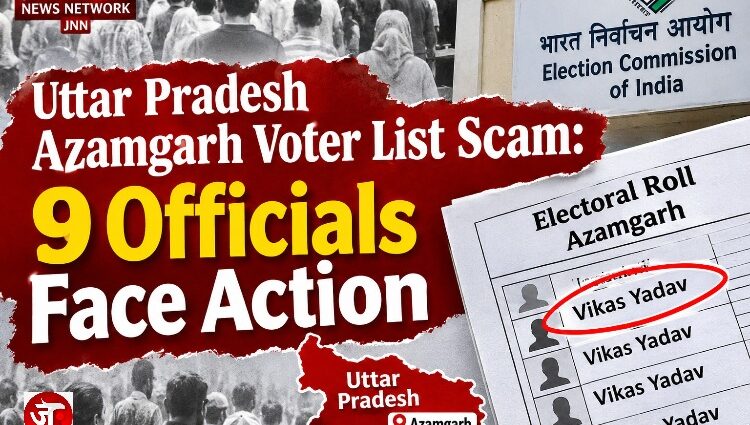
The controversy over alleged voter-list irregularities in Azamgarh has taken a significant turn, after an official inquiry confirmed that the name Vikas Yadav appeared 13 times in the Hindi electoral roll of Assembly Constituency 347-Azamgarh. The findings have prompted action against nine election personnel, bringing renewed scrutiny to the accuracy of electoral rolls in Uttar Pradesh.
The issue had gained political attention after Samajwadi Party chief Akhilesh Yadav raised questions about the repeated entries at a press conference on October 15, 2026. The subsequent inquiry by election authorities has now established that the discrepancies were real, although the investigation has drawn an important distinction between repeated names and proof of deliberate electoral fraud.
According to reports published on October 24 and 25, Uttar Pradesh Chief Electoral Officer Navdeep Rinwa ordered departmental proceedings against three supervisory officers and action against five Booth Level Officers (BLOs) and a computer assistant. The orders also require a comprehensive examination of electoral rolls across Azamgarh district.
What did the investigation uncover?
The inquiry found 13 entries bearing the Hindi name Vikas Yadav in the Azamgarh constituency’s electoral roll. Two entries had already been deleted under the prescribed procedure. The remaining 11 entries were found to relate to 11 different individuals living in separate villages.
Of those 11 individuals, only one was the actual Vikas Yadav cited in the original complaint. Applications using Form 8, the prescribed form for correcting electoral-roll details, were obtained for the other 10 voters to rectify their names and particulars.
The investigation therefore confirmed a serious data-integrity problem, but it did not establish that one individual had cast, or could cast, multiple votes, or that a deliberate conspiracy to manipulate the election had been proved. Uttar Pradesh’s Chief Electoral Officer told The Times of India that the possibility of negligence or deliberate mischief required further investigation.
The orders identify the following personnel for action in connection with the preparation and supervision of the electoral rolls: Three supervisory officers: Narendra Gangwar, the then Sadar Sub-Divisional Magistrate and Electoral Registration Officer; Dr. Monika Agarwal, Assistant Electoral Registration Officer; and Madhavendra Pratap Singh, the then Sadar Naib Tehsildar and Assistant Electoral Registration Officer.
Departmental proceedings have been ordered against the three officers over alleged negligence and inadequate supervision.
Five BLOs and one computer assistant are Geeta Devi Pratham; Geeta Devi Dwitiya; Sunita Devi; Sheela Devi; Umesh Kumar Yadav, and Sanjay Kumar Prajapati, computer assistant
The five BLOs and the computer assistant have been ordered to be removed from voter-list duties, with notices initiating the process for termination of their services. Proceedings under Section 32 of the Representation of the People Act, 1950, have also been directed. These are disciplinary and legal proceedings, not confirmation that every proposed termination has been completed.
The Chief Electoral Officer has directed the Azamgarh District Election Officer to conduct a detailed examination of the electoral rolls across all Assembly constituencies in the district and submit a report within one week. The wider exercise is intended to determine whether similar discrepancies exist elsewhere and establish accountability for errors in the voter-registration process.
The timing is significant. The Azamgarh case follows separate voter-roll irregularities reported in Pilibhit and anomalies in electoral rolls for Uttar Pradesh Legislative Council constituencies. On October 26, The Indian Express also reported a broader order for scrutiny of Forms 6, 7 and 8 entered by computer assistants following the Special Intensive Revision exercise.
These developments make one issue unavoidable: who verifies the records on which citizens’ voting rights depend, and who is held accountable when those records are wrong?
A voter list is not merely a government database. It is the foundation on which the right to participate in an election is exercised. An incorrect name can create confusion, obstruct legitimate voters and undermine confidence in the electoral process.
The official action is a significant development for the reporting by Azamgarh Times, which brought the issue into public discussion. The investigation confirms that the reported discrepancy was not imaginary. But the ultimate test will be whether the authorities correct every affected record, complete a transparent investigation and ensure that similar errors do not recur.
With the Uttar Pradesh Assembly elections approaching, this development assumes particular significance.
JANPATH NEWS NETWORK (JNN)
Independent. Fearless. On the People’s Path.