










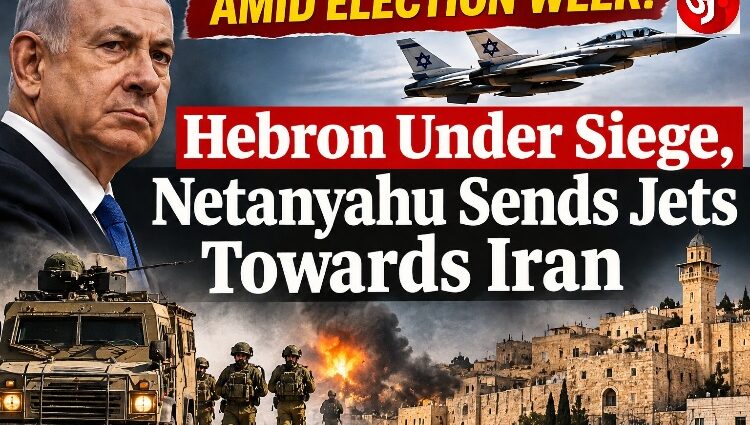
With Israel heading into elections on October 27, Netanyahu orders a sweeping West Bank crackdown; sends fighter jets towards Iran’s border.
October 25, 2026
Israel is heading towards election day amid mounting violence, an expanding military operation in the occupied West Bank and renewed tensions with Iran. Four days before Israelis go to the polls, the country finds itself at the intersection of security fears, military escalation and a political battle that could shape the region’s future.
This timing has placed Israel’s military posture and Benjamin Netanyahu’s approach to security under intense scrutiny.
On Friday, October 23, two Palestinian gunmen attacked a temporary Israeli military checkpoint near Hebron in the occupied West Bank. The attack killed Staff Sgt. Ron Yonatan Roytman, 23, and Sgt. Yuval Shai Svilem, 20, and wounded three other Israeli personnel. The two gunmen were killed by Israeli forces following an approximately 20-minute exchange of fire.
The Israel Defense Forces said it believed the gunmen had intended to carry out a larger attack against Israeli civilians. That assessment is central to Israel’s justification for the military response.
Netanyahu instantly ordered a major operation in the occupied West Bank, including a cordon around Hebron and preparations for wider restrictions. Israeli forces began searches, arrests, demolitions and evacuation measures in areas associated with the attackers.
By Saturday, reports described extensive disruption to Palestinian life, with families displaced and movement restricted. The military campaign was no longer simply a response at a checkpoint. It was reaching into neighbourhoods, homes and the daily lives of residents across the affected areas. .
This turned from counterterrorism to a potentially much wider operation where Netanyahu has warned that Israel is prepared to launch a West Bank operation on a scale not seen since the Six-Day War. He has promised evacuations, house-to-house searches, weapons seizures and the destruction of what the government describes as terrorist infrastructure.
The language signals the possibility of a far-reaching campaign, although its eventual scale and duration remain uncertain.
The central question is what happens to civilians caught inside it. Palestinians in Hebron and surrounding areas face the prospect of movement restrictions, displacement, property destruction and prolonged uncertainty. Israeli authorities, meanwhile, argue that decisive action is necessary to prevent further attacks.
Running alongside the security offensive is another contentious policy: settlement expansion. Netanyahu has spoken of building and legalising more than 100 new settlements and more than 100 farms. His government has pursued settlement approvals and the retroactive legalisation of outposts since taking office in late 2022.
The juxtaposition is striking. While the government presents its military campaign as an effort to dismantle armed networks, its settlement policy is reshaping the same occupied territory.
For Palestinians, settlement expansion raises fundamental questions about land, displacement and the possibility of a viable future state. Much of the international community considers Israeli settlements in the occupied West Bank illegal under international law, a position Israel disputes.
The two policies are not identical, and the available reporting does not establish that the settlement announcements were caused by Friday’s attack. But their simultaneous advancement highlights the broader struggle over who controls the land and what political future remains possible for its Palestinian population.
Fighter jets approach Iran’s border
The West Bank is not the only front drawing attention. According to an October 21 report by Axios, dozens of Israeli fighter jets, accompanied by aerial refuelling aircraft, flew through Syrian and Iraqi airspace towards Iran’s border earlier in the week before turning back.
Israeli and US officials described the sortie as a training exercise and a demonstration of military reach intended to deter Iran ahead of the October 27 election.
But the report also carried a more troubling assessment: some US sources believed Israel may have hoped the flight would provoke an Iranian response, potentially providing a justification for further strikes. That remains an attributed assessment by unnamed sources, not an established Israeli objective.
The flight nevertheless demonstrated how quickly a show of force could become a source of regional danger. A miscalculation involving Israeli aircraft and Iranian air defences could trigger retaliation and reopen a military confrontation neither side might be able to contain.
The election shadow
Israel’s October 27 election provides the political backdrop to these developments. Netanyahu’s government has made security a central concern, and the latest attack has intensified debate over the government’s ability to protect Israelis and its approach to the Palestinian territories and Iran.
That timing warrants scrutiny, but it does not establish that the attack, the West Bank operation and the military sortie were orchestrated to influence voters. The available evidence does not prove such a connection.
What is clear is that Israelis are approaching election day amid a rapidly escalating security debate, while Palestinians in the occupied West Bank are facing a new wave of military restrictions and displacement.
The danger extends beyond the ballot box. A broader West Bank offensive could deepen instability, while any confrontation with Iran could draw other regional actors into the crisis.
Three developments now demand close attention: how far Israel expands its operation in the West Bank, whether settlement expansion accelerates, and whether the military signalling towards Iran remains a deterrent or becomes the prelude to another confrontation.
The coming days may bring further operations, restrictions and political declarations. They may also reveal whether the current escalation remains geographically contained or develops into a wider regional crisis.
Election week has become a test not only of Israel’s security strategy, but of the consequences that strategy may carry for Palestinians and the wider Middle East.
JANPATH NEWS NETWORK (JNN)
Independent. Fearless. On the People’s Path.