










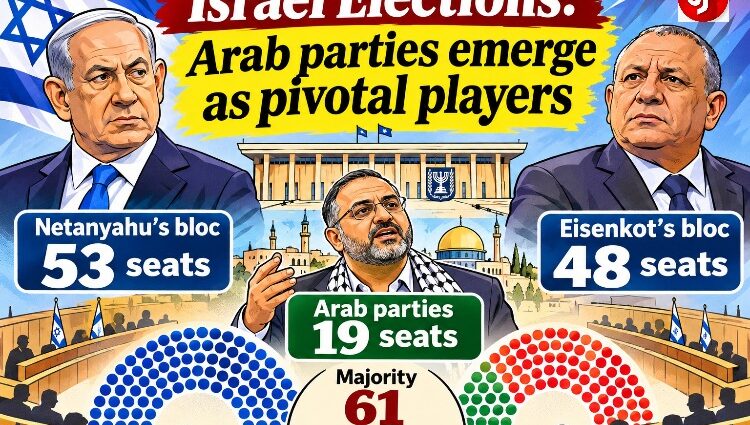
Israel’s Election Earthquake: 53 seats for Netanyahu. 48 for Eisenkot. 19 for Arab parties. Israel’s political future hangs in the balance.
October 28, 2026
Benjamin Netanyahu may be ahead in Israel’s election count, but the veteran prime minister is nowhere near securing the parliamentary majority he needs to form a government. The emerging verdict is a political deadlock, with the opposition challenging his leadership and Arab parties gaining unprecedented leverage in the struggle for power.
With approximately 85.6% of the total vote counted, the latest reported figures put Netanyahu’s bloc at 53 seats, the bloc led by opposition challenger Gadi Eisenkot at 48 seats, and Arab parties at 19 seats. The 120-member Knesset requires 61 seats for a majority.
The figures remain provisional, and around 600,000 double-envelope ballots, including absentee and military votes, were still awaiting counting in the latest update. The final outcome could therefore change for Israel.
Netanyahu leads, but can he govern?
Netanyahu’s Likud remains the largest individual party in Israel, but the wider coalition arithmetic is the real test. His right-wing and religious allies must assemble enough support to reach 61 seats. Netanyahu has called for a strong right-wing government in Israel, but the current numbers leave his bloc short.
The prime minister’s political opponents see the results as a rebuke to his leadership. Eisenkot has argued that voters rejected Netanyahu’s continuation in office and called on him to leave politics.
Yet opposition momentum is not the same as a governing majority. Eisenkot’s bloc also falls short of 61 seats, and assembling a coalition will require difficult negotiations over political priorities and potential partners.
Arab parties emerge as pivotal players
The combined strength of the Arab parties is one of the most consequential features of the emerging result for Israel. Their reported 19 seats could prove decisive in determining whether an alternative government can be assembled in Israel.
But the arithmetic comes with a major political obstacle: Netanyahu’s bloc has ruled out partnering with Arab parties, while Eisenkot has also faced constraints over cooperation with them. The opposition must therefore work out whether a viable parliamentary arrangement is possible without the support needed to reach a majority.
The result puts a sharp question before Israel’s political establishment: can a government be formed when the largest competing blocs are both short of the numbers, and the parties holding potentially decisive seats face barriers to coalition participation?
A vote shaped by war and political accountability
The election comes amid continuing debate over the security failures of October 7, 2023, the wars that followed, Netanyahu’s leadership and the direction of Israel’s national security policy. Netanyahu has highlighted military achievements and called for a right-wing government. His challengers have argued that the country needs a change in leadership.
Turnout reached 77.7%, the highest in more than two decades, according to Reuters. That high participation underlines the significance of the contest, even as the final political outcome remains uncertain.
What happens next in Israel?
The remaining ballots must be counted and the results finalised. Coalition negotiations will then determine whether either side can secure the support needed to govern Israel. If no viable majority emerges, Netanyahu could remain caretaker prime minister during prolonged negotiations, and the possibility of another election cannot be ruled out for Israel.
The verdict: Netanyahu’s lead is not a victory in Israel
Netanyahu is ahead in the reported seat count. He has not secured a majority. Eisenkot has not secured one either.
For Israel, the election has produced a contest for power, not a settled transfer of it. The final ballots and the coalition negotiations will determine whether Netanyahu can remain at the helm or whether the opposition can build an alternative.
Source note: Based on the latest reported partial count available on October 28, 2026, and Reuters reporting. Figures are provisional and may change as outstanding ballots are counted.
JANPATH NEWS NETWORK (JNN)
Independent. Fearless. On the People’s Path.