








Modi takes a swipe at Congress after four-state Legislative Council election; BJP, SP trade victories in UP, while Bihar delivers surprises.
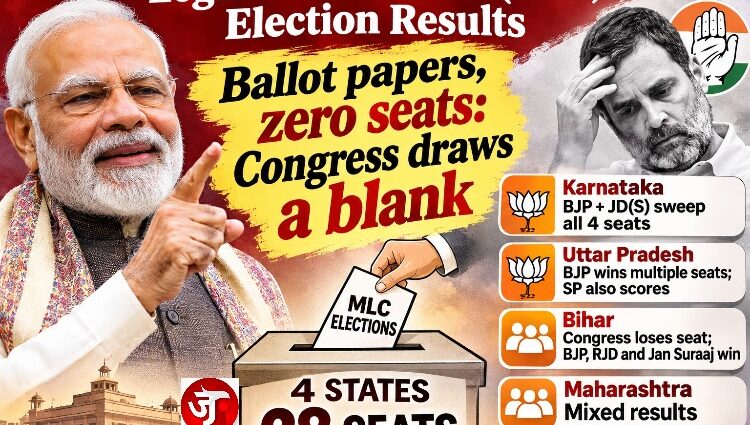
October 28, 2026: Ballot Papers, Zero Seats: Congress Draws A Blank As Bjp-Jd(S) Sweeps Karnataka Mlc Polls: The results are in, and the Congress has little to celebrate. In the Legislative Council elections across four states, the party failed to win a single seat among the 12 it contested, handing Prime Minister Narendra Modi an opportunity to take aim at its campaign against electronic voting machines.
The elections covered 28 Legislative Council seats across Uttar Pradesh, Bihar, Maharashtra and Karnataka. Voting took place on October 23 using ballot papers, with counting beginning on October 27.
Modi was quick to seize on the outcome. In a post on X, he asked: “MLC elections in 28 seats across 4 big states – Uttar Pradesh, Maharashtra, Bihar and Karnataka. Elections held using ballot papers. Guess how many seats Congress won?”
The barb was pointed. Congress and other Opposition parties have repeatedly questioned the use of EVMs and called for a return to paper ballots. Modi’s post used the Congress’s performance in these elections to challenge that political argument.
However, the results of these specialised teachers’ and graduates’ constituencies should be understood in their own context. Their electorate is limited to eligible teachers and graduates, rather than the general voting population.
Karnataka: NDA sweeps all four seats
The sharpest setback for Congress came in Karnataka, where it governs the state but failed to win any of the four Legislative Council seats contested.
The BJP-JD(S) alliance swept all four constituencies. The BJP retained three seats, while its ally Janata Dal (Secular) wrested the Bengaluru Teachers’ constituency from Congress.
JD(S) candidate A P Ranganath defeated sitting Congress MLC Puttanna by 908 votes, ending the latter’s hold on the seat. The BJP retained the North-East Teachers’, South-East Graduates’ and West Graduates’ constituencies.
The outcome gives the BJP and JD(S) a political boost and strengthens their argument that their alliance can challenge Congress beyond the state’s Assembly elections. It is a setback for the ruling party, although the result does not threaten its existing majority in the Karnataka Legislative Council.
Uttar Pradesh: BJP leads, Samajwadi Party holds its ground
Uttar Pradesh produced a more mixed contest. The BJP secured five of the 11 seats, while the Samajwadi Party won three, with counting continuing in the remaining constituencies in the latest reports.
The SP registered wins in the Varanasi Teachers’ and Agra-Aligarh Teachers’ constituencies, among others, while the BJP retained several key seats and made gains in the state’s teachers’ and graduates’ constituencies.
The results underline the BJP’s strength in the state, but they also show that the SP remains a significant competitor in these specialised elections. The final tally was still being established as counting continued.
Bihar: Congress loses, but BJP also takes a hit
Bihar delivered a more fragmented verdict. The Jan Suraaj Party, led by Prashant Kishor, entered the Legislative Council after its candidate Suresh Prasad Rai defeated sitting Congress MLC Madan Mohan Jha in the Darbhanga Teachers’ constituency.
The Rashtriya Janata Dal also scored a victory, wresting the Patna Teachers’ seat from the BJP. An Independent candidate won the Saran Teachers’ constituency.
The outcome was therefore not a uniform sweep for the BJP. While Congress failed to win any of the seats it contested, the results also exposed vulnerabilities for established parties, including the BJP, in individual constituencies.
Maharashtra: a mixed picture
Maharashtra’s five seats produced a more competitive picture, with the BJP-led Mahayuti and opposition parties in the contest. Counting was still underway in some constituencies in the latest reports, making it premature to declare a final overall winner.
The state’s results underline that the four-state exercise was not a single statewide mandate but a collection of separate contests, each shaped by its own electorate, candidates and local political calculations.
The larger political message
For Modi, the Congress’s failure to win any of the 12 seats it contested offered a political opportunity. His remarks linked the results to the wider debate over voting machines and ballot papers, putting pressure on the Opposition to explain its electoral performance under a voting system it has advocated.
For Congress, the immediate challenge is to examine why it failed to convert its support into victories, particularly in Karnataka, where it holds power. The party’s defeat in Bengaluru Teachers’ is especially notable because the JD(S) took the seat from a sitting Congress MLC.
Still, these results should not be mistaken for a verdict on the entire electorate. Teachers’ and graduates’ constituencies represent a specific voter base, and Legislative Council elections operate differently from general elections and Assembly polls.
JANPATH NEWS NETWORK (JNN)
Independent. Fearless. On the People’s Path.