









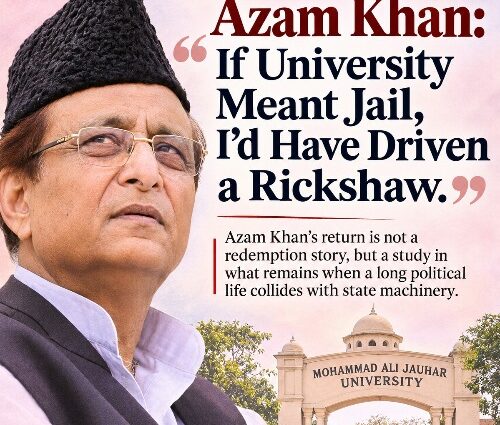
Azam Khan’s return is not a redemption story, but a study in what remains when a long political life collides with state machinery.
Sunday, November 22, 2026:
At 78, the Samajwadi Party veteran Azam Khan walked out of Dasna Jail in Ghaziabad on 18 November 2026 on interim bail in an Enforcement Directorate money-laundering case tied to Mohammad Ali Jauhar University. Hours earlier the Supreme Court had declined to stay the Allahabad High Court’s order, observing that “the sky will not fall.” The sequence was almost theatrical: released from Rampur jail on 31 October in a dual-PAN case, re-arrested at the gate by the ED, shifted to Dasna, and finally out again after the High Court found that written grounds of arrest had not been supplied. The next hearing is on 10 December. This is interim relief, not vindication.
Azam Khan said, in a voice reflecting pain:
If I’d known that setting up a university could land me in jail, I would have driven a rickshaw or had my children roll beedis, because everyone loves freedom.”
Azam Khan’s first substantial public appearance was a return to the university campus in Rampur. The visit was not ceremonial. The institution he helped found in 2006, named after the Khilafat-era leader Maulana Mohammad Ali Jauhar, has become both his most ambitious project and his most exposed flank.
ED has provisionally attached land and buildings valued at roughly ₹426 crore as alleged proceeds of crime, with a claimed market value far higher. Allegations include coercive acquisition of farmers’ land, diversion of government funds and materials while he held ministerial portfolios, and irregularities in the trust. Whether they amount to proven guilt is a question for courts; whether the intensity and sequencing of action have political colour is a question the public is already answering.
Azam Khan’s language after release was characteristic: wounded, theatrical, and precise in its self-portrait. He spoke of weight falling from 98 kg to 70 kg, of confinement in a small cell, of food unfit even for a stray dog, and of years spent with an M.Tech-educated son. The bitterness is real. So is the calculation. He has invited the Rampur Development Authority to bring bulldozers and demolish the buildings so the world can “see how a temple of education is demolished when it is built by a Muslim.” The line converts a land and compliance dispute into an identity contest. It is effective politics. It is also a demand that due process and proportionality still apply even when the founder is a polarising Muslim politician who once wielded considerable power.
The same man, on the day Yogi Adityanath’s mother died, offered condolences without the usual edge: a “great loss,” a prayer for patience, an acknowledgement that a mother is a treasure. The gesture sits awkwardly beside the 2019 FIR that briefly named his own deceased mother in an encroachment matter. Both moments are true to him. Azam Khan has never specialised in consistency of tone; he has specialised in making the contest personal.
He is positioning himself for the 2027 Uttar Pradesh assembly elections even while the legal arithmetic remains hostile. Under the Representation of the People Act, a conviction of two years or more ordinarily disqualifies a person for the sentence period plus six years unless a higher court stays the conviction itself. Bail is not enough. In the dual-PAN matter the High Court suspended sentence but refused to stay conviction.
Other cases produce similar barriers. Some reports therefore conclude he cannot contest. Yet he has already asked, in public, “Why should I not contest?” and described the coming polls as “inkalab” rather than election – a deluge, not mere change. The practical path is clearer as star campaigner than as candidate.
In western Uttar Pradesh’s Muslim-majority pockets he remains a recognisable voice; his return gives the Samajwadi Party a counter to both the BJP’s narrative and any attempt by Asaduddin Owaisi’s AIMIM to split that vote. His recent jibe that “Hyderabadi biryani” is not preferred in his region was not subtle. He is signalling loyalty to the SP while reminding the party that his years of legal isolation were not met with the solidarity he expected.
What is actually on the table is narrower than the rhetoric. The ED case is still live; the attachment of university assets stands; local development authority notices on buildings remain a threat. His freedom is conditional and temporary. The broader pattern of central-agency action against opposition figures, Indian Express investigations have repeatedly shown a heavy concentration of ED cases on non-BJP politicians, gives him a ready political frame. It does not erase the specific allegations against the trust and the land.
Khan has not emerged subdued. The old combative instincts are intact .
The most important aspect of Mohammad Ali Jauhar University is not Azam Khan’s political association with it, but what the institution was intended to offer the people of Rampur. In a region where access to quality higher education has historically been a challenge for many families, the university represented an opportunity for young men and women to pursue degrees, acquire professional skills and imagine futures beyond the limitations of their circumstances. It was an investment in education as a means of social mobility, particularly for communities that have often struggled to access such opportunities. This is what makes the controversy surrounding Jauhar University particularly significant.
He has returned not as a man reduced to political tactics, but as someone still bound to the institution that was meant to outlast him.
In the end, Azam Khan remains larger than the cases that have consumed him. He is the man who built a university named after a freedom fighter when he could have settled for the usual monuments of politics, the veteran whose tongue still cuts and whose spirit has not been broken by prison, and the father who measured the cost of that institution in the years of freedom he lost. His return to Jauhar University is not a calculated manoeuvre but the homecoming of someone who still believes the dream outlives the ordeal. Whether the courts ultimately clear him or not, the image that lingers is of an old politician standing once more on the campus he created, insisting that education must survive even if the buildings do not. In that insistence lies both his defiance and his measure.
JANPATH NEWS NETWORK (JNN)
Independent. Fearless. On the People’s Path.