
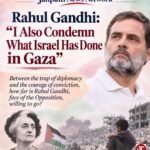







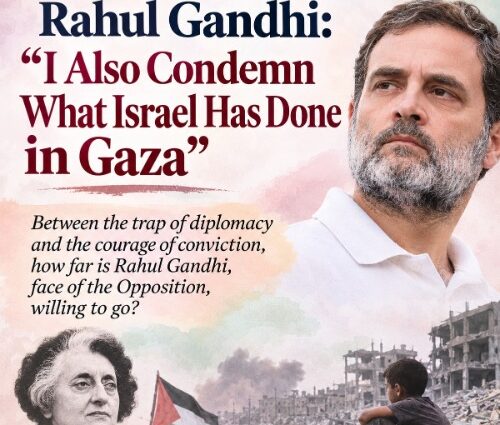
Between the trap of diplomacy and the courage of conviction, how far is Rahul Gandhi, face of the Opposition, willing to go?
Saturday, November 21, 2026
Rahul Gandhi has repeatedly condemned Israel’s actions in Gaza, including describing collective punishment as a crime against humanity. But his defence of India’s strategic relationship with Israel raises a difficult question: has diplomacy softened the language of conviction? His grandmother, Indira Gandhi, approached Palestine from a very different political tradition.
Rahul Gandhi is being criticised for saying that India should maintain a strong relationship with Israel, including purchasing weapons from it. Some have interpreted his remarks as an endorsement of a government whose military campaign in Gaza has caused immense civilian suffering. Others have accused him of placing strategic convenience above solidarity with Palestinians.
But there is something missing from this controversy.
Rahul Gandhi has, in fact, spoken about Gaza repeatedly. His record is considerably more substantial than the charge of silence suggests.
On October 19, 2023, barely twelve days after the Hamas-led October 7 attacks, Rahul issued a statement that left little ambiguity about his position.
He wrote:
“The killing of thousands of innocent civilians, including children in Gaza and the collective punishment of millions of people by cutting off their food, water and electricity are crimes against humanity.”
He continued:
“Hamas’ killing of innocent Israelis and taking of hostages is a crime and must also be condemned.”
And concluded:
“The cycle of violence between Israel and Palestine must be brought to an end.”
This was not simply a call for peace. Rahul explicitly condemned the collective punishment of Gaza’s population and described it as a crime against humanity.
In September 2024, he was again direct in an interview with the Hindustan Times:
“I also think what Israel did and is doing, bombing innocent civilians, and killing women and children, is absolutely wrong and should not be allowed to continue.”
These are not the words of a politician who has ignored Palestine.
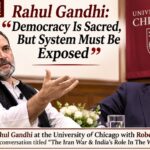
And at the University of Chicago on November 18, 2026, Rahul reiterated his position during an interaction with political scientist Professor Robert Pape.
Rahul Gandhi said:
“I condemn what happened in October. I think that was absolutely horrible, should never have happened. Killing of innocent people is absolutely wrong. But I also condemn what Israel has done in Gaza, and one cannot get away from both the wrongs.”
Then came the statement that has caused the political storm:
“We have a relationship with Israel, good relationship with Israel. We buy weapons from Israel, and that’s good.”
He explained that India had strategic reasons for maintaining the relationship, adding that Israel produced very good weapons and India had to acquire the best equipment for its armed forces.
Rahul Gandhi was emphatic:
“So I’m fully for having a good relationship with Israel.”
The following day, Rahul Gandhi clarified his position on X:
“I support a strong relationship with Israel. We have strategic interests, including buying the best weapons for our armed forces. But that cannot mean silence on Gaza.”
He added:
“I condemn the October 7th attacks and the killing of innocent people. I also condemn what Israel has done in Gaza. One wrong cannot justify another.”
There is a genuine foreign-policy argument here. India has strategic interests, defence requirements and international relationships that cannot be wished away. But there is also a moral question that cannot be lost in the political storm.
Can India condemn the conduct of a government while continuing to deepen military cooperation with it? At what point does strategic partnership become an excuse for avoiding consequences?
And how strong must a condemnation be before it begins to influence policy?
Indira Gandhi: Palestine was not a diplomatic inconvenience
To understand the difference in political temperament, one must return to Indira Gandhi.
Her support for Palestine was not an occasional expression of sympathy. It was a defining part of India’s post-independence foreign-policy tradition.
India had supported Palestinian self-determination long before the present conflict. Indira Gandhi maintained close relations with Palestinian leader Yasser Arafat and the Palestine Liberation Organization. Her government regarded the Palestinian struggle as part of the larger history of anti-colonial resistance.
In April 1985, addressing the United Nations Seminar on the Question of Palestine in Beijing, Indira Gandhi stated:
“Our sympathy for the Palestinian Arabs has been a part of independent India’s foreign policy from its very inception.”
She continued:
“Thus our support for the Palestinian cause has been time-tested and consistent.”
Then came a particularly powerful passage:
“The plight of Palestinians has been one of the tragedies of history. Few people have been more systematically oppressed and humiliated in their own land.”
This was not carefully calibrated diplomatic language. It was a declaration of historical and political solidarity.
Indira also made clear that temporary political alignments could not erase the Palestinian people’s rights.
She said:
“Power politics and partnerships based on temporary political alignments have imposed certain new constraints on the feasible alternatives open to the international community for a political resolution of this problem. These do not, however, gainsay the need for urgent new initiatives.”
That sentence is especially relevant today.
She was acknowledging the realities of power politics, but refusing to allow them to become an excuse for abandoning the Palestinian cause.
The price of an independent foreign policy
Indira Gandhi’s foreign policy was never designed to make Washington comfortable.
During the 1971 Bangladesh liberation war, the United States under President Richard Nixon and National Security Adviser Henry Kissinger tilted towards Pakistan. India, facing a major regional and humanitarian crisis, signed the Indo-Soviet Treaty of Peace, Friendship and Cooperation in August 1971.
When the United States deployed the USS Enterprise-led naval task force into the Bay of Bengal in December 1971, the strategic confrontation became unmistakable.
Indira Gandhi did not abandon India’s position to accommodate Washington.
Her relationship with the Soviet Union was a strategic partnership, but it was also an assertion that India would make its own decisions rather than accept the preferences of a superpower.
This did not mean that she rejected relations with America permanently. She later rebuilt diplomatic engagement with Washington, including her 1982 visit to the United States during Ronald Reagan’s presidency.
The lesson is not that India should reject strategic relationships. It is that strategic relationships need not dictate a country’s moral vocabulary.
Indira Gandhi understood the difference.
Priyanka Gandhi has inherited more of that language
The contrast within the Gandhi family is striking.
On October 28, 2023, Priyanka Gandhi criticised India’s abstention at the United Nations on a resolution calling for a humanitarian truce in Gaza.
She wrote:
“I am shocked and ashamed that our country has abstained from voting for a ceasefire in Gaza.”
On February 22, 2024, she went further:
“Being blind to genocide as it is carried out with impunity, turning our backs to the merciless slaughter of thousands of innocent children…”
She criticised countries that provided ports, funding and arms to Israel while Gaza’s population faced bombardment, starvation and the destruction of hospitals.
On July 26, 2024, following Benjamin Netanyahu’s address to the US Congress, Priyanka called on governments around the world to condemn what she described as Israel’s “genocidal actions” and force them to stop.
These were not diplomatic hints. They were explicit demands for international accountability.
Sonia Gandhi, too, challenged the government’s approach. In October 2023, she criticised India’s abstention at the United Nations and questioned Israel’s disproportionate response. In June 2026, she again wrote about India’s silence on Gaza and its relationship with Israel.
The family is therefore not speaking with one voice, even though Rahul and Priyanka both condemn Israel’s actions.
The trap of diplomacy
Rahul’s position deserves a fair reading.
He is arguing that India must be able to maintain strategic relationships without surrendering its independent voice. His reference to Israel, the United States, Russia and China suggests that he wants India to operate without being constrained by any one power.
There is logic to that argument, but the difficulty lies in what happens when strategic interests collide with stated principles.
If India buys weapons from Israel while condemning the destruction in Gaza, what limits does Rahul believe should apply to that relationship? Would he support suspending particular defence purchases if credible evidence established serious violations of international humanitarian law? Would he demand stronger diplomatic measures? Would he support restrictions on military cooperation?
Rahul Gandhi has not answered those questions in the statements examined here. And this is where the criticism of his position becomes legitimate. His condemnation of Israel is real and defence of the strategic relationship is equally real. The question is whether the former is sufficiently strong to place meaningful limits on the latter.
And where is the rest of India’s political leadership?
Rahul is not the only Indian leader who has spoken. Priyanka and Sonia Gandhi, Shashi Tharoor, Asaduddin Owaisi and Left leaders have all criticised Israel’s conduct or India’s response. But the scale of public intervention has been uneven.
Prime Minister Narendra Modi was quick to declare India’s solidarity with Israel after October 7, 2023. His subsequent statements acknowledged the humanitarian crisis in Gaza, and India continued to express support for Palestinian statehood and humanitarian assistance.
External Affairs Minister S. Jaishankar has spoken about civilian casualties, humanitarian law and the need for a ceasefire. National Security Adviser Ajit Doval raised humanitarian concerns during his March 2024 meeting with Netanyahu, although his intervention was diplomatic rather than a public denunciation.
The question is why India’s strongest public expressions of solidarity with Israel came so quickly, while its criticism of the devastation in Gaza has generally been more measured.
A country that has historically supported Palestinian self-determination should not have to choose between maintaining diplomatic relations and speaking plainly about civilian suffering.
What does it mean to stand for what India believes in?
Rahul Gandhi has repeatedly said that India must not allow any country to dictate its foreign policy.
That is a sound principle. But it must apply in both directions.
India should not be forced to abandon Israel because another country demands it. Equally, India should not hesitate to criticise Israel because it buys Israeli weapons or values its defence relationship.
Indira Gandhi’s words remain relevant:
“Power politics and partnerships based on temporary political alignments” must not erase the basic rights of Palestinians.
That is the historical standard against which Rahul’s position will inevitably be judged.
He has spoken. He has condemned Israel’s actions. He has done so repeatedly and in unusually direct language for a leader who also defends a close strategic relationship with Israel.
But condemnation is only one part of leadership. The more difficult test is whether conviction survives when it becomes costly.
JANPATH NEWS NETWORK (JNN)
Independent. Fearless. On the People’s Path.