




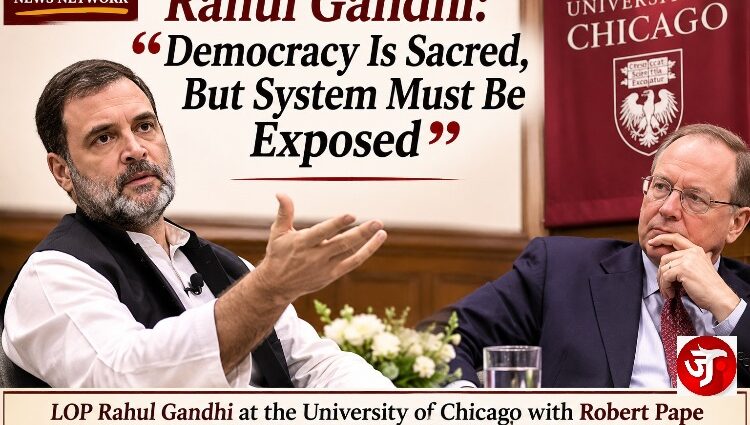
LOP Rahul Gandhi was at the University of Chicago with Robert Pape for a conversation billed as “The Iran War & India’s Role In The World.”
In a packed hall at the University of Chicago, Leader of the Opposition Rahul Gandhi sat down with political scientist Robert Pape for a conversation billed as “The Iran War & India’s Role In The World.” What emerged was less a detached academic seminar and more a blunt assessment of both India’s democratic health and its place in a fracturing global order.
The interaction took place on Wednesday, 18 November 2026 at the University of Chicago on a two-day visit to the United States. He spoke at Columbia University in New York on Tuesday and at the University of Chicago on Wednesday.
Gandhi opened the domestic discussion with a line that cut through the usual political noise. “Indian democracy is sacred,” he said. “For me to even say that there is a problem in Indian democracy is difficult without 100, 200, 300 per cent proof.” The threshold he set was deliberately high. He was not offering casual allegations; he was arguing that only overwhelming evidence could justify questioning the system itself.
That caution, however, did not translate into silence. Gandhi made clear that the opposition has no intention of boycotting elections. “If we say that we are not going to contest elections, we end Indian democracy that very minute,” he told the audience. In his view, withdrawal would not merely demoralise party workers; it would hand the ruling side the ability to declare the entire process illegitimate in the eyes of ordinary citizens. The strategy, he insisted, is to keep fighting inside the system:
“Our strategy is to expose what is going on and take the beating until the people of India realise that the system has been fully demolished.”
He went further, claiming that information is now flowing from within the Election Commission itself and that “it is now only a matter of time before this entire structure collapses.” He repeated earlier allegations about illegitimate voters in the 2024 elections, including the claim that a Brazilian woman who had never visited India voted multiple times in a state election. Whether these assertions hold up under scrutiny remains a matter of intense political contestation. What Gandhi signalled in Chicago was that the opposition intends to keep pressing the issue in public rather than step away from the electoral arena.
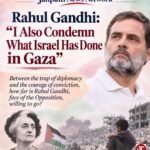
The conversation then turned outward. On India’s foreign policy, Gandhi was equally direct. He acknowledged that India maintains good relations with Israel and continues to buy weapons from it. He condemned the October 7, 2023 terror attack. At the same time, he criticised Israel’s military response and argued that India’s choices must be driven by its own national interests rather than alignment with any single power. Looking ahead, he rejected the idea that the next global order will be written solely in Washington. India, China, the Middle East, and Russia, he said, will all shape what comes next.
The session also touched on the practical consequences of the Iran conflict for India: energy-security risks, the broader geopolitical realignment under way, pollution, and economic pressures. These were not abstract academic points. For a country that imports a large share of its oil from the region, the outcome of the fighting carries direct costs.
What emerged from the University of Chicago stage was a dual message. Domestically, Gandhi presented the defence of democratic norms as both a moral and a strategic imperative – sacred enough that it cannot be abandoned, yet damaged enough that it must be openly challenged. Internationally, he sketched a multipolar future in which India cannot afford to be a bystander.
Whether that framing persuades voters at home or partners abroad will be tested in the months ahead. For now, the record of the conversation is public, and the arguments are on the table.
JANPATH NEWS NETWORK (JNN)
Independent. Fearless. On the People’s Path.