









Three crore infiltrators? The numbers behind Amit Shah’s SIR claim raise disturbing questions about India’s electoral rolls
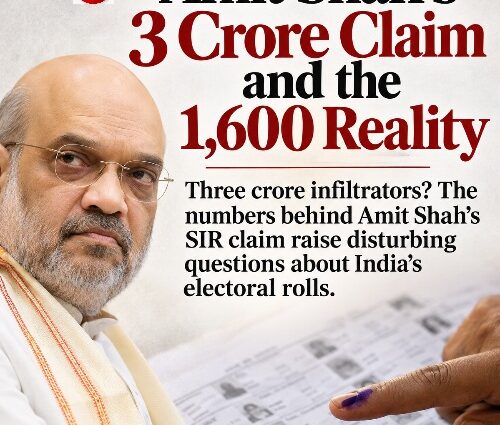
Friday, November 20, 2026: On 2 November 2026, Union Home Minister Amit Shah stood in Hyderabad and declared that of the roughly 13 crore names deleted during the Election Commission’s Special Intensive Revision (SIR) of electoral rolls, three crore belonged to “infiltrators” – people who “never existed,” largely Bangladeshis. He framed the deletions as a necessary purge of a vote bank and challenged the opposition to defend their presence on the rolls.
Days later, reporting by Hindustan Times showed that across six states with a combined electorate of nearly 9.86 crore, election authorities had identified only about 1,600 suspected foreign nationals. In Karnataka, where nearly a crore names were deleted, officials reported 716 foreigners, the majority Nepalese domestic workers in Bengaluru. Kerala accounted for roughly 500; Goa for 419. Jharkhand found three (from Afghanistan). Meghalaya found two. The Election Commission itself had not compiled a national figure and had not asked states to systematically track foreigners as a separate category.
An investigation by The Reporters’ Collective added a structural detail: the ECI’s ERONET software used by electoral officers had no option to mark a voter as a non-Indian citizen. RTI replies from more than 100 Electoral Registration Officers in Bihar, the first state to undergo SIR, recorded no non-citizens among those deleted. The stated grounds for deletion remained absence, shifting, duplication, and death.
The Speech in Thiruvananthapuram
On 18 November, economist and political commentator Parakala Prabhakar addressed a one-day workshop organised by the collective “Keralam Against SIR” in Thiruvananthapuram. In the video that later circulated on X, he called the exercise “a bloodless political genocide.”
“SIR is nothing but killing your citizenship,” he said. “SIR is nothing but a bloodless political genocide.” He argued that India had never conducted an exercise of this nature before. Citizens had never been required to prove their eligibility to vote by submitting documents at government offices in this manner. Neither the Constitution nor the Representation of the People Act, he contended, contemplated a nationwide intensive revision of this scale. The limited power under Section 21(3) for special revisions in a constituency or part thereof was designed for contingencies such as floods or fires that destroyed physical rolls, a purpose long overtaken by digitisation.
He demanded that SIR be scrapped, all eligible voters restored to the rolls, and elections held after the exercise (including those in Kerala, Tamil Nadu, and West Bengal) be annulled. Parties that believed the process was illegal, he added, should boycott elections conducted on the resulting lists. “Nothing short of this would rescue the Constitution and India as a democracy and a republic.”
The Logical Challenge
In earlier remarks responding directly to Shah’s claim, Prabhakar had made a pointed observation: if three crore foreigners had been on the rolls before SIR, then the 2014, 2019, and 2024 general elections, and numerous state elections, were conducted on contaminated lists. “If that is true, please resign and conduct elections after purification of voters’ list,” he said. Five months after a Supreme Court direction to submit lists of suspected illegal immigrants identified during SIR to the competent authority, no such list had been produced.
He has also noted that the adult population is roughly 103 crore, yet post-SIR elector numbers have fallen in several states rather than risen. Deletions, he and others argue, have fallen disproportionately on migrants, daily-wage workers, women, and certain minority communities, groups whose absence from the rolls does not require them to be foreigners.
What the Numbers Leave Unresolved
The discrepancy between a political claim of three crore infiltrators and verified detections in the low thousands does not by itself prove that every deletion was improper. Electoral rolls do contain dead, duplicate, and shifted entries, and cleaning them is a legitimate administrative task. What the available evidence does show is that the public justification repeatedly advanced for the scale and intensity of SIR, the detection and removal of large numbers of foreign infiltrators, rests on figures that official records, software design, and state-level reporting have so far failed to substantiate.
The larger question raised by Prabhakar in the Thiruvananthapuram speech remains: whether the process is primarily about purifying rolls, or about redrawing the boundary of who counts as a voter in India’s universal adult franchise. That distinction, more than any single number, is what the current data and the absence of a clear institutional mechanism for identifying foreigners have placed under scrutiny.
JANPATH NEWS NETWORK (JNN)
Independent. Fearless. On the People’s Path.