









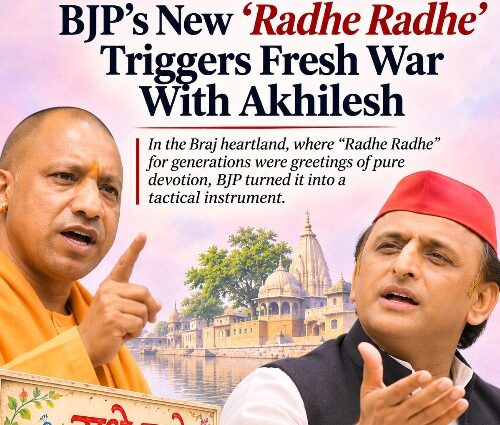
In the Braj heartland, where “Radhe Radhe” for generations were greetings of pure devotion, BJP turned it into a tactical instrument.
Sunday, November 22, 2026
“Radhe Radhe” has always for generations been the greeting of pure devotion in the Braj heartland, and right now, the BJP has turned it into a calculated political instrument. From its two-day Mathura Chintan Shivir, the party unveiled the chant “Radhe Radhe, Kamal Khila De”, an attempt to sacralise its election symbol and seek divine sanction for a third consecutive term in Uttar Pradesh.
This is political theatre at its most revealing. After the fulfilment of the Ram Mandir promise in Ayodhya, the BJP is staging a sequel in Mathura, shifting its emotional register from the martial resolve of Ram to the softer, more intimate bhakti of Radha and Krishna. Psychologically, it is a bid for cultural ownership: to make the lotus feel less like a party emblem and more like a blessed object under Radha Rani’s protective gaze. The hope is that voters will internalise the bloom as inevitable, almost religiously ordained.
Akhilesh Yadav’s counter was pure theatre of inversion. With characteristic wit he reframed the greeting itself: “Radhe Radhe,” he suggested, is what one says at a farewell. The lotus, he implied, is already wilting; the new chant is less a prayer for revival than an unconscious admission of decline. In one stroke he punctured the grandeur, turning sacred invocation into political irony. The psychology is sharp and defensive, ridicule as a weapon to demystify the slogan before it can embed itself in public consciousness.
The BJP’s reply, through minister Kapil Dev Agarwal, stayed firmly inside the same symbolic frame: under Radha Rani’s blessings the lotus does not wilt; it continues to bloom. The exchange is less about policy than about who controls the emotional vocabulary of the state.
Yet this duel of slogans and mockery, vivid as it is, risks becoming a distraction from a more consequential realignment. The emergence of the Samajik Parivartan Morcha, Asaduddin Owaisi’s AIMIM and Chandrashekhar Azad’s Azad Samaj Party, with Azad projected as the chief ministerial face, introduces a third axis into Uttar Pradesh’s contest. It is a deliberate attempt to mobilise Dalit, minority and less privileged communities outside both the BJP’s Hindutva consolidation and the Samajwadi Party’s PDA outreach.
While the BJP plans Jan Chaupals across Uttar Pradesh to deepen its cultural Hindutva messaging and Akhilesh takes his PDA Rath Yatra into Gorakhpur itself, the Owaisi–Azad alliance signals a fragmentation of the opposition space. In a state where electoral arithmetic is often decided by who can claim the marginalised without alienating the rest, this new formation forces every major player to recalibrate.
The slogan war over Radha and the lotus is the visible drama. The quieter, more structural drama is the contest over who truly represents the communities that neither the BJP nor the Samajwadi Party can afford to lose. In the end, “Radhe Radhe, Kamal Khila De” may prove memorable or fleeting. But the deeper psychology of Uttar Pradesh politics remains unchanged: every symbol is contested, every community is a battlefield, and the theatre of devotion is never far from the arithmetic of power.
JANPATH NEWS NETWORK (JNN)
Independent. Fearless. On the People’s Path