










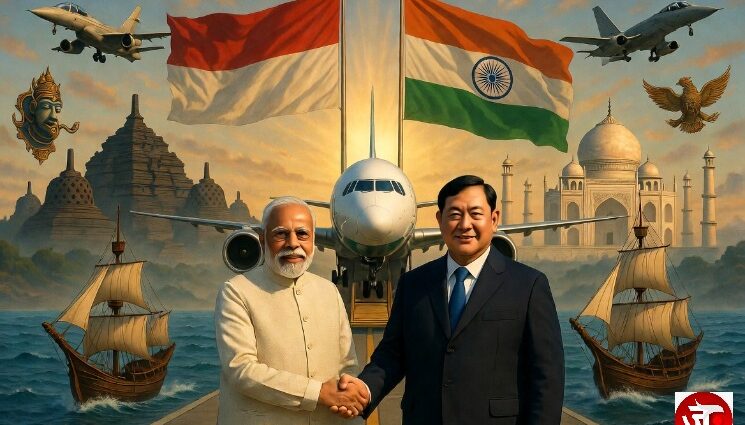
JAKARTA: July 7, 2026: Prime Minister Narendra Modi’s arrival in Indonesia this week was marked by every symbol of modern statecraft. Indonesian President Prabowo Subianto personally welcomed him, fighter jets escorted Air India One into Jakarta’s skies, and Indonesia conferred upon the Indian Prime Minister its highest civilian honour, the Bintang Adipurna, an accolade reserved for those who have made exceptional contributions to the Republic.
Bilateral talks produced agreements spanning defence, maritime cooperation, critical minerals, steel, healthcare, agriculture, digital technology, and the proposed supply of India’s BrahMos and Astra missile systems.
While some diplomatic relationships are measured in decades. India and Indonesia measure theirs in nearly two thousand years.
One historical nuance is worth noting. While Indonesia’s name literally combines the Greek words Indos (India) and nesos (islands), modern historians generally use the term “Indianization” to describe centuries of cultural exchange rather than political control. Historians call this process “Indianization,” but perhaps a better word would be conversation, a dialogue between two ancient civilizations that transformed both. The relationship was built through merchants, monks, scholars, and sailors, not conquest. That distinction makes the story even more remarkable.
Long before passports, embassies, or international treaties existed, Indian sailors crossed the Bay of Bengal guided only by stars, seasonal monsoon winds, and courage. They did not arrive carrying armies. They brought merchants, philosophers, monks, craftsmen, poets, mathematicians, and storytellers.
Unlike many chapters of world history written through conquest, India’s influence in Indonesia spread largely through commerce, ideas, faith, and culture. Indonesian kingdoms selectively embraced Indian philosophy while shaping it into something uniquely their own.
Today, that conversation still echoes through Indonesia. Indonesia often surprises those unfamiliar with Southeast Asia. and you may be surprised to learn that Indonesia is a Muslim Nation performs the Ramayana, home to the largest Muslim population on Earth, with more than 280 million people, India seconds this with 200 million Muslims
Yet every evening in Yogyakarta, audiences still gather beneath the shadow of the magnificent Prambanan Temple to watch performances of the Ramayana Ballet.
In Java, Muslim puppeteers continue performing Wayang Kulit, narrating stories of Rama, Sita, Hanuman and Arjuna. while the children grow up learning lessons from the Mahabharata.
Another fascinating factor is the Indonesian government buildings carry Sanskrit names, airlines are named after Garuda, the mythical bird of Vishnu, military exercises borrow names from ancient epics, and rather than rejecting older traditions, Indonesia layered new faith upon an older cultural foundation.
That remarkable synthesis may be one of the world’s greatest examples of religious coexistence. While India is often described as one of the world’s most linguistically diverse countries, with well over 1,500 languages and dialects, Indonesia, spread across more than 17,000 islands, speaks over 700 living languages.
At the same time, both nations faced the same civilizational challenge: How do you unite extraordinary diversity without destroying it? India chose the philosophy of “Unity in Diversity,” while Indonesia adopted Bhinneka Tunggal Ika, “Unity in Diversity”, a national motto drawn from a 14th-century Javanese poem with Sanskrit roots.
Separated by thousands of kilometres of ocean, both countries independently embraced remarkably similar ideas of nationhood. Sanskrit Still Lives in Everyday Indonesia, while visitors often don’t realise they are hearing Sanskrit every day.
Some common Indonesian words include: Agama (religion); Bumi (earth); Jiwa (soul); Manusia (human); Dharma (faith); Suci (holy); Cinta (love); and Widya (knowledge).
The great Buddhist university of Nalanda attracted scholars from the powerful Srivijaya Empire in Sumatra while Indian temple architecture inspired masterpieces like Borobudur, the world’s largest Buddhist monument, and Prambanan, Indonesia’s greatest Hindu temple complex.
Thus, Narendra Modi visit to Indonesia is far more than bilateral friendship – a broader Indo-Pacific strategy in which two ancient maritime civilizations are rediscovering their shared geography, their democracy in many colours as both India and Indonesia are among Asia’s largest democracies, both multi-ethnic; both multilingual; multi-religious, whose lives are lived across populations, separated by mountains, forests, islands and oceans, and continue to wrestle with familiar challenges, but navigate through change with bigger plans for tomorrow.