







ISRAEL’S POLITICAL EARTHQUAKE: Netanyahu’s Anti-Arab Red Line Meets Election Arithmetic; Will He Have to Eat Humble Pie?
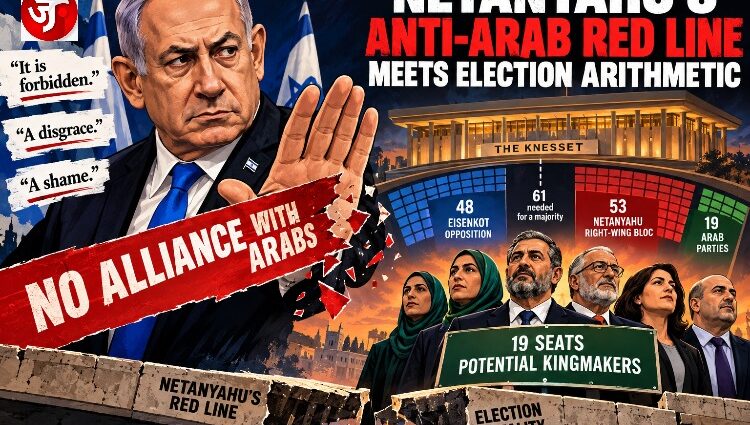
He called it a shame. He called it a disgrace. He declared it forbidden. But now the very Arab parties Benjamin Netanyahu has spent the election campaign attacking have emerged as the potential kingmakers in Israel’s political future.
Israel’s October 27 parliamentary election has delivered a result that neither Benjamin Netanyahu nor his principal challenger, former military chief Gadi Eisenkot, can easily navigate.
The final count has left Netanyahu’s right-wing and ultra-Orthodox bloc with 53 seats, Eisenkot’s opposition bloc with 48, and the Arab-led Joint List and Ra’am with a combined 19 seats in the 120-member Knesset.
A government needs 61 seats. The mathematics is brutally simple: neither major camp can form a government without attracting additional support. And the 19 Arab lawmakers could become decisive.
For Netanyahu, the irony is particularly striking. After making the exclusion of Arab parties a central political message, he now faces an election in which their parliamentary strength could determine whether he remains in power.
There is a theoretical possibility of a tactical change. A Fox News report quoted an analyst saying it was not inconceivable that Netanyahu might approach an Arab party, although such a move was considered highly unlikely. This is speculation, not evidence of negotiations. emerge as potential kingmakers
The more realistic possibility is an Eisenkot-led arrangement. Eisenkot has left the door open to cooperation with Arab parties under certain conditions. However, some of his potential coalition partners oppose such cooperation.
The political irony is even sharper. Netanyahu’s strategy appears to be to make Arab-party cooperation politically toxic for Eisenkot, rather than pursue it himself.
The words that may come back to haunt Netanyahu
In Netanyahu’s election-night address on October 28, Netanyahu did not leave much room for interpretation.
He declared:
“It is simply forbidden to endanger Israel and form a government that rests on anti-Zionist Arab parties.”
Netanyahu went further, describing the possibility of an alliance with Arab parties as a “shame and a disgrace”, accusing them of opposing Israel’s existence and attacking its soldiers.
This was not an incidental campaign remark. It was a political red line. Yet the election has produced precisely the arithmetic that makes that red line difficult for his opponents to maintain as well.
The Arab vote: From political exclusion to parliamentary power
The most consequential development is the unprecedented strength of Arab political representation. The Joint List won 11 seats, while Ra’am secured eight. Together, they have 19 lawmakers, almost twice their combined representation in the outgoing Knesset.
The turnout was approximately 77.9%, one of the highest recorded in decades. This is significant beyond the coalition arithmetic. Arab citizens of Israel, who make up roughly one-fifth of the country’s population, have demonstrated that their votes can shape the country’s political future.
The question now is whether Israel’s Jewish-led political establishment is prepared to recognise that parliamentary reality.
There is also a historical precedent. In 2021, Mansour Abbas’s Ra’am broke a longstanding political taboo by joining the coalition that brought Naftali Bennett and Yair Lapid to power. That government lasted just over a year.
The possibility of Arab parliamentary support is therefore not entirely without precedent. What is different now is the scale of the Arab parties’ representation and the political hostility surrounding the prospect of cooperation. AP News+1
Netanyahu’s counterattack: Allegations of a stolen election
Rather than accepting the political setback quietly, Netanyahu’s Likud has alleged that the election was stolen through fraud and intimidation involving Arab parties.
The allegations include claims of bribery, threats, forged documents, double voting and foreign interference allegedly involving Qatar. However, these remain allegations, not established findings.
Israel’s Central Elections Committee has said there is no basis to conclude that the election’s integrity was systematically compromised. The committee chairman has requested a Shin Bet investigation into suspected foreign influence, while the security agency has stressed that the inquiry does not establish wrongdoing by Arab voters as a community.
Qatar has denied involvement. The accusations have prompted Arab political leaders to accuse Netanyahu of attempting to delegitimise their voters and undermine their electoral gains.
Reuters reported on October 29 that Netanyahu’s attacks intensified as the possibility of an opposition government relying on Arab support became increasingly relevant.
Eisenkot faces his own political test
The opposition cannot simply celebrate Netanyahu’s setback. Gadi Eisenkot’s bloc has 48 seats. Even with all 19 Arab lawmakers behind it, the combined strength would be 67, comfortably above the 61-seat threshold.
But this is where the political complications begin. Several Jewish-led opposition parties have publicly ruled out entering a government with Arab parties. Netanyahu has repeatedly used that position to challenge Eisenkot’s legitimacy as an alternative prime minister.
Ra’am leader Mansour Abbas has also indicated that his party is not prepared to join a Netanyahu-led government under the current political circumstances. The emerging possibility is that Arab parties could support an opposition government from outside a formal coalition, or provide parliamentary backing on confidence votes. Whether such an arrangement can command sufficient political agreement remains uncertain.
The opposition must now decide whether its opposition to Netanyahu is strong enough to overcome its own reservations about Arab political cooperation.
What happens next?
- November 4: The election results are expected to be formally presented following certification.
- November 10: The newly elected Knesset is scheduled to be sworn in.
- Coalition negotiations: President Isaac Herzog will consult party leaders before deciding whom to invite to form a government.
- If negotiations fail: Israel could face another election, potentially early next year.
Netanyahu remains caretaker prime minister during the process. He could still seek support from smaller parties, persuade opposition lawmakers to defect or pursue a national unity arrangement.
The bigger story: Can Israel’s democracy accommodate its Arab citizens?
The deeper significance of this election lies beyond Netanyahu’s political survival. For years, Arab citizens have been part of Israel’s electorate but have frequently found themselves treated as outsiders in the country’s political calculations. Their representation has often been dismissed as politically unacceptable by major Jewish-led parties.
Now, 19 parliamentary seats have made that exclusion much harder to sustain. The election has exposed a contradiction at the heart of Israeli politics: parties can appeal to democratic representation when seeking votes, but what happens when those votes come from a community they have publicly sought to exclude from government?
Netanyahu’s immediate response has been to challenge the legitimacy of the Arab vote. But the larger political question cannot be dismissed through allegations that have yet to be substantiated.
Will Israel’s next government be determined by the votes of its elected representatives, or by political red lines that exclude an entire section of its electorate from meaningful participation?
Will Netanyahu have to eat humble pie?
Not necessarily by personally entering an alliance with Arab parties. In fact, his election-night speech suggests that he remains firmly opposed to such an arrangement.
But politically, he faces an uncomfortable reality: the parties he has sought to discredit now possess unprecedented parliamentary leverage.
And his challenger faces an equally difficult choice: cooperate with Arab lawmakers, negotiate outside support, or risk allowing Netanyahu another opportunity to govern.
The irony is difficult to miss.
JANPATH NEWS NETWORK (JNN)
Independent. Fearless. On the People’s Path.