









Spain mourns 69 victims after 2 high-speed trains collide in Toledo. Probe finds signal failure and a strange control-centre decision.
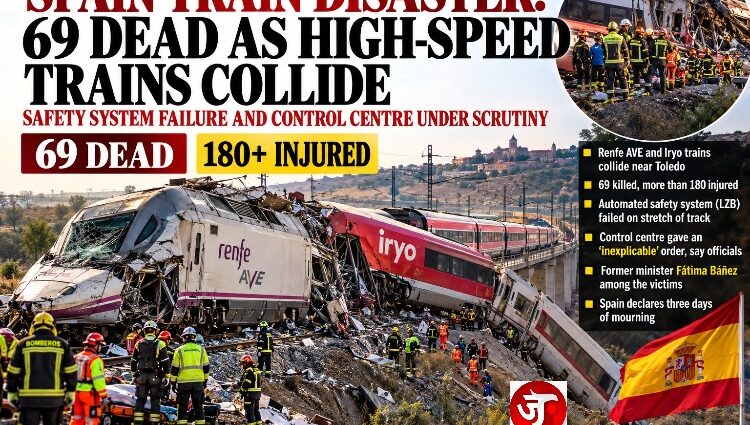
October 30, 2026: Spain is mourning one of the deadliest railway disasters in its modern history after two high-speed trains collided near Urda in the province of Toledo on October 28, killing at least 69 people and leaving more than 180 injured.
The catastrophic rear-end collision involving a state-operated Renfe AVE train and a privately operated Iryo service has raised grave questions about railway safety, signalling failures and decisions made inside the country’s central rail traffic control centre.
The accident occurred at approximately 8:53 am on the Madrid-Seville high-speed railway line. The Renfe train slammed into the rear of an Iryo train that had come to a standstill on the tracks. The impact sent several carriages off the rails, with some plunging down an embankment.
More than 500 passengers were travelling aboard the two trains, turning the stretch of railway into a massive emergency rescue site.
A chain of failures: How did the collision happen?
The investigation has increasingly focused on a failure of the German-designed LZB automatic train protection and signalling system.
According to preliminary information released by Transport Minister Óscar Puente, the system malfunctioned at around 8:30 am because of a computer communications failure, affecting a stretch of approximately 60 kilometres of track. Several trains were automatically brought to a halt.
At approximately 8:36 am, the central rail traffic control centre in Madrid reportedly authorised the Renfe AVE train to resume normal-speed operations, even though a red signal remained active.
The Iryo train, meanwhile, remained stationary after experiencing a transmission problem and the Renfe train subsequently travelled approximately 25 kilometres before crashing into it at around 8:53 am.
Puente described the control centre’s decision as “inexplicable”, saying investigators were examining why the train had been allowed to resume normal operations instead of following the restricted-speed procedure required when automatic safety systems fail.
The precise sequence of events, including the decisions and communications between controllers and train crews, remains under investigation. Euronews+2
Former minister Fátima Báñez among the dead
The tragedy has also claimed the life of former Spanish Employment Minister Fátima Báñez, 59, whose death was confirmed on October 29 by the Spanish employers’ organisation CEOE.
Báñez had been travelling aboard the Iryo train. She was serving as president of the CEOE Foundation at the time of her death.
Spain’s second major rail disaster in one year
The October collision comes just months after another devastating high-speed railway accident near Adamuz in Córdoba province on January 18, 2026, which killed 46 people.
The two disasters have intensified scrutiny of Spain’s railway safety infrastructure, particularly as the Madrid-Seville corridor has now witnessed two fatal high-speed rail accidents within the same year.
Prime Minister Pedro Sánchez has promised a thorough investigation, pledging that any negligence or failures in the safety system will be addressed.
He has also acknowledged that restoring public confidence in Spain’s high-speed rail network will require decisive action.
Three days of national mourning
Spain has declared three days of official national mourning, from October 29 to October 31. Flags are flying at half-mast across public buildings and other government institutions.
Rescue workers, emergency personnel and investigators have been working at the crash site, while families continue to mourn victims and seek answers about how such a catastrophic collision could occur on one of Europe’s established high-speed rail networks. Boletín Oficial del Estado+1
The disaster has moved beyond a railway accident investigation. It has become a major test of accountability and public confidence in the country’s transport infrastructure.
With a general election scheduled for November 29, the tragedy has also placed railway safety and government accountability firmly in the political spotlight.
One signalling failure. One disputed control-room decision. Two trains carrying hundreds of passengers. And 69 lives lost. Spain now faces a painful question: if a railway system built around sophisticated safety technology cannot prevent two high-speed trains from colliding, what went wrong in the chain of safeguards designed to protect human lives?
JANPATH NEWS NETWORK (JNN)
Independent. Fearless. On the People’s Path.