










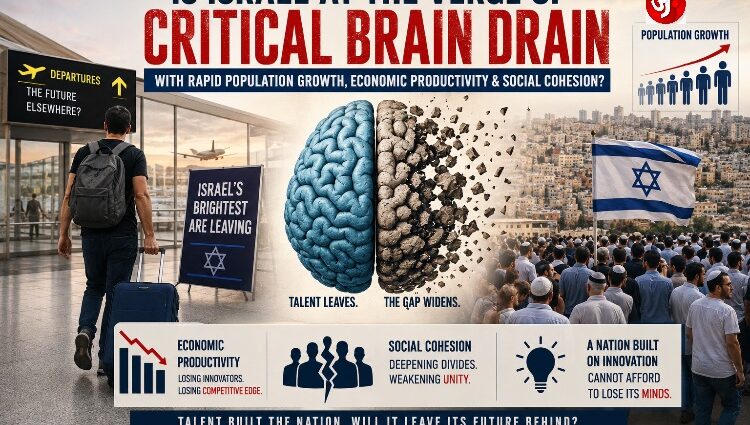
Israel is grappling with growing concerns over a potential brain drain as political, economic and demographic pressures fuel debate about the country’s long-term future.
Israel’s rapidly expanding Ultra-Orthodox (Haredi) population, characterised by high birth rates and lower workforce participation among many men, has intensified discussions over education, military service and economic productivity. These issues form the backdrop of Chris Kunzler’s video essay, Why Liberal Zionists Like Ethan Klein Hate Orthodox Jews and Why It Matters, which explores Israel’s deepening internal social and ideological divisions from the creator’s perspective.
At the heart of the debate lies a widening divide between Israel’s secular, highly educated workforce and its rapidly growing Ultra-Orthodox, or Haredi, population. The issue has increasingly become a source of political tension, economic concern and cultural conflict, extending far beyond disagreements over religion.
Israel’s population has surpassed 10 million and continues to grow at one of the fastest rates among developed economies. A significant driver of that growth is the Haredi community, where families commonly have six or more children. Demographers project that Ultra-Orthodox Jews could comprise roughly one-third of Israel’s population by the middle of the century if current fertility trends continue.
This remarkable growth has become one of the defining forces shaping Israeli politics and public policy.
Israel has earned the nickname “Start-Up Nation” because of its thriving technology sector, world-class universities and highly skilled workforce.
Yet economists warn that this success depends heavily on maintaining a large pool of educated, productive workers.
Many Haredi men devote years, and often decades, to full-time religious study rather than participating in the labour market. While workforce participation among Haredi women has increased substantially over recent years, male participation remains considerably below the national average.
Educational differences also contribute to the debate. Many Ultra-Orthodox schools devote most classroom time to religious studies and, in some cases, provide limited instruction in mathematics, science and English. Critics argue this leaves many graduates less prepared for employment in Israel’s increasingly technology-driven economy.
Supporters counter that preserving religious scholarship is central to Jewish identity and that growing numbers of Haredim are gradually entering higher education and professional careers.
Perhaps no issue illustrates Israel’s internal divisions more sharply than military service. Most Jewish Israelis are subject to compulsory military service. However, for decades many Haredi men have received exemptions while pursuing religious studies.
Following the October 7 attacks and the prolonged regional conflict that followed, public frustration over these exemptions has intensified. Many secular Israelis argue that national defence should be shared equally, while Ultra-Orthodox leaders maintain that Torah study provides a different but equally essential contribution to the nation’s survival.
The issue has repeatedly threatened governing coalitions and become one of the country’s most divisive political disputes.
Concerns About Brain Drain
Alongside demographic changes, Israel has experienced growing concern over the immigration of skilled professionals. Political polarisation, judicial reform disputes, security concerns and uncertainty created by prolonged conflict have prompted some scientists, entrepreneurs, academics and technology workers to relocate abroad or consider doing so.
While Israel continues to attract investment and retains a powerful innovation ecosystem, economists caution that sustained out-migration of highly skilled workers could reduce tax revenues, weaken productivity and place additional pressure on the country’s public finances.
Whether this amounts to a lasting “brain drain” remains debated. Some analysts see it as a temporary response to political instability, while others warn it could become structural if domestic tensions persist.
These questions recently resurfaced through online commentary and political discussion, including a video essay by commentator Chris Kunzler examining tensions between secular Israelis and Ultra-Orthodox Jews. Using comments by Ethan and Hila Klein as a starting point, the video argues that internal cultural divisions often provoke stronger reactions among some liberal Zionists than broader debates surrounding the Israeli-Palestinian conflict.
Israel’s challenge is not simply one of demographics but of integration.
The country possesses one of the world’s most dynamic economies, yet its future prosperity may increasingly depend on successfully integrating rapidly growing religious communities into higher education, the modern workforce and national service while respecting religious freedoms and cultural traditions.
For policymakers, the question is not whether Israel’s population will continue to grow. It almost certainly will. The more difficult question is whether economic productivity, educational attainment and social cohesion can grow at the same pace.
The answer may shape not only Israel’s economy but also its political stability and social fabric for decades to come.