









July 10, 2026 | Janpath News Network
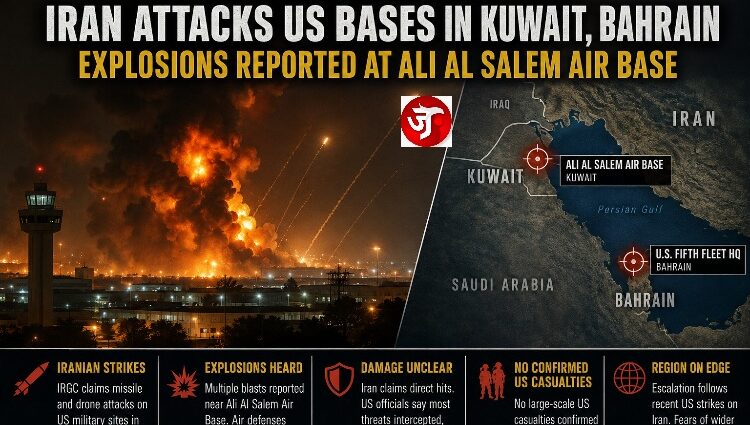
The Middle East edged closer to a wider regional war on Friday after Iran strikes a fresh wave of missile and drone attacks targeting American military installations in Kuwait and Bahrain, marking one of the most serious escalations since the latest round of US-Iran hostilities began. No confirmed deaths in the latest reported blasts at Ali Al Salem Air Base (July 2026 incidents).
Explosions were reported near Kuwait’s strategically vital Ali Al Salem Air Base, a key facility used by the United States Air Force, as air defence systems roared into action across the Gulf. Residents described hearing multiple blasts while warning sirens echoed across parts of Kuwait. Kuwaiti authorities later confirmed that defensive systems had intercepted several incoming aerial threats.
The strikes came just days after the United States carried out attacks on Iranian military targets, including installations reportedly linked to drone and missile operations in southern Iran. Tehran has presented Friday’s operation as direct retaliation.
In a statement, Iran’s Islamic Revolutionary Guard Corps (IRGC) claimed responsibility for coordinated missile and drone strikes against multiple US military positions across the Gulf. Iranian officials asserted that American facilities in Kuwait and Bahrain were successfully hit, describing the operation as a decisive response to what they called “US aggression.”
Those claims, however, remain contested.
American military officials maintain that most incoming missiles and drones were intercepted by layered air-defence systems, adding that preliminary assessments indicate limited damage and no confirmed large-scale casualties. Independent verification of the competing battlefield claims remains unavailable as the situation continues to unfold.
At the centre of the latest confrontation is Ali Al Salem Air Base, one of Washington’s most important military hubs in the Gulf. The installation supports surveillance, logistics, troop deployments and regional air operations, making it a critical pillar of American military strategy in the Middle East. Any successful strike against the base would carry significant military and political implications.
Kuwait now finds itself in an increasingly uncomfortable position. Although it is not a direct participant in the conflict, its role as host to thousands of American troops has placed it squarely within the expanding battlefield. The government has reinforced security, activated air-defence networks and heightened military readiness while attempting to prevent the conflict from spilling further onto Kuwaiti soil.
The latest exchange underscores how rapidly the regional confrontation has evolved.
What began as targeted military strikes has expanded into a dangerous cycle of retaliation stretching across the Gulf. American operations against Iranian military infrastructure have been met by Iranian missile and drone attacks targeting US positions in Kuwait, Bahrain and elsewhere in the region. Maritime security in the Strait of Hormuz remains under pressure, commercial shipping continues to face heightened risks, and regional governments have intensified security measures amid fears of further escalation.
For global markets, the implications extend well beyond the battlefield. The Gulf remains one of the world’s most critical energy corridors, and any sustained military confrontation threatens international oil supplies, shipping routes and economic stability. Even isolated attacks on military infrastructure have the potential to unsettle markets and deepen geopolitical uncertainty.
As Friday’s events unfolded, governments across the region remained on high alert while diplomats urged restraint. Yet the prospect of renewed negotiations appears increasingly distant as both Washington and Tehran continue to respond to military action with further military action.
For now, the fog of war remains as dense as ever. Explosions have been reported. Missiles have been fired. Air defences have been activated. But the full extent of the damage, and whether this latest confrontation marks another brief exchange or the opening chapter of a much broader conflict, has yet to become clear.
One thing, however, is beyond dispute: the Gulf has entered another perilous phase, and the margin for miscalculation is growing dangerously thin.