









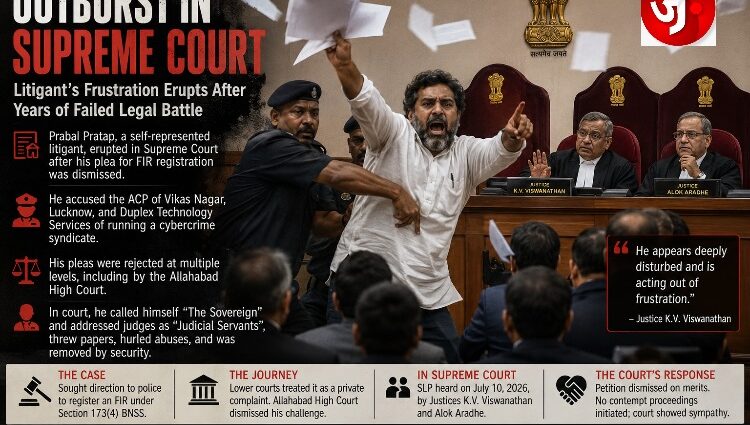
New Delhi, July 10: A dramatic and emotionally charged scene unfolded inside the Supreme Court on Friday when a self-represented litigant, Prabal Pratap, erupted in anger moments after the apex court dismissed his plea seeking the registration of an FIR against a senior police officer and a private company.
The extraordinary courtroom episode has drawn attention not only because of the outburst itself, but also because it appears to reflect the emotional toll of years of unsuccessful litigation and a prolonged sense of grievance.
Pratap had been pursuing legal action against the ACP of Vikas Nagar, Lucknow, and Duplex Technology Services, alleging that they were involved in a cybercrime syndicate. He had repeatedly sought directions for police to register an FIR. However, his application under the Bharatiya Nagarik Suraksha Sanhita (BNSS) was treated as a private complaint by the lower court rather than resulting in an FIR. His challenge before the Allahabad High Court also failed, prompting him to approach the Supreme Court through a Special Leave Petition.
A Bench comprising Justices K.V. Viswanathan and Alok Aradhe heard the matter on July 10 and ultimately dismissed the petition, finding no legal grounds to interfere with the earlier decisions.
What followed stunned those present in the courtroom.
Rather than advancing legal arguments, Pratap identified himself as “The Sovereign” and repeatedly addressed the judges as “Judicial Servants.” He attempted to instruct the Bench to order the registration of an FIR, declaring that the court should comply with his directions.
When Justice Viswanathan questioned whether he was attempting to order the court, the situation rapidly escalated. Pratap reportedly threw case papers into the air, shouted abusive remarks directed at the Chief Justice of India, and continued issuing commands before security personnel intervened and escorted him from the courtroom.
Despite the seriousness of the disruption, the Bench chose not to initiate contempt proceedings.
Instead, Justice Viswanathan observed that the litigant appeared to be deeply disturbed and acting out of frustration, indicating that the court viewed the episode through the lens of emotional distress rather than deliberate defiance. The judges opted for restraint instead of punishment.
The incident has also sparked discussion about the growing challenges faced by self-represented litigants who spend years pursuing legal remedies without success. Prolonged litigation, repeated judicial setbacks, and the belief that one’s grievances remain unheard can sometimes push individuals toward emotional breaking points.
Legal observers have also noted that Pratap’s references to himself as “The Sovereign” resemble fringe “sovereign citizen”-style beliefs seen in some countries, where individuals reject the authority of courts and public institutions. Such theories have no recognition under Indian law.
While the Supreme Court firmly rejected Pratap’s petition on legal merits, its measured response to his courtroom behaviour underscored an important judicial principle: maintaining the dignity of the court while recognising that, in some cases, anger and disruption may be symptoms of profound personal distress rather than mere contempt.
The episode serves as a stark reminder that behind many prolonged legal battles are individuals who may be struggling not only with the justice system, but also with the emotional burden of years spent seeking relief that never comes.