









In the vast and diverse landscape of India, education is often hailed as the great equalizer, a beacon of hope for millions of children aspiring to a better future. Yet, for countless school children in rural and remote areas, the path to school is not a straightforward commute but a daily odyssey fraught with physical dangers, natural obstacles, and systemic neglect. Unpaved roads, treacherous terrains, unreliable transport, and swollen rivers test their resolve. Nowhere is this more starkly illustrated than in the Himalayan regions of Uttarakhand, where children risk their lives crossing rivers on makeshift contraptions because bridges washed away years ago remain unrepaired.
Rural India presents a mosaic of challenges for young commuters. In many villages, “roads” are little more than dirt tracks that turn into muddy quagmires during the monsoon. Children trudge for kilometers through slush, carrying heavy school bags, their uniforms often soaked and shoes caked in clay. In flood-prone plains or hilly districts, these paths can become impassable, forcing detours or outright cancellation of classes. Public transport is sparse or nonexistent; overcrowded jeeps, shared autos, or rickety buses ply irregular routes on these unmade roads, sometimes leading to accidents. Many children walk or cycle, exposing themselves to traffic hazards, wildlife, and extreme weather.
Crossing rivers amplifies these hardships dramatically. During the dry season, children might wade through shallow streams or use temporary stepping stones. But when rivers are in full spate, swollen by heavy rains or glacial melt, the stakes rise perilously. Makeshift solutions like rope bridges, bamboo rafts, or hand-operated trolleys become the only lifeline. These are often fragile, weather-beaten, and terrifyingly inadequate for the volume of daily users.
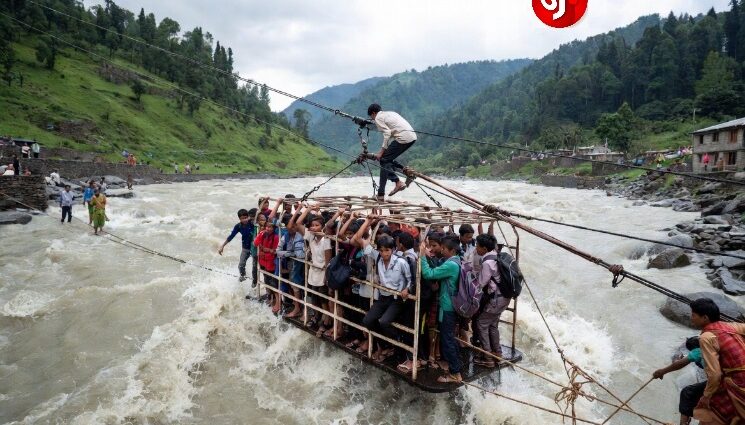
An example lies along the Ramganga River, the natural boundary between Bageshwar and Pithoragarh districts in Uttarakhand. A suspension bridge here collapsed in the devastating 2018 floods and has not been rebuilt despite years of appeals. In its place, authorities installed a manually operated rope trolley, a rudimentary wooden platform suspended on cables that villagers pull by hand. For over 100 schoolchildren (and sometimes more than 50 daily), this is the sole route to schools like the Government Inter College at Nachani in Pithoragarh.
Below, the river surges in full spate, its waters turbulent and unforgiving. Children clamber onto the trolley, often with parents or older siblings helping pull the ropes from either bank, especially when younger ones lack the strength. The contraption sways precariously, threatening to flip or snap at any moment. Even adults approach it with fear. A man had drowned at this spot years earlier when the trolley lost balance. Yet, the children persist. Seema, a Class 12 student, and her peers make this crossing daily, their lives literally hanging by a thread, all for the sake of education.
This is not an isolated incident. Similar stories echo across India: children in Assam navigating makeshift rafts, students in other Himalayan villages trekking narrow mountain paths, or groups in remote areas balancing on fallen logs or swimming across currents. A 2017 report highlighted numerous dangerous journeys worldwide, including in India, where the absence of basic infrastructure leads some children to drop out entirely.
theirworld.orgThese hardships reveal deeper issues. Infrastructure development lags in remote areas, despite government schemes like Sarva Shiksha Abhiyan or rural road programs. Monsoons exacerbate vulnerabilities, yet rehabilitation is slow. Safety concerns, drownings, injuries from trolleys or falls, are real, yet children’s determination shines through. Their resilience underscores a profound truth: education is not merely a right but a necessity they pursue against all odds.
The consequences extend beyond immediate risks. Exhausting commutes affect concentration, attendance, and health, particularly for girls who face additional safety concerns. In a country striving for inclusive growth, such barriers perpetuate cycles of poverty and inequality.Addressing this requires urgent action: rebuilding bridges like the one at Bhakuna, improving rural connectivity, providing safe school transport, and ensuring timely disaster recovery. Until then, the image of children braving a roaring river on a rickety trolley serves as a powerful reminder of their courage—and a call to bridge the gap between policy and reality.In the end, these young travelers embody the spirit of India’s aspiration. They cross not just rivers and muddy paths, but obstacles to a brighter tomorrow. It is time society and governance match their perseverance with concrete support.