








The Middle East has entered one of the most dangerous phases of the 2026 Iran war
By Janpath News Network – July 13, 2026
The Middle East has entered one of the most dangerous phases of the 2026 Iran war, as direct military exchanges between the United States and Iran spread across the Gulf, regional states scramble to defend their airspace, and the Strait of Hormuz emerges as the most consequential battlefield of the conflict.
What began as a direct confrontation involving the United States, Israel and Iran has evolved into a sprawling regional crisis. Missiles and drones are now crossing multiple national borders, American forces are striking targets along Iran’s southern coastline, Gulf states are intercepting incoming projectiles, and commercial ships are navigating one of the world’s most important waterways under the shadow of attack.
As of July 13, there is little sign of meaningful de-escalation.
Instead, the conflict increasingly resembles a dangerous cycle: an attack on shipping or American-linked interests is followed by US strikes on Iranian military infrastructure; Iran retaliates against US military facilities across the region; Gulf states activate their air defences; and the Strait of Hormuz becomes still more hazardous to commercial traffic.
The battlefield is no longer confined to Iran but to the Gulf itself.
Iran Under Fire, Iran Strikes Back
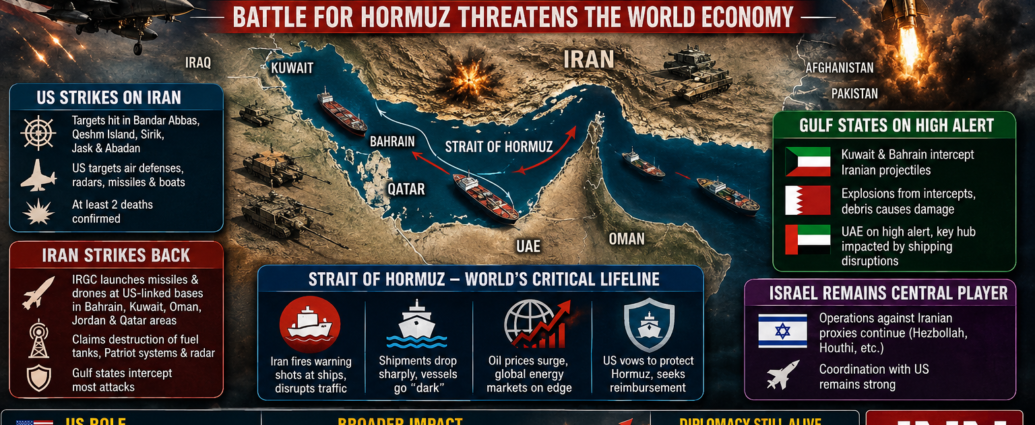
The United States has continued military operations against Iranian targets, particularly along Iran’s strategically important southern coastline. Explosions have been reported in and around areas including Bandar Abbas and Qeshm Island, while US operations have targeted Iranian air-defence systems, coastal surveillance infrastructure, missile and drone facilities, and naval assets.
US Central Command says its operations are intended to degrade Iran’s ability to threaten civilian mariners and commercial shipping in and around the Strait of Hormuz. CENTCOM has publicly listed repeated rounds of strikes against Iran throughout July, demonstrating that the campaign is no longer an isolated retaliation but an ongoing military operation.
Iran, however, has responded by widening the geographical scope of the conflict.
The Islamic Revolutionary Guard Corps has claimed attacks against US-linked military facilities across Bahrain, Kuwait, Jordan and Oman. Iranian authorities have also made claims of damage to American military infrastructure, including radar installations, fuel facilities and air-defence systems.
Some of those claims remain difficult to verify independently.
Governments across the Gulf have presented a different picture, reporting that many Iranian missiles and drones were intercepted before reaching their targets. Kuwait and other regional states have repeatedly activated air-defence systems, while falling debris from interceptions has itself created risks to civilians and infrastructure.
This distinction is crucial. In a conflict saturated with propaganda, dramatic claims of destroyed bases, shattered missile batteries and devastating attacks can circulate long before independent evidence emerges.
What is beyond dispute, however, is the expanding geography of the war.
Countries that are not formally at war with Iran are nevertheless becoming operational spaces in the conflict because they host American military forces, defence infrastructure or strategically important facilities.
The Gulf states are discovering an uncomfortable reality: hosting foreign military assets can turn supposedly secure territory into part of a regional battlefield.
The Strait of Hormuz: The War’s Most Dangerous Front
The greatest immediate threat to the wider world may not come from a missile striking a military base.
It may come from the narrow waters of the Strait of Hormuz.
Iran has asserted increasing control over shipping through the strategic waterway and has claimed that the strait is closed or subject to Iranian authorization. The United States disputes the idea that Tehran can control international passage and has continued military operations intended to protect commercial navigation.
The result is an extraordinary confrontation over who effectively governs one of the world’s most important maritime chokepoints.
Commercial shipping has already been severely affected. Tanker traffic has fallen sharply, some vessels have switched off their automatic identification systems, and shipping operators are increasingly adopting unusual routes and procedures to reduce their exposure.
Reuters reported on July 13 that tanker traffic through Hormuz had fallen to its lowest level in nearly two months, with only six tankers recorded transiting the waterway on Sunday. Some ships have effectively “gone dark” by switching off tracking systems, while others have explored alternative arrangements, including ship-to-ship transfers outside the most dangerous areas.
Iran says it is defending its sovereignty and responding to US military intervention. Washington says it is defending freedom of navigation.
Between those two positions sit the crews of commercial ships, energy companies, insurers and governments whose economies depend on the uninterrupted movement of oil and gas.
The Strait of Hormuz is therefore no longer merely a regional battlefield.
It is an economic pressure point capable of transmitting the consequences of war from the Persian Gulf to petrol pumps, factories and households thousands of kilometres away.
The United States: From Retaliation to Maritime Enforcer
Washington is now deeply embedded in the conflict.
US forces have conducted repeated strikes against Iranian military targets, including air defences, coastal radar installations, missile and drone infrastructure, and naval assets. American officials say these operations are intended to prevent Iran from attacking civilian ships and threatening international navigation.
President Donald Trump has gone further, portraying the United States as the power that will protect the Strait of Hormuz and suggesting that other countries benefiting from secure passage should help pay for that protection.
That position introduces another dimension to the conflict.
The United States is no longer presenting its role solely as retaliation against Iranian attacks. It is increasingly framing itself as the military guarantor of a global trade route.
Iran rejects that role.
Tehran views expanded US military activity around the strait as a challenge to Iranian power on its own doorstep. The more Washington attempts to enforce navigation, the more Iran may seek to demonstrate that the waterway cannot function normally without its cooperation.
This creates an exceptionally dangerous strategic contest.
The United States possesses overwhelming conventional military power. Iran, however, does not need to defeat the US military in a traditional battle to impose enormous costs. Mines, missiles, drones, fast boats, electronic disruption and attacks on vulnerable commercial vessels can generate fear and economic disruption far beyond their immediate physical damage.
The struggle for Hormuz is therefore deeply asymmetric.
America seeks to guarantee movement.
Iran needs only to make movement dangerous.
The Gulf States: Allies Caught in the Crossfire
For Bahrain, Kuwait, Qatar, Oman, Saudi Arabia and the United Arab Emirates, the conflict presents a profound dilemma.
Many Gulf states maintain close security relationships with Washington. Several host American military forces or strategically important facilities. At the same time, these countries have spent years attempting to reduce tensions with Iran and avoid becoming battlegrounds in a larger confrontation.
That balancing act is now under severe pressure.
Bahrain and Kuwait have reported intercepting Iranian projectiles, while governments across the region have strengthened their air defences and warned of threats to civilian safety.
The United Arab Emirates remains a particularly important regional actor. It has close security ties with the United States, normalized relations with Israel under the Abraham Accords, and serves as a major commercial, aviation and energy hub.
Even when not directly struck in a particular wave of attacks, the UAE cannot escape the economic consequences of a conflict centred on the Gulf. Shipping disruptions, insurance costs, investor anxiety and volatile energy markets spread across borders with considerably greater efficiency than diplomacy ever seems to manage.
The Gulf monarchies therefore face a nightmare scenario: they may not want a wider war, but geography and military alliances make neutrality increasingly difficult.
Israel Remains at the Centre of the Wider Conflict
Israel remains a central strategic actor even when it is not conducting the most visible operations on a particular day.
The current war traces back to the US-Israeli military campaign against Iran that began on February 28. The conflict has since expanded into a broader confrontation involving Iranian military forces, American forces, regional states and Iran-aligned armed groups.
Israel also continues to confront Iranian-linked forces elsewhere in the region, including Hezbollah in Lebanon, while the possibility of renewed direct Israeli strikes against Iran remains a constant factor in Tehran’s military calculations.
This creates a conflict with several overlapping layers.
There is the direct US-Iran war.
There is the longstanding Israel-Iran confrontation.
There are Iran-aligned armed groups operating across the region.
There are Gulf states attempting to defend themselves without becoming full participants.
And there is the maritime confrontation over the Strait of Hormuz.
Any one of these fronts could ignite another.
A War Fought With Missiles, Drones and Conflicting Narratives
One of the defining characteristics of this conflict is the difficulty of determining the true scale of battlefield damage in real time.
Iran announces successful strikes.
The United States announces the destruction of Iranian military capabilities.
Gulf governments announce successful interceptions.
Military footage appears online, often stripped of context.
Claims spread across social media before independent investigators can determine where a video was filmed, when an explosion occurred or what was actually hit.
The information war is therefore running almost as intensely as the military campaign.
For responsible reporting, claims by any combatant must be treated as claims until independently verified.
That does not mean nothing is known.
The broader picture is increasingly clear: the conflict is expanding geographically, the ceasefire that briefly raised hopes of de-escalation has effectively collapsed, commercial shipping is under severe pressure, and military forces across the region are operating at heightened readiness.
The Economic Shock Is Already Spreading
The consequences are no longer confined to military maps.
Oil prices rose sharply on July 13 as renewed US-Iran attacks intensified fears over supplies moving through the Strait of Hormuz. Commercial tanker traffic has slowed dramatically, while uncertainty over the security of the waterway is forcing markets to calculate the possibility of prolonged disruption.
The psychological effect can be almost as powerful as an actual blockade.
Oil traders do not need every tanker to be stopped. Shipping companies do not need every vessel to be attacked. Insurers do not need every route to become impossible.
They merely need the risk to become high enough.
Once that happens, insurance premiums rise, shipping schedules change, energy prices increase and inflationary pressure spreads through the global economy.
A missile fired in the Gulf can therefore eventually appear as a higher fuel bill in India, Europe, Africa or East Asia.
This is why Hormuz matters far beyond the Middle East.
Despite the escalating violence, diplomatic channels have not completely disappeared.
Iran and Oman have discussed arrangements for the safe passage of ships, while Qatar has also played a mediating role. Washington and Tehran have continued to send conflicting signals about negotiations even as their armed forces exchange attacks.
The contradiction is striking but not unusual.
Wars often produce the surreal spectacle of governments bombing one another while diplomats continue talking in another room.
The difficulty is that the central disagreement is no longer simply about one attack or one military installation. It concerns the future security architecture of the Gulf. Questions churn such as who controls access to the Strait of Hormuz? Can Iran restrict shipping? Can the United States enforce passage militarily?
These are not questions easily settled by a temporary pause in fighting.
For now, Iran appears determined to demonstrate that military pressure on its territory will carry consequences across the Gulf. The United States appears equally determined to prevent Tehran from controlling or closing the Strait of Hormuz.
Neither side wants to appear to retreat and this is precisely what makes the situation so dangerous.
A Region at War, a World Watching Hormuz
As of July 13, 2026, the Middle East stands at a precarious crossroads.
Iran remains under sustained military pressure but retains the ability to retaliate across a wide geographical area.
The United States possesses overwhelming firepower but faces the enormous challenge of protecting dispersed military installations and commercial shipping simultaneously.
Gulf states are intercepting incoming threats while desperately trying to prevent their territories from becoming permanent battlefields.
Israel remains central to the strategic confrontation with Iran.
And at the centre of everything lies the Strait of Hormuz: a narrow passage through which the economic consequences of war can travel to the entire world.
The conflict is no longer simply about who can destroy more military targets.
It is about who can control escalation, and so far, nobody appears to be succeeding.
And in the Middle East, where wars have an unfortunate habit of becoming larger than the people who start them, the next strike may matter far more than the last.
JANPATH NEWS NETWORK (JNN)
Independent. Fearless. On the People’s Path.