








Startling Glimpse Into Manmohan Singh’s UPA-Era Struggles
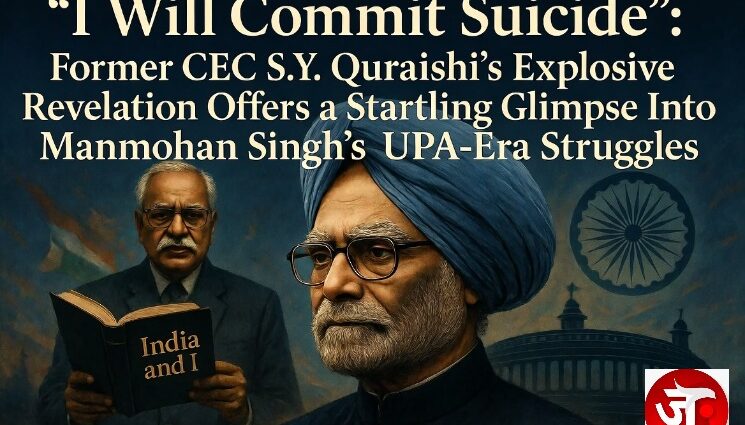
New Delhi, July 13, 2026: A startling recollection by former Chief Election Commissioner Dr. S.Y. Quraishi has reopened debate over the political pressures surrounding former Prime Minister Dr. Manmohan Singh during the turbulent UPA-2 years.
In his new book, India and I: A Hundred Memories, Not a Memoir, Quraishi reportedly recounts a dramatic 2012 conversation with the then-prime minister in which Singh allegedly told him:
“If that is what you think, I will commit suicide.”
The extraordinary remark, according to Quraishi’s account, came amid tensions between the Election Commission and members of the Union government during the fiercely contested 2012 Uttar Pradesh Assembly elections.
The statement was apparently not meant as a literal declaration of intent, but as an anguished and dramatic response during a tense conversation. Even so, the recollection offers a striking glimpse into the pressures confronting Singh at the height of the UPA government’s political troubles.
The controversy reportedly centred on remarks made during the Uttar Pradesh election campaign by then Union Law Minister Salman Khurshid concerning an increase in the quota for minorities.
The Election Commission objected to the remarks and accused Khurshid of violating the Model Code of Conduct. The confrontation soon escalated as senior political figures publicly criticised the Commission, prompting Quraishi, then Chief Election Commissioner, to raise his concerns directly with the prime minister.
According to Quraishi’s recollection, Singh listened to his concerns and assured him that the attacks on the Election Commission would stop. It was during this emotionally charged exchange that the prime minister allegedly made the now startling remark.
The account is likely to revive one of the most fiercely contested debates surrounding the UPA years: how much authority did Manmohan Singh truly exercise over his own government?
Singh was widely respected for his personal integrity, scholarship and role in India’s economic transformation. Yet throughout his second term as prime minister, critics repeatedly portrayed him as a leader constrained by coalition pressures, powerful cabinet colleagues and the Congress party leadership.
Political opponents frequently alleged that the real centre of power lay outside the Prime Minister’s Office, particularly with Congress president Sonia Gandhi and the party’s senior leadership. Congress leaders and Singh’s supporters, however, have long rejected the simplistic portrayal of him as merely a figurehead.
Quraishi’s recollection does not, by itself, settle that historical debate. But it provides a dramatic personal account of a prime minister apparently frustrated by the political and institutional tensions surrounding his government.
More than a decade after the UPA lost power in 2014, the episode is certain to fuel renewed political arguments over one of the most controversial periods in recent Indian history.
For Singh’s admirers, the story may reveal the human burden carried by a restrained and deeply private prime minister navigating an extraordinarily difficult political environment.
For his critics, it may reinforce the charge that the head of the government was unable to fully control ministers or the wider political machinery operating around him.
Either way, the alleged remark is a powerful reminder that behind the carefully controlled language of government and politics often lies a far more turbulent reality.
Dr. Manmohan Singh, who served as prime minister from 2004 to 2014, died on December 26, 2024, at the age of 92. He is therefore unable to respond to Quraishi’s newly published recollection.
Quraishi’s book is presented not as a conventional political memoir but as a collection of personal memories from a long career spent at the heart of Indian public life.
Among those hundred memories, however, this one may prove among the most politically consequential.
A single sentence, recalled years later, has once again opened a window into the tensions, frustrations and hidden struggles behind the closed doors of power during the UPA era.
JANPATH NEWS NETWORK (JNN)
Independent. Fearless. On the People’s Path.