








JNN’s Nightly News Roll
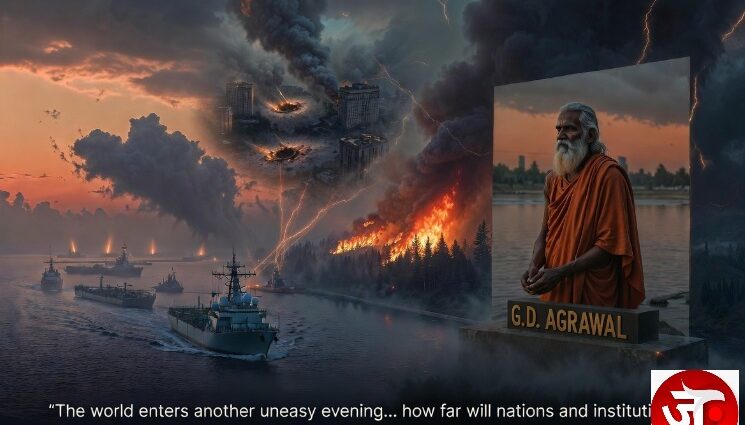
July 13, 2026: From the contested waters of the Strait of Hormuz to the burning forests of Europe, from missile-scarred Kyiv to the enduring memory of an Indian scientist who gave his life for the Ganga, the world enters another uneasy evening confronted by crises that appear different on the surface but are bound together by a deeper question: how far will nations and institutions allow danger to grow before decisive action becomes unavoidable?
At the centre of the global storm is the rapidly escalating confrontation between the United States and Iran.
Fresh exchanges of strikes have sharply intensified the conflict, while a dangerous struggle for control of the Strait of Hormuz has placed one of the world’s most strategically important waterways at the heart of the confrontation. The United States has carried out strikes against Iranian military targets, while Iran has responded with attacks of its own and asserted authority over the strait. With a significant share of the world’s oil supplies historically passing through the narrow waterway, every missile launch and every threat to shipping now carries consequences far beyond the Middle East. Oil prices, maritime trade and global economic confidence are all increasingly exposed to the crisis.
The latest violence threatens to unravel already fragile efforts to contain the war. The Strait of Hormuz, once primarily a symbol of strategic vulnerability, has now become an active arena of confrontation, with Washington and Tehran making competing claims over security and control while commercial shipping faces growing uncertainty.
The conflict unfolds against the profound political upheaval created by the death of Iran’s longtime Supreme Leader, Ayatollah Ali Khamenei, earlier in the 2026 war. The leadership transition and the struggle to project continuity have added another layer of uncertainty to a country simultaneously confronting military attacks, international pressure and questions over its nuclear future.
And it is precisely on the nuclear question that France has now drawn a hard line. French Foreign Minister Jean-Noël Barrot has declared that sanctions relief cannot come while Iran continues its nuclear programme, ballistic missile programme and activities that Paris considers destabilising to the wider region. The position places France firmly among those demanding fundamental changes from Tehran before economic pressure can be eased.
Military tensions are rising, the Strait of Hormuz is again a flashpoint, and the nuclear issue remains embedded at the heart of any possible diplomatic settlement.
Elsewhere, another kind of emergency is unfolding.
Europe is battling extreme heat and devastating wildfires. A major blaze near the historic Fontainebleau forest south-east of Paris has forced evacuations, disrupted transport and brought firefighting aircraft into action, while Spain has also suffered deadly fires amid scorching temperatures and dangerously dry conditions. The crisis has once again exposed the growing vulnerability of communities, forests and infrastructure to increasingly severe heat.
In Ukraine, the war continues its relentless rhythm of destruction, with Russian missile and drone attacks striking Kyiv and other targets. The conflict, now long removed from the shock of its opening days, continues to extract its toll through repeated bombardments, civilian deaths and the slow exhaustion of a country forced to live under the constant possibility of another attack.
In Bangkok, tragedy has taken another form, with a catastrophic pub fire killing at least 27 people and leaving others critically injured, another reminder of how quickly an ordinary night can become a scene of unimaginable loss.
Yet amid the wars, fires and geopolitical confrontations dominating the headlines, India carries the memory of a very different struggle, one fought not with missiles or armies, but with the body and conscience of a single man.
Professor G.D. Agrawal, later known as Swami Gyan Swaroop Sanand, was a respected environmental engineer, former professor at IIT Kanpur and one of India’s most uncompromising voices for the protection of the Ganga. On June 22, 2018, he began an indefinite fast demanding stronger and legally binding protection for the river. His demands included a dedicated law to safeguard the Ganga and action against projects and activities he believed were damaging its natural flow and ecological health. For 111 days, he continued his protest. On October 11, 2018, at the age of 86, G.D. Agrawal died after his prolonged fast.
His death was not simply the end of a protest. It was the final act of a man who had placed his own life behind an environmental warning he believed the country could no longer afford to ignore.
The Ganga is more than a river in India. It is a source of water, livelihood, agriculture, faith, culture and identity for hundreds of millions of people. Yet its survival has long been threatened by pollution, untreated waste, industrial pressure, construction and the competing demands of development.
Agrawal understood that contradiction perhaps more painfully than most. A scientist by training and a spiritual seeker by choice, he stood at the meeting point of data and devotion. He did not argue merely that the Ganga was sacred. He argued that a sacred river could not survive on reverence alone.
His 111-day fast remains one of the most poignant chapters in India’s environmental movement. It also raises an uncomfortable question about public attention: why must a person sometimes approach death before society begins to listen?
Years later, his sacrifice still speaks.
It speaks whenever a river is treated as an economic resource without being recognised as a living ecological system. It speaks whenever environmental protection is postponed in the name of immediate convenience. And it speaks whenever those warning of long-term catastrophe are dismissed because their message is less urgent to the news cycle than the crisis that eventually proves them right.
From the Strait of Hormuz to the Ganga, the scale of the struggle may be different, but the underlying lesson is hauntingly similar.
The world is increasingly living with the consequences of warnings ignored, compromises delayed and problems allowed to deepen until they become emergencies.
In the Middle East, the price may be war and global economic disruption; in Europe, it may be forests consumed by flames and communities driven from their homes; in Ukraine, it is measured in shattered buildings and lives lost under another night of missiles, and in India, it is remembered in the story of an 86-year-old professor who fasted for 111 days because he believed a river was worth saving, even at the cost of his own life.
Tonight, the world is not short of warnings. The real question is whether anyone is prepared to listen before the next warning becomes another tragedy.
JANPATH NEWS NETWORK (JNN)
Independent. Fearless. On the People’s Path.