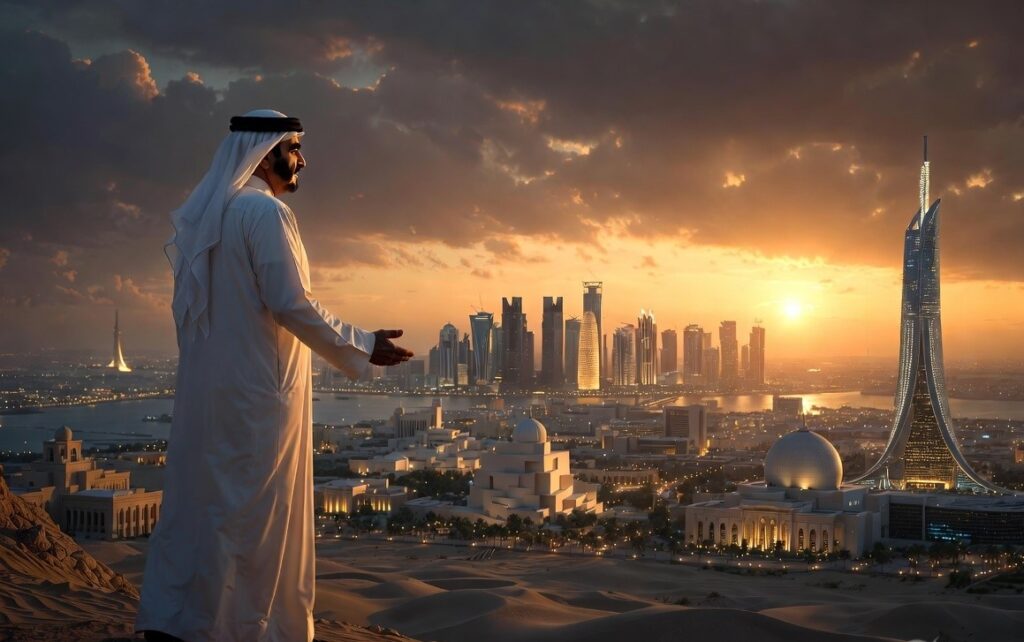









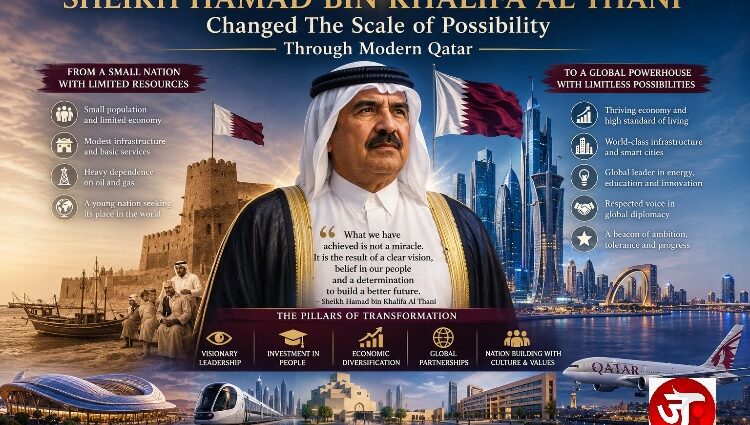
The world remembers a strategist, a moderniser, a controversial and consequential statesman in Sheikh Hamad bin Khalifa, but his greatest monument is not a palace, a tower or a statue. It is modern Qatar itself.
Doha, July 14, 2026: Some rulers inherit nations. A rare few reinvent them. His Highness Sheikh Hamad bin Khalifa Al Thani belonged to the latter category.
With his passing in Doha on Sunday, July 12, 2026, at the age of 74, Qatar has lost the man widely regarded as the architect of its modern rise, while the wider world has lost one of the most consequential and unconventional Arab leaders of the modern era.
Sheikh Hamad ruled Qatar from 1995 to 2013. In those 18 extraordinary years, he transformed a small Gulf state, once little known beyond the region, into an energy giant, a financial power, a diplomatic mediator, a global media centre, an educational hub and one of the most influential small nations on Earth.
He did not enlarge Qatar’s territory, but enlarged its reach, making the world pay attention to a nation whose size might otherwise have condemned it to the margins of international affairs.
That was the remarkable achievement of Sheikh Hamad bin Khalifa Al Thani: he understood that in the modern world, power is not measured by geography alone. It can be built through energy, ideas, institutions, diplomacy, education, investment and the courage to think beyond the limits imposed by size.
Born in Doha on January 1, 1952, Sheikh Hamad was educated in Qatar before attending the Royal Military Academy Sandhurst in Britain. He rose through the ranks of Qatar’s armed forces and was appointed heir apparent in 1977.
On June 27, 1995, he assumed power from his father, Sheikh Khalifa bin Hamad Al Thani, in a bloodless palace coup while the latter was abroad. It was a dramatic beginning to an even more dramatic era.
The Qatar Sheikh Hamad inherited was wealthy in potential but had not yet become the global force the world knows today. Beneath its desert and offshore waters lay enormous natural wealth. Its geographical position placed it in one of the most strategically sensitive regions on Earth. Yet resources and geography alone do not create greatness. Many nations possess riches. Far fewer possess the vision to convert those riches into lasting national power. Sheikh Hamad did.
He looked at Qatar and saw not a small state trapped by its size, but a nation liberated by its possibilities.
He innovatively turned gas into national power where at the centre of Qatar’s transformation was the North Field, the immense natural gas reservoir that would become the foundation of the country’s economic revolution. Under Sheikh Hamad, Qatar accelerated the development of liquefied natural gas on a scale that fundamentally altered the country’s destiny. Within little more than a decade, Qatar emerged as a dominant force in the global LNG market.
The revenues were enormous. But Sheikh Hamad’s deeper achievement was not simply that Qatar became rich.
It was what Qatar did with that wealth: Check it out: The country invested in infrastructure, education, healthcare, aviation, culture, international finance and global assets. Doha began its astonishing transformation from a relatively modest Gulf capital into one of the most recognisable modern cities in the world.
Skyscrapers rose along the waterfront. New institutions appeared. Global businesses arrived. Qatar Airways expanded its international reach. Museums, universities, research centres and sporting facilities became part of a larger national project.
In 2005, the Qatar Investment Authority was established to invest the country’s wealth internationally and secure prosperity beyond the age of hydrocarbons. Over time, Qatari capital would become visible across the world, from European financial institutions and major corporations to landmark properties, infrastructure and sport.
Qatar was no longer merely exporting gas but buying influence, building relationships, diversifying its future and placing itself inside the economic architecture of the wider world.
Sheikh Hamad understood something that many resource-rich states learn too late: wealth buried beneath the ground is temporary. Wealth transformed into institutions, knowledge and strategic influence can outlive generations.
His Greatest Creation was Al Jazeera – Bring forth the Revolution of the Arab Airwaves: Launched in 1996, the Doha-based television network disrupted the traditional landscape of Arab broadcasting. At a time when much of the region’s media remained tightly controlled, formal and cautious, Al Jazeera brought argument, confrontation, competing viewpoints and uncomfortable questions into millions of homes.
It was controversial from the beginning. Governments were angered. Diplomats complained. Critics accused it of bias. Supporters praised it for breaking taboos. But nobody could ignore it. That was precisely the point!
Through Al Jazeera, a small Gulf state acquired something no army could have purchased: a global voice.
After the attacks of September 11, 2001, the wars in Afghanistan and Iraq, and later the upheavals of the Arab Spring, the network became one of the most recognised media organisations in the world.
Suddenly, events across the Middle East were not being interpreted only from Washington, London, Paris or other traditional centres of global media power. Doha had entered the conversation. For Qatar, Al Jazeera became an extraordinary instrument of soft power. For the Arab media landscape, it was a rupture from the past. For Sheikh Hamad, it was proof of a larger philosophy: a small nation could become globally significant if it created institutions the world could not afford to ignore.
This tiny state spoke to the world: Sheikh Hamad also transformed diplomacy into a form of national power.
Qatar cultivated close security ties with the United States while maintaining channels with Iran. It engaged with Western governments while speaking to political movements and armed groups that others could not or would not approach. It positioned itself as a mediator in disputes across the Middle East and beyond. Call it diplomacy based on access, not on ideological purity.
Qatar’s strength increasingly came from its ability to speak to people who refused to speak to one another.
In a region often divided into hostile camps, Doha sought room between them.
That strategy was risky and frequently controversial. Qatar’s relationships and regional alignments sometimes angered its neighbours and attracted criticism from allies. Yet the underlying logic was unmistakable: a small country surrounded by larger powers could not dominate through military force. It had to become useful.
Interestingly, Sheikh Hamad made Qatar useful to competing sides, building usefulness, in international affairs, can become a formidable form of power.
Yet perhaps the most profound part of Sheikh Hamad’s legacy lies not in gas terminals, skyscrapers or foreign investments, but in education. In 1995, Sheikh Hamad and Sheikha Moza bint Nasser established the Qatar Foundation for Education, Science and Community Development. From that vision emerged Education City, an ambitious intellectual centre that brought branches of major international universities to Doha and sought to make Qatar a centre for learning, research and innovation.
The symbolism was powerful – A country whose prosperity had risen from beneath the earth was investing in what could be created inside the human mind. Universities, research institutions, scientific programmes and scholarship opportunities became part of a deliberate attempt to prepare Qatar for a future in which natural resources alone would not be enough.
Sheikh Hamad appeared to understand a fundamental truth of history: oil wells empty, gas fields eventually decline, buildings age and financial markets fluctuate. Human knowledge is the one national resource capable of renewing itself.
The physical transformation of Qatar during Sheikh Hamad’s reign was extraordinary. A reimaged Qatar put it on the global map where Doha’s skyline became a symbol of the new nation. Cultural institutions such as the Museum of Islamic Art projected a confidence rooted not only in modernity but in civilisation and heritage.
Sport became another pillar of Qatar’s global strategy.
The country hosted major international competitions, including the 2006 Asian Games, and in 2010 won the right to host the 2022 FIFA World Cup. The decision was historic. For the first time, football’s greatest tournament would be held in the Arab world.
The World Cup bid reflected the same philosophy that had driven much of Sheikh Hamad’s rule: Qatar would not wait for the world to discover it. Qatar would create reasons for the world to come.
This little country used aviation, sport, culture, media, diplomacy, education and investment as interconnected instruments of national influence to grow to a global power: Each entity strengthened the others.
See his chain: A global airline brought people to Doha. Global sporting events gave them a reason to come. International media gave Qatar a voice. Energy gave it economic strength. Investment gave it international stakes. Diplomacy gave it relevance. Education gave it a future. This was not a collection of isolated projects, but a national strategy.
Then, in June 2013, Sheikh Hamad did something almost as remarkable as his rise to power.
He voluntarily abdicated. At the age of 61, he handed authority to his son, Sheikh Tamim bin Hamad Al Thani, in a carefully managed and peaceful transition: In a region where rulers often remain in office until death or removal, the decision was striking.
Sheikh Hamad had seized power in 1995 because he believed Qatar needed a different future. Eighteen years later, he stepped aside because he believed that future required a new generation and the transformation continued under Sheikh Tamim, but the foundations had been laid.
The Qatar that hosted the 2022 FIFA World Cup, mediated in international crises, invested billions across continents and remained central to global energy security was, in profound ways, the Qatar Sheikh Hamad had imagined decades earlier.
His legacy was not without controversy: Sheikh Hamad’s era was accompanied by serious questions and controversies.
Qatar faced international criticism over the treatment of migrant workers and the kafala labour system. Questions persisted over political freedoms and the limits of domestic dissent. Al Jazeera, celebrated by many as a revolutionary media force, was also accused by critics of selective editorial standards. Qatar’s relationships with political movements across the region repeatedly generated controversy and suspicion.
Modernisation did not mean democratisation in the Western sense. Qatar remained a hereditary monarchy.
These contradictions are part of the historical record, but history must also measure scale.
And on that scale, Sheikh Hamad’s transformation of Qatar was extraordinary.
On July 12, 2026, the life of Sheikh Hamad bin Khalifa Al Thani came to an end. But the Qatar he helped create remains. It stands in the towers of Doha and the universities of Education City, visible in LNG ships crossing the oceans and in Qatari investments embedded in the global economy, heard through international media and seen in stadiums that welcomed the world.
.
Sheikh Hamad bin Khalifa Al Thani changed its scale of possibility. The world remembers a strategist, a moderniser, a controversial and consequential statesman, and the architect of one of the most remarkable national transformations of the modern age. His greatest monument is not a palace, a tower or a statue. It is modern Qatar itself.
JANPATH NEWS NETWORK (JNN)
Independent. Fearless. On the People’s Path.
Picture this!