










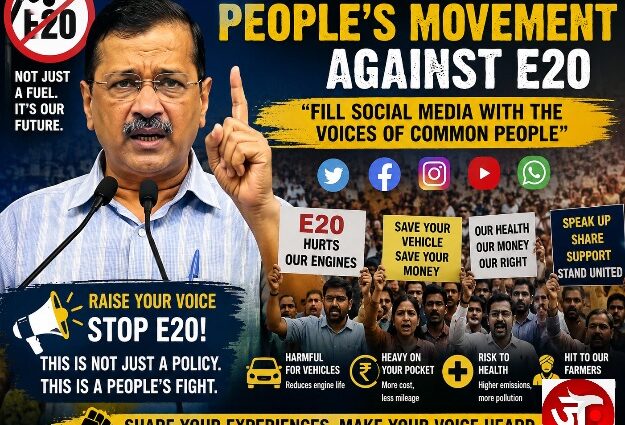
A new battle over India’s fuel policy is moving from government offices and courtrooms to petrol pumps, service centres and social media.
Aam Aadmi Party leader Arvind Kejriwal has called upon citizens across India to speak publicly about their experiences with E20 petrol, urging those who believe they have suffered reduced mileage, higher running costs or vehicle-related problems to record their stories and share them online.
“Yesterday, I wrote a letter to the Prime Minister,” Kejriwal said in a public appeal. “Let us together raise our voice against E20.”
“My appeal to all workers and leaders of the Aam Aadmi Party is that everyone should step out of their homes and go to petrol pumps and service stations,” he said. “There, talk to people, make videos, and share them on social media.”
His appeal extends beyond his own political party.
“All those people in the country who are unhappy with E20 should make their own videos and post them on social media,” Kejriwal urged. “The government is not going to listen like this. We have to fill the entire social media with the voices of common people to put pressure on them.”
The campaign strikes at the heart of a rapidly growing national controversy: Was India’s transition to E20 petrol too fast, and were millions of vehicle owners given enough information, protection and choice?
What exactly is E20?: E20 is petrol blended with 20 percent ethanol and 80 percent petrol. Ethanol can be produced from feedstocks including sugarcane and maize, and the Indian government has promoted ethanol blending as an important part of its strategy to reduce dependence on imported crude oil, support domestic agriculture and lower certain emissions.
India reached the 20 percent ethanol-blending target in 2025, five years ahead of the original 2030 target under the National Policy on Biofuels. That achievement has been presented by the government as a major success in energy security.
But the speed of the transition has also created a fundamental question: What happens to the enormous number of vehicles already on Indian roads that were designed, manufactured or sold before E20 became the national standard?
That is where the debate becomes more complicated. The government maintains that E20 is scientifically tested and that the overall benefits of the ethanol-blending programme outweigh its disadvantages. It has acknowledged that some vehicles may experience a reduction in fuel economy, while arguing that the impact is generally limited.
Many motorists, however, say their experiences are different.
Across India, vehicle owners have taken to social media to complain about lower mileage, increased fuel consumption, rougher performance and concerns about the possible long-term effects of higher ethanol content on older fuel systems.
These experiences are not uniform, and not every mechanical problem reported by a vehicle owner can automatically be blamed on E20. Vehicle age, maintenance, engine design, traffic, driving style, fuel quality and mechanical faults can all affect mileage and performance.
But that does not make the public concern irrelevant.
It makes independent investigation more necessary.
The mileage question: One of the central complaints against E20 is simple: ethanol contains less energy per litre than petrol. That means a higher ethanol blend can, depending on the vehicle and its engine calibration, result in some reduction in fuel economy. The government has acknowledged the possibility of a modest mileage penalty in some vehicles.
For an individual motorist, even a seemingly small percentage can matter.
A person driving hundreds or thousands of kilometres every month does not experience a mileage reduction as an abstract percentage in a government report. He experiences it at the petrol pump, in the family budget and in the number of times he must refill the tank.
This is especially important in India, where motorcycles, scooters and small cars are not luxuries for millions of families. They are the machinery of everyday survival. They take workers to offices, children to school, carry shopkeepers, delivery workers, sales representatives and small entrepreneurs through their working day.
If fuel efficiency falls, the cost is not absorbed by a statistic.
It is paid by the citizen.
A 2026 LocalCircles survey found widespread concern among vehicle owners about mileage and the effects of E20, particularly among owners of older vehicles. Such surveys are based on self-reported experiences and therefore should not be treated as laboratory tests, but the scale of public dissatisfaction cannot simply be dismissed as internet noise.
When thousands of people begin asking the same questions, a responsible government should answer them with transparent data.
The viral cases and an important warning: The E20 controversy has also produced dramatic viral claims.
One widely discussed case involved YouTuber Sourav Joshi, who initially linked a severe mileage problem in his Mercedes-Benz GLC to E20 petrol. The claim spread rapidly and became part of the national debate.
But the case also demonstrated why individual stories must be investigated carefully. Mercedes-Benz said its BS-VI petrol vehicles sold in India were E20-compatible, and subsequent reporting indicated that the particular vehicle’s problem was not established to have been caused by E20 alone.
That distinction is crucial. The campaign against compulsory E20 should not depend on exaggeration. It does not need to.
The legitimate questions are serious enough:
What happens to older vehicles? Which exact models are fully compatible with E20, and which are merely capable of running on it with possible compromises” Who bears the cost if fuel-system components deteriorate? Are consumers being given adequate warnings? Why should motorists who do not want E20 be denied an alternative? And if E20 provides lower energy per litre than conventional petrol, should its pricing reflect that difference?
These questions deserve technical answers, not slogans from either side.
The greatest issue may be the absence of choice
For many critics, the deepest objection is not simply that E20 exists.
It is that consumers increasingly feel they have no meaningful alternative. A transition affecting millions of machines purchased over many years is not the same as introducing a new smartphone charger. Cars and motorcycles are expensive assets. Families often save for years to buy them and keep them for a decade or longer.
A government may decide that the country must move toward cleaner or more domestically produced fuels. But a national transition should also account for the property already owned by citizens.
If a person owns a vehicle designed primarily around E10 or a lower ethanol blend, should that person not have access to an appropriate fuel? Why not clearly labelled choices at petrol pumps? Why not E20 for vehicles designed and optimised for E20, while retaining another suitable grade for motorists who own older vehicles or prefer a lower ethanol blend?
Consumer choice is not an attack on environmental policy.
It is a safeguard against forcing the cost of a national transition onto people who had no role in designing that transition.
This is why Kejriwal’s latest appeal is politically significant: He is asking AAP workers and ordinary citizens to go directly to the places where the effects of fuel policy are experienced: petrol pumps and service centres, talk to drivers, mechanics, two-wheeler owners, taxi drivers, people who drive old cars and new cars, and record their experiences.
Document the vehicle model, year of manufacture, previous mileage, current mileage and any diagnosed mechanical problems. And then place those voices before the country.
If carried out responsibly, such a campaign could create something India badly needs: a vast public record of real-world experiences with the E20 transition.
But the key word must be responsibly.
A video should distinguish between suspicion and proof. If a mechanic believes E20 caused damage, the evidence should be shown. If mileage has fallen, the comparison should be documented over multiple tankfuls under reasonably similar driving conditions. If a vehicle is E20-compatible, that fact should also be acknowledged.
The E20 controversy should not become another political shouting match in which one side declares the fuel a national miracle and the other declares it the destroyer of every engine in India.
Citizens deserve better than competing absolutes.
The debate over E20 is no longer only about ethanol in petrol, rather whether ordinary Indians were adequately consulted, adequately informed and adequately protected during one of the biggest changes to the fuel they use every day. And until those questions are answered convincingly, the voices demanding answers are unlikely to become quieter.
JANPATH NEWS NETWORK (JNN)
Independent. Fearless. On the People’s Path.