










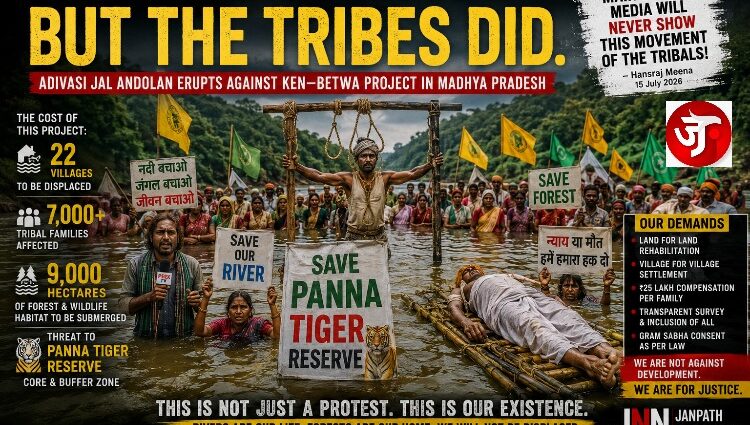
July 16, 2026: While television studios remain consumed by political shouting matches, a powerful tribal protest has been unfolding waist-deep in the waters of Madhya Pradesh against the Ken-Betwa Project.
Videos are now circulating widely on social media that show hundreds of Adivasi men and women staging extraordinary acts of resistance against the Ken-Betwa River Linking Project, prompting allegations that one of India’s largest tribal movements is being ignored by much of the mainstream media.
The latest footage, shared by tribal rights activist Hansraj Meena on July 15, has gone viral across independent media circles. In the video, protesters stand in the muddy waters of the Ken River carrying banners reading “Save Panna Tiger Reserve,” “Save Our River,“ and “Save Forest.” Women in traditional attire form human chains in the river. One protester lies silently on a bamboo raft, symbolising death and displacement, while another stands with his arms spread beneath a wooden frame resembling a hanging noose, a haunting image intended to portray what protesters call the “execution” of their homeland.
The demonstrations are part of the escalating Jal Andolan against the Ken-Betwa River Linking Project, India’s first interlinking of rivers under the National Perspective Plan. The project promises irrigation, drinking water and hydroelectric power for the drought-prone Bundelkhand region. But for thousands of tribal families living along the Ken River, it represents something very different: the possible loss of their homes, forests, culture and way of life.
According to environmental and ground reports, the proposed Daudhan Dam will displace 22 villages, with 10 villages facing complete submergence, affecting more than 7,000 families, the overwhelming majority belonging to the Gond and Kol tribal communities. Critics also warn that nearly 9,000 hectares of land, including significant portions of the core and buffer zones of the Panna Tiger Reserve, will be submerged, threatening critical habitat for tigers, gharials, vultures and other wildlife, while requiring the felling of thousands of trees.
The protesters insist they are not opposed to development, but to what they describe as development without justice. Their demands include land-for-land rehabilitation, relocation within similar forest ecosystems, higher compensation, transparent surveys, inclusion of all affected families, and the legally mandated consent of Gram Sabhas. Many allege that compensation has been unevenly distributed and that numerous eligible families have been left out of official records.
The movement has also drawn attention for its striking forms of non-violent protest. Alongside the Jal Andolan, tribal communities have organised Chita Andolans, lying on symbolic funeral pyres beneath banners reading “Justice or Death,” undertaken fasts, and covered themselves in soil to represent their inseparable bond with the land. These demonstrations have continued for months despite limited national attention.
Supporters of the project argue that it will transform water availability across Bundelkhand, irrigate vast agricultural areas and generate much-needed electricity. Yet environmentalists and tribal organisations contend that the human and ecological costs have been consistently underestimated.
Hansraj Meena’s viral post has reignited a broader debate over media priorities. Activists argue that while conflicts involving political parties dominate television coverage, grassroots struggles by Indigenous communities against large infrastructure projects often receive little sustained national attention. As images of tribal families standing silently in rising waters spread across social media, many are asking why one of India’s most visually powerful environmental protests has remained largely absent from prime-time news.
For the protesters standing in the river, the message is unmistakable: if the nation will not hear their voices on land, they will carry their protest into the water itself. Sometimes the loudest cry for justice is made in silence, which is inconvenient for television because silence does not fit neatly between commercial breaks.