









DELHI BRACES AS CJP’S “CHALO SANSAD” CALL DRAWS THOUSANDS, FOUNDER DECLARES: “THE BIGGEST MARCH IN INDIA’S HISTORY IS ABOUT TO BEGIN”
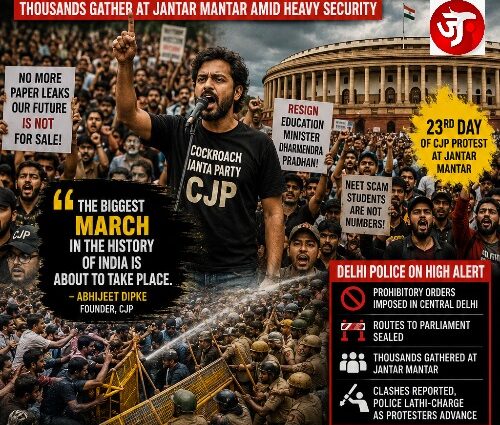
New Delhi witnessed one of its most politically charged mornings on July 20, 2026, as thousands of students, youth activists, parents, teachers, and supporters converged at Jantar Mantar in response to the Cockroach Janta Party’s (CJP) nationwide “Chalo Sansad” (March to Parliament) call. The march coincided with the opening of Parliament’s Monsoon Session, transforming the heart of the capital into a tense standoff between demonstrators demanding educational accountability and a massive security deployment determined to prevent the procession from reaching Parliament.
Standing before a sea of supporters waving placards and chanting slogans, CJP founder Abhijeet Dipke delivered a fiery address that quickly became the defining moment of the morning. Declaring that “the biggest march in the history of India is about to take place,” Dipke asserted that citizens had travelled from every corner of the country to make their voices heard. He insisted that “no one can stop us from going to Parliament,” arguing that the movement had grown beyond a protest against a single examination and had become a larger struggle to defend democracy, transparency, and the future of India’s youth. Dipke further alleged that democratic institutions had come under sustained pressure over the past decade and urged protesters to remain peaceful while refusing to back down.
The “Chalo Sansad” mobilisation marked the latest escalation in a movement that has occupied Jantar Mantar for nearly twenty-three consecutive days. What began as outrage over alleged irregularities in the NEET examination has steadily evolved into a broader youth-led campaign demanding sweeping reforms to India’s education system. Protesters accuse authorities of failing to safeguard the integrity of competitive examinations and have linked repeated exam controversies to severe psychological stress among students, including reports of suicides associated with intense academic pressure.
A central demand of the movement remains the resignation of Union Education Minister Dharmendra Pradhan, whom protesters hold politically accountable for what they describe as systemic failures in the conduct and oversight of national examinations. Demonstrators have also called for an independent investigation into alleged examination irregularities, stronger safeguards against paper leaks, mental health protections for students, and comprehensive reforms aimed at restoring public confidence in India’s competitive examination system.
Adding emotional weight to the protest has been the participation of renowned education reformer and climate activist Sonam Wangchuk, whose prolonged hunger strike became one of the movement’s most powerful symbols. Wangchuk has since been admitted to hospital following his fast, yet his supporters say his message continues to inspire thousands gathering in Delhi. Throughout the protest site, posters, banners, and speeches frequently referenced Wangchuk’s sacrifice, portraying it as a moral appeal for educational justice rather than a partisan political campaign.
Anticipating attempts to march towards Parliament, the Delhi Police imposed extensive security measures across central Delhi. Prohibitory orders restricting large public gatherings were enforced, multiple roads leading to Parliament were sealed, and heavy deployments of police and paramilitary personnel were positioned at strategic intersections. Barricades, metal fencing, and security checkpoints created multiple layers of defence around the Parliament complex, reflecting official concerns over maintaining law and order during the opening day of the Monsoon Session.
Authorities maintained that the proposed march had not received official permission, warning that any attempt to breach security restrictions would invite police action. Despite these warnings, thousands assembled at Jantar Mantar throughout the morning, many expressing their determination to continue towards Parliament regardless of administrative restrictions.
As tensions rose, reports emerged of confrontations between protesters and police when sections of the crowd attempted to move beyond designated protest areas. Eyewitness accounts described barricades being pushed, heated verbal exchanges, and instances of lathi-charge as security personnel sought to disperse advancing demonstrators. The situation remained fluid throughout the day, with authorities monitoring crowd movements while protest organisers urged supporters to remain united.
The Cockroach Janta Party, despite its unconventional name and satirical origins, has increasingly positioned itself as a platform representing frustrated students and young citizens demanding institutional accountability. Its campaign has attracted widespread attention on social media and across independent news platforms, reflecting broader public concerns over educational governance and youth employment.
Live coverage of the day’s developments tracked the evolving confrontation between protesters and authorities, documenting speeches, crowd movements, security measures, and the uncertain fate of the attempted march to Parliament. With events continuing to unfold, observers awaited further updates regarding possible detentions, negotiations, or additional demonstrations as one of the most closely watched youth protests of the year entered a decisive phase.