









OMAR ABDULLAH’S J&K STATEHOOD PROTEST AND CJP’S “CHALO SANSAD” MARCH TURN DELHI INTO A CAULDRON OF DISSENT
DELHI’S STREETS ROAR AS PARLIAMENT OPENS: TWO POWERFUL PROTESTS SHAKE THE CAPITAL ON DAY ONE OF THE MONSOON SESSION
New Delhi, July 20, 2026: The opening day of Parliament’s Monsoon Session has been met not with calm ceremony, but with the thunder of slogans echoing across the capital. As lawmakers assembled inside Parliament, the streets outside became the battleground for two of the country’s most significant protest movements, each demanding action on issues they say can no longer be ignored.
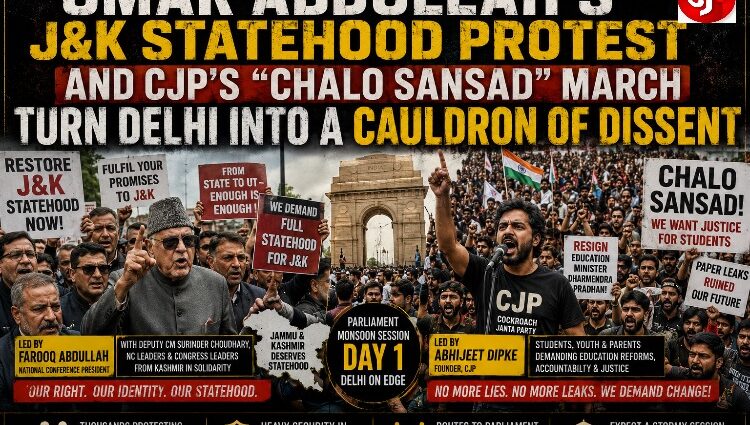
At Jantar Mantar, veteran National Conference leader Dr. Farooq Abdullah led a determined demonstration demanding the immediate restoration of full statehood to Jammu and Kashmir, reviving one of the country’s most contentious constitutional debates. Surrounded by National Conference leaders, Deputy Chief Minister Surinder Choudhary, party legislators, and Congress leaders from Jammu and Kashmir, including JKPCC President Tariq Hameed Karra, Abdullah declared that the Centre must fulfil the promises it made before both the people and the Supreme Court following the 2019 reorganisation that reduced Jammu and Kashmir from a state to a Union Territory.
The National Conference argues that the Union Territory arrangement has weakened democratic governance, delayed development, and stripped the people of Jammu and Kashmir of the autonomy they once enjoyed. Protesters accused the Centre of postponing the restoration of statehood despite repeated assurances given before Assembly elections and constitutional proceedings.
Although Chief Minister Omar Abdullah was forced to return to Jammu and Kashmir to oversee relief efforts after devastating flash floods, he confirmed that the demonstration would proceed under the leadership of his father, Farooq Abdullah. Before the protest, Abdullah had appealed to opposition parties across the country to stand together in what he described as a peaceful constitutional struggle to restore democratic rights.
Just a short distance away, another movement was gathering force.
The Cockroach Janta Party (CJP), whose youth-led agitation has now entered its twenty-third consecutive day, continued its high-profile protest demanding sweeping education reforms following the NEET examination controversy. Led by Abhijeet Dipke, thousands of students, parents, teachers, and supporters assembled for the party’s ambitious “Chalo Sansad” campaign, demanding accountability for alleged examination irregularities, justice for students, and the resignation of Union Education Minister Dharmendra Pradhan.
The movement has gained national prominence through the prolonged hunger strike of education reformer Sonam Wangchuk, who remains hospitalised after weeks without food but continues to inspire demonstrators gathered at Jantar Mantar. Protesters carried banners condemning paper leaks, examination failures, and what they described as a broken education system that has pushed countless students into despair.
With two major protests unfolding simultaneously on the very day Parliament convened, central Delhi witnessed one of its largest security deployments in recent months. Delhi Police imposed prohibitory orders, sealed roads leading towards Parliament, erected multiple barricades, and stationed large numbers of security personnel throughout the area to prevent unauthorised marches.
The simultaneous demonstrations have transformed Jantar Mantar into the political heartbeat of the nation. One movement is demanding the restoration of constitutional rights for Jammu and Kashmir. The other is calling for accountability, educational reform, and justice for millions of students. Though driven by different causes, both protests share a common message: promises must be honoured, institutions must be accountable, and public grievances can no longer be ignored.
As heated debates begin inside Parliament, the voices rising from Jantar Mantar are expected to resonate within the House. Opposition parties are preparing to press the government on Jammu and Kashmir’s statehood, the NEET controversy, education reforms, and broader questions of governance and accountability.
On a day meant to mark the beginning of a new parliamentary session, Delhi instead became a city where the streets demanded to be heard as loudly as the chambers of Parliament itself.