







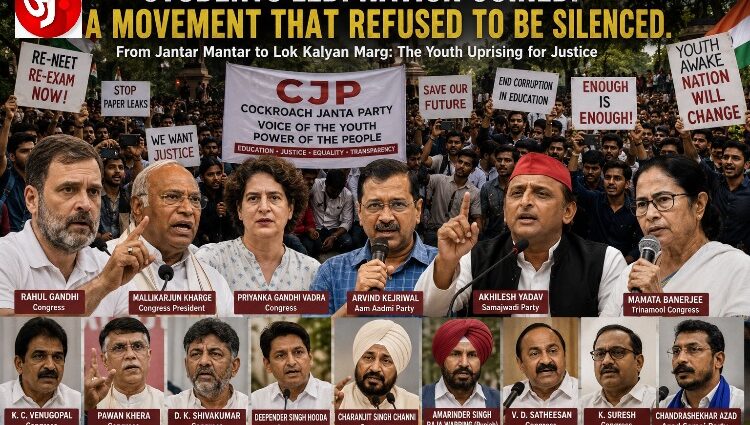
STUDENTS LED. NATION JOINED. A MOVEMENT THAT REFUSED TO BE SILENT
Every mass movement has two stories: the slow-burning fire that ignites it, and the moment that turns it into a national blaze. The Cockroach Janta Party (CJP)-led student movement had already lit that fire. Politicians’ arrival poured political oxygen onto the flames.
The movement began modestly in June, with only a few hundred students, activists, and supporters gathering daily at Delhi’s Jantar Mantar. Outrage over the NEET paper leak, mounting frustration with unemployment and the education system, and Sonam Wangchuk’s prolonged hunger strike steadily transformed scattered demonstrations into a determined youth campaign. Nightly vigils, relentless social media outreach, and growing public solidarity ensured that the crowds increased day by day.
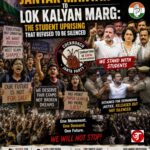
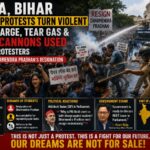
The first major turning point came with the “Chalo Sansad” march on July 20. By then, the movement had already grown into one of Delhi’s largest youth mobilisations in recent years. Thousands assembled at Jantar Mantar despite prohibitory orders, determined to march toward Parliament. Police responded with lathi charges, tear gas, and mass detentions. Although the protest site was temporarily cleared, hundreds of demonstrators regrouped through the night, refusing to let the movement die.
From a Spark to a National Uprising: Rahul Gandhi’s Entry Gave the Movement a New Force
What began as a student-led movement soon united much of India’s Opposition. While the protests remained firmly driven by students and young citizens, support poured in from across the political spectrum. Congress leaders including Mallikarjun Kharge, Rahul Gandhi, Priyanka Gandhi Vadra, K. C. Venugopal, Pawan Khera, D. K. Shivakumar, Deepender Singh Hooda, Charanjit Singh Channi, V. D. Satheesan, Amarinder Singh Raja Warring, K. Suresh and several Members of Parliament joined demonstrations and marches. The Aam Aadmi Party, led by Arvind Kejriwal, publicly backed the students, offered legal and medical assistance to those injured or detained, and condemned the police crackdown. Samajwadi Party president Akhilesh Yadav joined the protests and was detained alongside other opposition leaders. Trinamool Congress chief Mamata Banerjee also extended support to the students’ demands, while leaders from several other opposition parties voiced solidarity, turning what had begun as a youth movement into a nationwide democratic campaign for accountability and educational justice.
The following day, July 21, became the movement’s defining political moment.
Thousands once again reclaimed Jantar Mantar despite heavy rain and the previous day’s crackdown. At the same time, Rahul Gandhi, Priyanka Gandhi Vadra, and senior Congress leaders launched their own protest march toward Lok Kalyan Marg, demanding justice for students. Their dramatic detention, including images of Rahul Gandhi sitting and lying on the road while resisting police action, instantly dominated national headlines and social media. Akhilesh Yadav (from the Samajwadi Party, detained during related opposition protests and widely reported alongside the Congress leadership)
The politicians did not create the movement. The students had already built it through weeks of relentless organising, personal sacrifice, and extraordinary resilience. Sonam Wangchuk’s hunger strike had become its moral conscience, while thousands of young people had already transformed it into a significant public mobilisation.
What Rahul Gandhi did was elevate it.
The movement’s political impact became unmistakable on July 21. Rahul Gandhi’s dramatic detention during the protest outside Prime Minister Narendra Modi’s residence propelled the issue into the global spotlight. Images and videos of the Leader of the Opposition being carried away by police spread rapidly across social media, while Rahul Gandhi became one of the most-discussed political figures on X internationally. International media, including Reuters, the Financial Times, and The Guardian, prominently covered the protests, transforming what began as a student-led campaign into a story watched far beyond India’s borders. On X, Rahul Gandhi’s hashtag slipped into the international lines, gaining global attention. It was not long after that he was released in the night!
His participation brought the full weight of the principal Opposition behind the students. The arrests transformed what had largely been viewed as a student agitation into a national political confrontation. Television cameras, national newspapers, international observers, and opposition parties shifted their focus to the protests with renewed intensity.
After the police crackdown on July 20, his intervention helped keep the movement in the national conversation instead of allowing it to fade from public attention.
In that sense, Rahul Gandhi became the amplifier rather than the architect. The foundation had already been laid by students who refused to abandon the streets. Their arrival ensured that their voices echoed far beyond Jantar Mantar, turning a powerful youth movement into one of the defining political stories of the moment.
History often remembers the faces that appear when cameras arrive. It is less generous to those who stood there before dawn, holding placards in the rain while everyone else debated whether the story was “big enough.” Human memory has a remarkable talent for confusing the spotlight with the sunrise.
JANPATH NEWS NETWORK (JNN)
Independent. Fearless. On the People’s Path.
Delhi #Farmers #GenZ #CockroachJantaParty #Students #StudentsMarch #FarmersMarch #CJP #RahulGandhi #ArvindKejriwal #CongressYouth