







JNN Morning News – July 23, 2026 – A Morning Written in Fire and Rain
The world wakes today to the sound of rising tensions, restless streets, and governments making decisions whose consequences may echo for generations. Across continents, diplomacy is giving way to deterrence, protests are challenging power, and nature itself continues to remind humanity that it answers to no ideology, no election, and no military alliance. This is not merely another day in the news cycle. It is another day in a world increasingly defined by confrontation.
The gravest concern remains the Middle East. In Palestine and Lebanon, hearts are still breaking amid fragile hopes. Families in southern Lebanon return to shattered homes after Israeli withdrawals under a shaky US-brokered ceasefire, only to face ruined villages, lost loved ones, and the daily fear of fresh violations. In Gaza, the pain lingers too: endless rebuilding, grief for the fallen, and quiet resilience against the odds. After years of bloodshed, both lands ache for true peace, yet the wounds run deep, and every fragile truce feels like a prayer whispered into the wind.
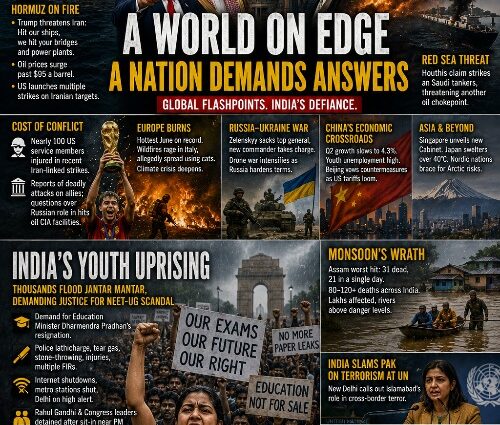
The Hormuz Crisis cannot find resolution, and President Donald Trump has signed a landmark civilian nuclear cooperation agreement with Saudi Arabia, granting American companies sweeping access to the Kingdom’s nuclear energy programme. While Washington insists the agreement is intended to strengthen peaceful energy cooperation and regional security, the possibility of future Saudi uranium enrichment has triggered unease among non-proliferation experts and raised concerns in Israel and across the region about a shifting nuclear balance.
But diplomacy now walks hand in hand with military escalation.
The United States has continued multiple rounds of military strikes against Iranian targets, while Iran has vowed an “eye for an eye” response and continues to threaten one of the world’s most vital maritime arteries. The Strait of Hormuz carries nearly one-fifth of global oil supplies, and every attack sends fresh shockwaves through international markets. With crude prices climbing beyond 95 dollars per barrel, the economic consequences are already being felt far beyond the Gulf.
The conflict has expanded even further as Iran-aligned Houthi forces claim attacks on Saudi-linked tankers in the Red Sea, placing a second global shipping corridor under pressure. Nearly one hundred American service members have reportedly been injured in recent Iranian-linked attacks, while reports of deadly strikes on allied forces and speculation surrounding possible Russian involvement in attacks on intelligence facilities have added new layers of uncertainty to an already volatile conflict.
This is no longer a regional crisis alone. Every new strike risks widening a confrontation whose consequences could reshape global security and energy markets.
Elsewhere, Europe faces crises of its own.
Spain continues celebrating one of the proudest moments in its sporting history after lifting the 2026 FIFA World Cup, defeating Argentina in a dramatic final. Madrid’s streets became seas of red and yellow as hundreds of thousands celebrated beneath soaring temperatures, while King Felipe VI and Queen Letizia welcomed the national heroes home. For a nation battling record-breaking heat and devastating wildfires, football offered a rare moment of collective joy.
Yet celebration exists alongside crisis.
Western Europe has recorded its hottest June on record, fuelling destructive wildfires, placing enormous pressure on public infrastructure, and contributing to excess deaths across the continent. In Italy, authorities continue investigating allegations that some devastating fires may have been deliberately started by arsonists using cats to spread the flames, a claim that has shocked the country while investigations continue.
In Russia, the war in Ukraine enters another uncertain chapter. President Volodymyr Zelenskyy has replaced Ukraine’s top military commander following growing tensions over battlefield strategy, while Russian forces continue pressing their offensive in eastern Ukraine. Ukrainian drones continue striking deep inside Russian territory, targeting logistics and oil infrastructure, even as Moscow hardens its negotiating position and presses forward with territorial ambitions.
Meanwhile, China’s economic engine continues showing signs of strain.
The world’s second-largest economy recorded its weakest quarterly growth in more than three years, despite strong exports in electric vehicles and artificial intelligence technologies. Youth unemployment remains stubbornly high, consumer spending continues to weaken, and Beijing is preparing for the possibility of renewed American tariffs while simultaneously attempting to stabilise its technology sector and strengthen its influence across the Global South.
Across the Indo-Pacific, tensions continue simmering in the South China Sea, Japan struggles through record-breaking temperatures exceeding forty degrees Celsius, Singapore introduces a new Cabinet blending experienced leadership with fresh faces, and Nordic nations are strengthening Arctic security partnerships amid growing geopolitical competition in the far north.
While the world watches conflicts abroad, India finds itself confronting a storm from within.
The student-led movement sparked by the NEET-UG examination paper leak has evolved into one of the largest youth uprisings in recent memory. Thousands of students, parents, teachers, activists, and ordinary citizens continue gathering at Jantar Mantar, demanding accountability, sweeping reforms to India’s examination system, and the resignation of Union Education Minister Dharmendra Pradhan.
The movement has become far larger than one examination.
It has become a protest against broken trust.
Police deployments continue to intensify across Delhi. Protest sites remain heavily barricaded. Clashes have seen lathicharges, stone-pelting, tear gas, injuries to police personnel, internet restrictions, and multiple FIRs. Metro stations around protest zones remain closed as security forces maintain a strong presence across the capital.
Despite repeated attempts to disperse demonstrators, the movement continues to grow.
Anonymous citizens continue sending food and supplies to protesters sheltering from monsoon rains. Volunteers work around the clock. Students continue arriving from across India, convinced that the struggle is no longer simply about examinations but about fairness, opportunity, and the future of an entire generation.
The political battle has intensified alongside the protests.
Congress leader Rahul Gandhi and several senior opposition leaders were detained after staging demonstrations near the Prime Minister’s residence, accusing the government of suppressing democratic dissent. Congress has consistently voiced support for students through parliamentary interventions, public demonstrations, advocacy for examination reforms, and outreach during crises, though many activists continue insisting that the student movement remain independent rather than aligned with any political party.
Even as political narratives compete for attention, the streets continue speaking in their own voice.
Nature, meanwhile, continues writing an even harsher story.
India’s southwest monsoon has unleashed widespread destruction across multiple states. Assam remains among the worst affected, with dozens of deaths, lakhs displaced, and the mighty Brahmaputra flowing above danger levels. Across Jammu and Kashmir, Himachal Pradesh, Nagaland, Maharashtra, Karnataka and several other states, floods, landslides, lightning strikes, and collapsing homes have pushed the seasonal death toll beyond one hundred in many estimates, with rescue teams continuing desperate operations amid relentless rainfall.
As one crisis unfolds after another, another sensitive issue remains under scrutiny.
The Shri Ram Janmabhoomi Teerth Kshetra Trust has accepted the resignation of its General Secretary, Champat Rai, as investigations continue into allegations concerning the management of temple funds. While no charges have been filed against Rai, the inquiry has intensified public debate over transparency and accountability. Trust officials maintain that temple construction continues uninterrupted and insist donations have been utilised responsibly.
From the burning waters of the Strait of Hormuz to the determined crowds gathered at Jantar Mantar, from the celebrations in Madrid to the flood-ravaged villages of Assam, today’s headlines tell the story of a world under immense pressure, where old certainties are crumbling, and a new generation is demanding answers that can no longer be postponed.
This is JNN Morning News. Where today’s headlines become tomorrow’s history.
JANPATH NEWS NETWORK (JNN)
Independent. Fearless. On the People’s Path.
#Delhi #Farmers #GenZ #CockroachJantaParty #Students #StudentsMarch #FarmersMarch #CJP #RahulGandhi
#ArvindKejriwal #CongressYouth #DelhiPolice #WorldNews #DonaldTrump #MiddleEast