









The Politics of Protest: Shared Goals, Different Paths
One of the most intriguing dimensions of the student movement is not simply its confrontation with the government, but its evolving relationship with India’s opposition parties, particularly the Congress.
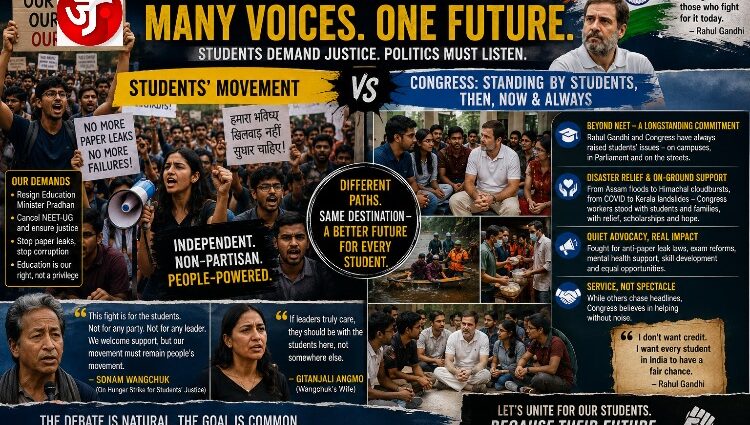
The movement centred at Jantar Mantar has consistently presented itself as an independent, citizen-led campaign rather than the youth wing of any political organisation. Its organisers have argued that the struggle is about restoring faith in India’s education system, ensuring accountability for examination failures, and protecting the future of millions of students, irrespective of political affiliation.
That insistence on remaining non-partisan has, at times, created visible distance between the movement and established political parties.
Many protesters questioned Congress’s decision to organise separate demonstrations, including Rahul Gandhi’s sit-in near the Prime Minister’s residence, rather than joining the main gathering at Jantar Mantar. The criticism became more pronounced after Gitanjali Angmo, wife of activist Sonam Wangchuk, publicly remarked that if opposition leaders genuinely wished to stand with the students, they could have joined them at the principal protest site instead of holding parallel programmes. Her comments reflected a concern shared by some activists that student anger should not become a backdrop for partisan politics.
Leaders associated with the movement have repeatedly emphasised that while support from political parties may be welcome, the movement itself must remain independent. Differences have also emerged over protest strategies, negotiations with the government, Parliament marches, and responses to police action. Organisers have expressed concern that excessive political branding, or unverified allegations of foreign influence, could distract from the movement’s central demands and weaken public trust.
Yet the relationship is more nuanced than simple disagreement.
Congress leaders and workers point out that their engagement with student issues did not begin with the present protests or the NEET-UG controversy. Long before the current agitation, Rahul Gandhi and the Congress had been campaigning on concerns such as examination stress, unemployment, paper leaks, rising educational costs, and access to quality education. Rahul Gandhi has frequently interacted with students at universities and colleges, raising issues of educational equity, mental health, youth employment, and implementation of education policy during public interactions and programmes such as the Bharat Jodo Yatra.
Beyond politics, Congress workers have also participated in relief efforts during national disasters affecting students and families. During floods in Assam and Himachal Pradesh, the COVID-19 pandemic, landslides in Kerala, and other natural calamities, party volunteers were involved in relief camps, distribution of essential supplies, assistance for displaced students, and advocacy for academic concessions where needed. The party has also supported calls for stronger safeguards against examination malpractice, mental health support for students, legal assistance for protesting youth in some instances, and student grievance mechanisms in states where it has been in government.
Congress leaders argue that much of this work has been carried out quietly, without attracting sustained national media attention. Supporters describe it as a philosophy of service before publicity, while critics contend that the party has often struggled to communicate its grassroots work effectively in an era dominated by high-visibility political messaging.
The present movement therefore reflects an unusual dynamic.
On one side stands a new generation determined to preserve its independence from established political structures. On the other stand opposition parties that argue they have been raising many of the same concerns for years and believe their support should be recognised rather than viewed with suspicion.
Despite disagreements over strategy and optics, both continue to press for greater accountability in the education system, stronger safeguards against examination irregularities, and justice for students affected by the NEET-UG controversy. The debate, then, is less about whether reform is needed than about who should lead the fight, and how that fight should be waged.
In the end, the movement’s greatest challenge may not be choosing between students and politicians, but ensuring that the students’ voices remain the loudest, even as political parties seek to lend their support.
JANPATH NEWS NETWORK (JNN)
Independent. Fearless. On the People’s Path.