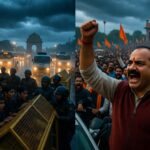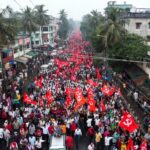








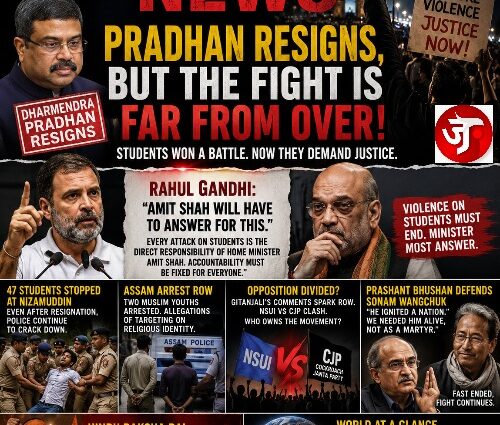
India woke up to one of the most dramatic political days in recent memory. Union Education Minister Dharmendra Pradhan’s resignation, celebrated by thousands of protesting students as a hard-earned victory, has quickly turned into the beginning of a much larger political battle rather than its conclusion. Politics, like unfinished homework, has an uncanny habit of multiplying overnight.
Even as celebrations erupted, opposition leaders insisted that the resignation alone was not justice.
Rahul Gandhi called it a significant victory for India’s youth but argued that the real question remains unanswered. He held Union Home Minister Amit Shah directly responsible for the police violence inflicted on student protesters, pointing to allegations of broken limbs, pellet-gun injuries, and dozens of critically injured students. Gandhi demanded accountability for everyone involved in planning and executing the crackdown, declaring that Amit Shah “will have to answer for this.”
Reports circulating on social media claimed that at least 47 students were stopped by Delhi Police at Nizamuddin even after Pradhan resigned, with allegations that protesters were forcibly removed from vehicles while attempting to reach Delhi.
Meanwhile, another controversy unfolded in Assam after the arrest of two Muslim youths, with activists alleging they were targeted solely because of their religious identity. The claims have further intensified political debate, although authorities have maintained that legal procedures were followed.
Inside the opposition camp, fresh tensions also surfaced. Comments made by Sonam Wangchuk’s wife, Gitanjali, were criticised by many Congress workers as being communal in tone, while a minor confrontation reportedly took place between NSUI activists and members of the Cockroach Janta Party (CJP). Both sides claim significant credit for transforming the student agitation into a nationwide movement.
The reality may be more complicated. Rahul Gandhi has spent nearly two decades rebuilding student politics through NSUI and the Indian Youth Congress, while the spontaneous energy generated by independent youth groups, including CJP, helped push the protests into an unprecedented national mobilisation. Together, along with support from multiple opposition parties and countless unaffiliated citizens, the movement gathered momentum that few expected.
Senior advocate Prashant Bhushan also entered the debate, defending Sonam Wangchuk after criticism over his decision to end his hunger strike in the presence of BJP leaders.
Bhushan argued that critics were missing the larger picture. According to him, Wangchuk’s prolonged fast and his subsequent forced hospitalisation ignited the conscience of the country’s youth, drawing thousands into the streets. He noted that Wangchuk continued fasting from the hospital and ultimately agreed to end his fast only after appeals from CJP leaders and government assurances that criminal cases against protesting students would not proceed. Keeping Wangchuk alive, Bhushan argued, would allow him to continue guiding the movement rather than becoming another martyr.
On the other side of the political spectrum, Hindu Raksha Dal chief Pinky Bhaiya (Bhupender Tomar) intensified his rhetoric, calling for supporters to march towards Jantar Mantar after previously threatening to confront student protesters. Yet, on the latest development (25 July 2026): In a post/video on his X account, he stated that the 26 July Jantar Mantar program is cancelled with immediate effect “due to the resignation of the country’s Education Minister.” He added a warning that the “Cockroach Party” should not think they can continue “anti-national activities,” as Hindu Raksha Dal and Hindutva warriors will not allow it.
It must be remembered that the RSS Chief Mohan Bhagwat earlier reportedly said: “Today’s youth need discussion, not dictation.” “When we were young, it was an era of obedience. That’s not the case anymore. The new generation asks questions. We have to explain the reasoning to them. We need to give them a lot of affection. We need to spend time with them. We need to communicate with them. Nowadays, conversation has stopped even within families.” Did his words have an effect on Pinky, to make him drop his march?
Around the World Tonight
The world beyond India’s borders was hardly quieter.
- Fighting continued across parts of the Middle East, with fresh concerns over maritime security and regional escalation.
- Global financial markets remained volatile as investors watched geopolitical developments and rising energy prices.
- Ukraine and Russia exchanged fresh attacks, keeping Europe on edge.
- International diplomatic efforts continued over Gaza, where humanitarian concerns remain severe.
- In the United States, the 2026 election cycle intensified as candidates sharpened their campaigns ahead of the coming contests.
As midnight approaches, India finds itself standing at a crossroads.
One minister has resigned. Students are celebrating. Opposition parties are demanding that accountability climb higher up the chain of command. Fresh protests are expected. Counter-mobilisations are being announced. Political credit is being fiercely contested.
Today’s victory may have closed one chapter. Judging by the streets, Parliament, and social media, the next chapter has already begun.
JANPATH NEWS NETWORK (JNN)
Independent. Fearless. On the People’s Path.