










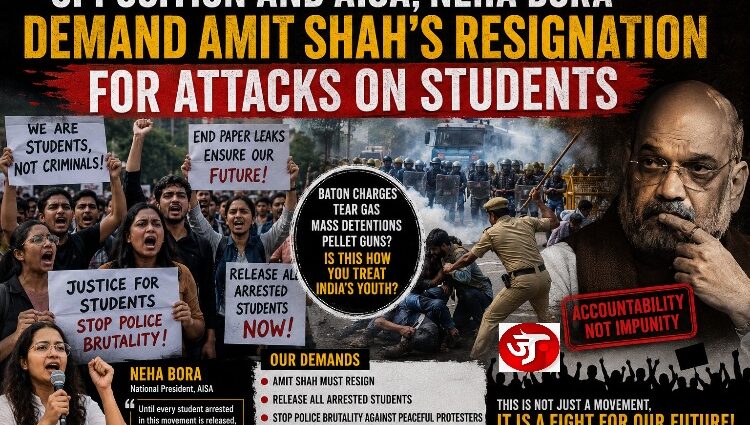
New Delhi, July 31: The political fallout from the nationwide anti-NEET paper leak movement has escalated dramatically, with the Opposition and student leaders now demanding the resignation of Union Home Minister Amit Shah over the police crackdown on protesters during the July 20 “Sansad Chalo” march.
What began as a student-led movement against repeated examination paper leaks has evolved into a larger battle over democratic rights, police accountability, and the government’s handling of dissent. Days after sustained nationwide protests forced the resignation of Union Education Minister Dharmendra Pradhan, Opposition parties have turned their attention to the Home Ministry, alleging that peaceful students were met with unnecessary force instead of justice.
The July 20 march to Parliament has become the defining flashpoint of the movement. Protesters allege that police resorted to baton charges, tear gas, mass detentions, and even pellet-gun fire to disperse thousands of students demanding accountability for repeated examination scandals. Delhi Police has denied using pellet guns, while the CRPF has not publicly responded to allegations regarding the Rapid Action Force’s role during the operation.
Leading the offensive inside Parliament, CPI(M) Rajya Sabha MP John Brittas declared that the INDIA bloc would intensify its campaign against the Home Minister.
“The Home Minister, who is responsible for this brutal assault on innocent students, must resign,” Brittas said, questioning how a government that repeatedly claims to champion India’s youth could preside over such a forceful response to peaceful demonstrators.
The demand has found support across the Opposition. Congress leader Rahul Gandhi has written to Amit Shah seeking accountability for the police action, while Trinamool Congress MP Sagarika Ghose has sought an urgent discussion in the Rajya Sabha. Shiv Sena (UBT) leader Sanjay Raut has also accused the government of deploying excessive force, particularly against women protesters.
Beyond the crackdown, the Opposition is preparing to challenge the appointment of Higher Education Secretary Naresh Pal Gangwar and question the government’s proposed amendments to the anti-paper-leak law, arguing that the real failure lay not in the absence of legislation but in its implementation.
Student leaders insist the movement is about far more than examinations. They argue that an entire generation was forced onto the streets after repeated failures to protect the integrity of India’s competitive examinations.
Among the strongest voices has been Neha Bora, National President of the All India Students’ Association (AISA) and one of the principal faces of the Jantar Mantar hunger strike. Reaffirming that the movement will not be silenced, Bora demanded the immediate release of every student arrested during the anti-paper-leak protests and called for accountability from those responsible for the crackdown.
“Our struggle is not over,” she declared. “Students asked for justice, transparency and fair examinations. They were answered with arrests and force. Until every detained student is released and accountability is fixed, this movement will continue.”
With Parliament now echoing the demands first raised on the streets, the anti-paper-leak movement has entered a new and politically volatile chapter, transforming from a campaign for examination reforms into a wider confrontation over democratic freedoms, police action, and ministerial accountability.