










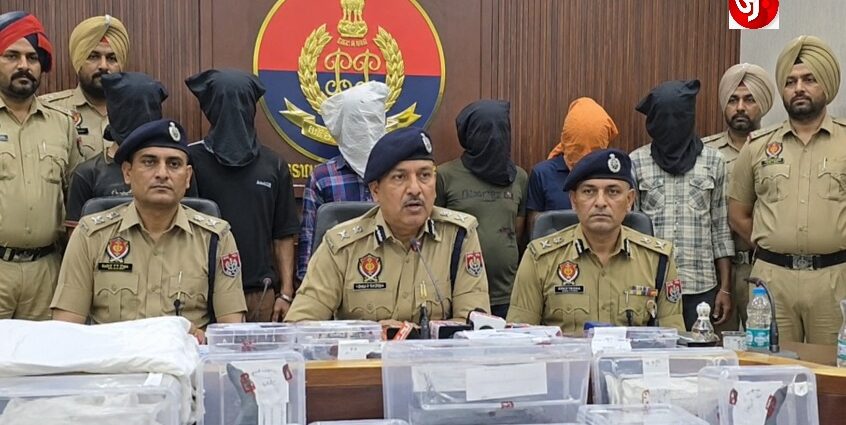
ISI-BACKED TERROR PLOT TARGETED JANTAR MANTAR PROTEST, PUNJAB POLICE SAY; 9 HELD, FOUR JUVENILES AMONG ACCUSED: Alleged cross-border handlers sought to exploit youth agitation in Delhi; petrol bombs, pistols seized as police probe surveillance of railway routes, hawala funding and recruitment network
AMRITSAR/NEW DELHI, AUGUST 5: In a chilling security breach cutting across India’s border state and the heart of the national capital, Amritsar Commissionerate Police say they have dismantled two alleged Pakistan ISI-backed terror modules, arresting nine people, including four juveniles, and uncovering what investigators describe as a plan to create violence at Delhi’s Jantar Mantar during recent youth protests.
The most disturbing element of the investigation is the alleged attempt to infiltrate a mass protest involving young Indians and turn public agitation into an opportunity for violence.
According to Punjab Police, members of one of the modules travelled to Jantar Mantar in New Delhi during the recent youth and student agitation associated with the Cockroach Janta Party (CJP) and protests over examination irregularities. Investigators allege that the suspects received logistical assistance and material connected with the preparation of petrol bombs, with instructions from foreign-based handlers to create a disturbance or launch an attack at the protest site.
The alleged plan, police say, could not be executed because of the heavy security deployment at Jantar Mantar. The suspects subsequently returned to Punjab. Their return, however, was followed by arrests.
Police said the operation led to the recovery of three illegal pistols, nine live cartridges, four petrol bombs and a stolen motorcycle, along with other material being examined by investigators.
Punjab DGP Gaurav Yadav and Amritsar Police Commissioner Gurpreet Singh Bhullar said the accused were allegedly operating under instructions from foreign-based ISI handlers who were attempting to recruit young people for terror-related activities.
The alleged assignments went far beyond obtaining weapons. Investigators say members of the network were being directed to conduct reconnaissance, watch security establishments and personnel, procure illegal firearms and prepare for acts intended to create fear and disruption. Even more troubling is the age of some of those allegedly drawn into the network: four of the nine apprehended are juveniles.
Police have also uncovered an unusual alleged surveillance operation.
Members of another module were allegedly instructed to install CCTV cameras near railway tracks, including routes connecting Amritsar towards Jalandhar and Delhi.
According to investigators, footage obtained through these cameras was being passed to handlers outside India.
The discovery raises serious questions about what information the handlers were attempting to collect and whether railway infrastructure, train movements or other sensitive activity was being mapped for future operations. Police are investigating the wider purpose of the surveillance.
Investigators further allege that handlers provided online instructions on preparing and using petrol bombs, demonstrating how remotely controlled networks can attempt to recruit, train and direct individuals without conventional organisational structures.
Money for the network was also allegedly routed through hawala channels, a financial trail investigators are now trying to reconstruct.
FIRs have been registered at Mohkampura, Airport and C-Division police stations in Amritsar, while investigators work to identify additional members of the network, trace financial transactions and establish the identities and locations of the alleged foreign handlers.
THE JANTAR MANTAR CONNECTION CHANGES THE DIMENSION OF THE CASE
The alleged attempt to exploit a legitimate protest is perhaps the most politically and socially consequential aspect of the investigation.
Thousands of young Indians have gathered in Delhi in recent weeks over examination controversies and demands for accountability. Police allegations that foreign handlers attempted to insert operatives into that environment create a dangerous new dimension.
But an important distinction must remain absolutely clear: There is no evidence in the police account reported so far that the wider protest movement or ordinary demonstrators were involved in the alleged terror conspiracy.
Rather, the police case is that alleged operatives sought to use the protest and the large gathering around it as an opportunity to cause violence.
That distinction matters enormously.
If the allegations withstand investigation and judicial scrutiny, the case would demonstrate something more sinister than a conventional terror plot: an attempt by foreign handlers to weaponise an existing democratic protest, exploit public anger and potentially transform a gathering of citizens into the scene of an attack.
Such an operation could have endangered protesters and security personnel alike while simultaneously discrediting an otherwise political movement.
The plot, according to police, failed, but the investigation continues. Authorities are now attempting to determine how extensive the network was, how the juveniles were recruited, who assisted the suspects in Delhi, where the weapons originated, how money moved through the hawala system and whether additional operatives remain unidentified. For Punjab Police, the arrests represent a major counter-terror breakthrough.
For India, however, the revelations carry a broader warning, for when foreign terror networks begin searching for angry, vulnerable or impressionable young people and attempting to hide their operations inside genuine public movements, the battlefield is no longer only at the border. It can emerge inside the crowd itself.
JANPATH NEWS NETWORK (JNN)
Independent. Fearless. On the People’s Path.