










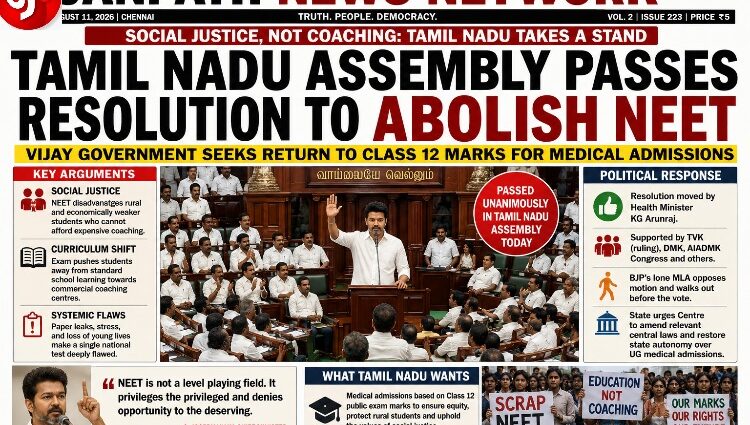
AUGUST 11: Tamil Nadu has once again put NEET at the centre of India’s education debate, with the Legislative Assembly adopting a resolution urging the Union government to abolish the National Eligibility-cum-Entrance Test for medical admissions in the state and permit students to enter undergraduate medical courses on the basis of their Class 12 public examination marks.
The resolution, moved by Tamil Nadu Health Minister K.G. Arunraj under Chief Minister C. Joseph Vijay’s TVK government, argues that the national entrance examination has created a system in which a student’s access to a medical seat can increasingly depend not simply on academic ability, but on access to expensive coaching, specialised preparation and the ability to spend an additional year preparing for a single high-stakes examination.
The Assembly’s move revives one of Tamil Nadu’s longest-running battles with the Centre over medical education and the question of who should determine the pathway to professional courses.
The resolution makes social justice its central argument.
Tamil Nadu contends that NEET places rural, poor, backward and Tamil-medium students at a disadvantage because students from wealthier families can afford private coaching centres and intensive preparation programmes that are often unavailable to students in government schools and economically weaker communities. The government argues that the school system should remain the foundation of academic assessment rather than forcing students to shift their attention from their regular curriculum towards commercial coaching.
That argument strikes at the heart of the NEET controversy.
For its supporters, a common national entrance examination is supposed to create a standardised and merit-based system in which students compete on the same examination rather than through different state-level admission mechanisms.
For its critics, however, the problem is that “the same examination” does not necessarily mean “the same opportunity”.
A student from an affluent urban family may have access to years of coaching, mock tests, specialised study material and private tutors. A student from a remote village may have a government school, limited resources and little access to the coaching ecosystem that has grown around NEET.
The examination may be identical, but the preparation environment is not.
Tamil Nadu’s resolution also points to a second concern: the repeated controversies surrounding the conduct of high-stakes examinations, including allegations of paper leaks and other irregularities, as well as the enormous psychological pressure placed on young aspirants.
The state argues that when an entire medical career is concentrated into one national examination, a technical failure, leak, cancellation, irregularity or poor performance on a single day can have consequences far beyond an ordinary examination setback.
For thousands of families, NEET has consequently become more than an entrance test.
It has become a year-long battle involving coaching fees, repeated examinations, financial pressure and intense competition for a limited number of medical seats.
Tamil Nadu wants to change that model.
Under the proposed approach, students would be admitted on the basis of their performance in the state’s Class 12 public examinations, restoring a system in which school education and sustained academic performance play the decisive role.
The resolution received support from the major political parties in the Assembly, while the BJP’s lone MLA opposed the motion and walked out before the vote. Reports described the resolution as being adopted by the House despite the BJP’s opposition.
The political symbolism is considerable.
Vijay’s government has made education and student welfare central to its political positioning, and opposition to NEET has long been part of the wider Tamil Nadu political debate. Vijay himself has previously criticised NEET and argued that it disadvantages rural students.
But passing a resolution in Chennai does not, by itself, abolish NEET.
That is where the battle now moves from the state Assembly to New Delhi.
The Union government would have to agree to the changes necessary for Tamil Nadu to follow its preferred admission system. The Centre has previously maintained that there was no proposal under consideration to amend the National Medical Commission Act to abolish NEET nationally.
The constitutional and legislative question is therefore likely to remain contentious.
Tamil Nadu is effectively asking for greater control over medical admissions while the Centre maintains a national framework for medical education.
And beneath the legal and political argument lies a much larger question:
For Vijay’s government, the answer is clear: Tamil Nadu should return to a system based on Class 12 marks.
For the Centre, the larger national framework remains intact.
And for millions of students watching the battle unfold, the question is painfully practical rather than ideological:
Will their future depend on what they learn in school, how much their families can spend on coaching, how well they perform on one examination, or some combination of all three?
Tamil Nadu has now placed its answer on the Assembly floor.
The next move belongs to New Delhi. And, as usual in India’s education wars, the students are the ones waiting for the adults to finish arguing over the rulebook.
JANPATH NEWS NETWORK (JNN)
Independent. Fearless. On the People’s Path.