









Poll Tracker Survey Projects INDIA Alliance Ahead of NDA, Triggers Fresh Political Buzz
A new opinion poll has set India’s political conversation ablaze with a dramatic claim: if Lok Sabha elections were held today, Rahul Gandhi would emerge as the preferred choice for Prime Minister.
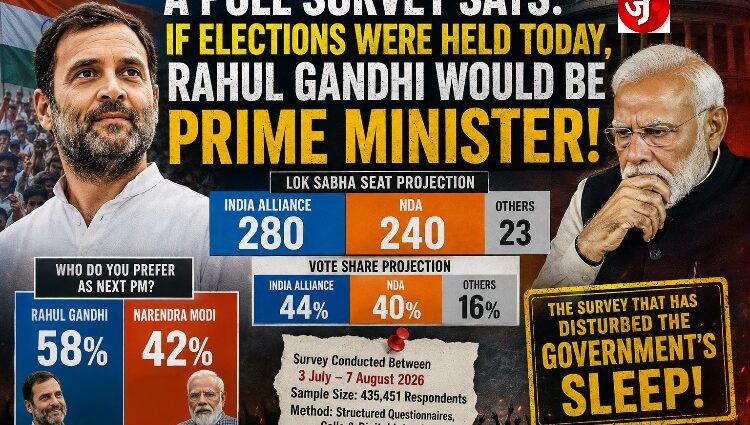
According to Poll Tracker’s “Mood of India 2026” survey, the INDIA alliance is projected to win 280 Lok Sabha seats, compared with 240 for the NDA, while Others are projected to secure 23 seats.
The survey also puts the INDIA alliance ahead on vote share, with 44 per cent, against 40 per cent for the NDA.
But the number attracting the greatest political attention is the survey’s preferred Prime Minister question.
Rahul Gandhi: 58 per cent.
Narendra Modi: 42 per cent.
If representative of the wider electorate, such a finding would signal a remarkable shift in the political landscape and place the opposition leader at the centre of a dramatically different electoral narrative.
The survey, with a reported sample size of 435,451 respondents, was conducted between 3 July and 7 August 2026 using structured questionnaires, calls, and digital interviews, according to the pollster’s posts.
PollTracker has posted multiple related “Mood of India 2026” findings around the same period, including dissatisfaction with NDA performance (58% unsatisfied vs 42% satisfied) and other preference questions.
Poll Tracker says it tracks public sentiment through structured questionnaires, telephone interviews and digital interviews, compiling the responses to assess political mood and voter preferences. The unusually large claimed sample of 435,451 respondents attracts attention.
PollTrackerThese results contrast with other contemporaneous surveys (such as CVoter youth/snap polls and earlier India Today Mood of the Nation findings) that continue to show Modi ahead on popularity and leadership metrics among broader or youth samples. Opinion polls of this nature vary widely in methodology, sample quality, and weighting, and should be treated as snapshots rather than definitive forecasts.
The figures have since spread rapidly across social media, accompanied by claims that the survey has rattled the ruling establishment and dramatically altered the political balance.
Other surveys conducted around the same period have produced very different findings, with Narendra Modi continuing to lead on several popularity and leadership measures. Differences in methodology, sampling, weighting and the composition of respondents can produce sharply contrasting results.
Still, the Poll Tracker findings have injected a new question into India’s political discourse:
Is the country witnessing a genuine change in voter sentiment, or is this simply another snapshot of an electorate that remains deeply divided and unpredictable?
For the opposition, the survey provides a potentially powerful story of resurgence.
For the NDA, it is a reminder that political dominance can never be assumed to be permanent.
The timing is significant.
The Cockroach Janta Party (CJP) protest at Jantar Mantar has also injected an unusual new energy into the political conversation, particularly among younger voices and sections of citizens expressing frustration with the political and institutional establishment.
Taken together, the viral survey and the visibility of the Jantar Mantar protest are contributing to a growing perception that the political landscape may be entering a new phase.
Whether that perception represents a genuine movement in voter sentiment or simply the amplification effect of social media remains to be seen. But politically, something is clearly happening: issues that once remained confined to scattered protests, online debates and opposition speeches are increasingly becoming part of a much larger public conversation.
And for voters, the final verdict remains where it has always been: not in a poll, not on television and not on social media, but inside the ballot box.
JANPATH NEWS NETWORK (JNN)
Independent. Fearless. On the People’s Path.