









From Gen Z to Gen Alpha, a generation that was expected to simply obey is beginning to demand answers
Something is happening in India.
Nobody quite knows what to call it yet. There is no single leader, no single political party, no single slogan capable of containing it. It is appearing in different places, among different generations, over entirely different grievances.
But the air feels different.
A generation that was once told to study hard, keep quiet, wait its turn and accept what it was given is beginning to ask a more uncomfortable question:
Why?
Why should a child have to walk through mud and broken roads to reach school?
Why should students eat poor-quality, watery dal, or expired food in institutions meant to protect them?
Why should drinking water, electricity, toilets and basic sanitation become matters requiring protest?
Why should young people spend years preparing for examinations only to confront paper leaks, recruitment delays and disappearing opportunities?
And perhaps most significantly:
Why should they remain silent?
Across social media, a remarkable series of images and reports is beginning to form a larger picture.
Gen Z voices are celebrating what they describe as a new wave of awareness among young Indians. Students and job aspirants have gathered in Prayagraj, raising issues of education, recruitment, paper leaks, unemployment and their future.
At the same time, something even more striking is emerging.
Gen Alpha is beginning to speak.
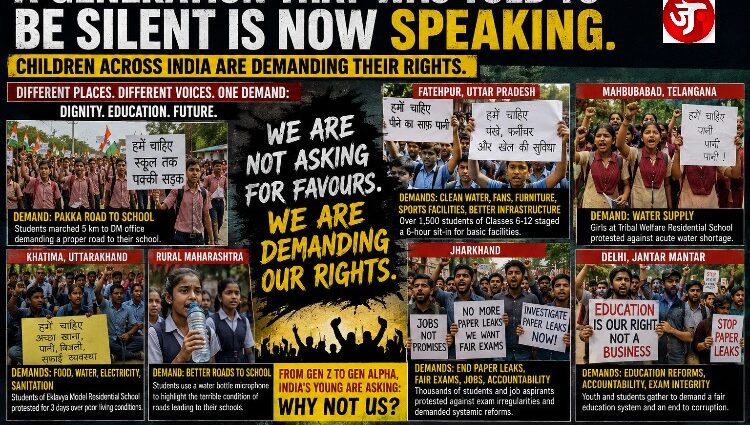
Hamirpur, Uttar Pradesh: Schoolchildren marched about 5 km to the district collectorate, carrying the national flag, demanding a proper paved road to their school. Reports say the children went to the authorities because the existing route was making access to school difficult.
Fatehpur, Uttar Pradesh: More than 1,500 students from Classes 6–12 staged a roughly six-hour sit-in at Sarvodaya Inter College. Their demands included clean drinking water, functioning fans, adequate furniture, sports facilities and better basic infrastructure. Reports also mention complaints about unhygienic toilets and additional charges for documents/admission-related matters.
Mahbubabad, Telangana: Girls at a Tribal Welfare Residential School and College boycotted classes and protested over an acute water shortage. They demanded uninterrupted drinking and household water, including enough water to use and clean hostel bathrooms. After the protest, the state minister reportedly assured them that regular water supply would be restored.
Khatima, Uttarakhand: Students at the Eklavya Model Residential School reportedly staged a three-day protest over basic living conditions, including food, water, electricity and sanitation. The incident reportedly led to administrative action, including an inquiry and the principal being removed pending investigation.
Rural Maharashtra: Students in villages including Tryambakeshwar/Peglawadi and Gohirewadi have been highlighted online for drawing attention to poor roads leading to their schools. One striking tactic involved students making a microphone from a water bottle to report the condition of the road. The imagery itself is powerful: children improvising a press conference because the infrastructure around them has failed.
Jharkhand: The movement among older students and job aspirants has moved beyond school infrastructure into the question of their future itself. Thousands of young protesters have demonstrated over alleged irregularities in JPSC/JSSC recruitment examinations, including alleged paper leaks. Their demands have included systemic reforms, cancellation of affected examinations and an independent investigation. Police used tear gas and batons when a march toward the state legislature escalated.
Delhi, Jantar Mantar: The CJP-led youth mobilisation has focused on exam integrity, accountability and the education system, bringing students and young people into the national political spotlight. Human Rights Watch and Amnesty International both documented the police response to the July 20 protest, including allegations of excessive force.
The larger pattern
What makes these incidents interesting is that the demands exist on different levels of the same ladder:
A road to school.
Water in a hostel.
Clean toilets.
Food that is fit to eat.
Electricity and fans.
Furniture.
Teachers and functioning schools.
Fair examinations.
Jobs.
Accountability.
A future.
Reports indicate that an average of 25 government schools have closed or merged every day in India over the past decade, totaling roughly 94,000 schools.
For decades, India’s young were frequently spoken about.
Now they appear increasingly determined to speak for themselves.
And this comes at a politically charged moment.
The viral Poll Tracker survey claiming that the INDIA alliance would win 280 Lok Sabha seats against 240 for the NDA, while placing Rahul Gandhi ahead of Narendra Modi in its preferred-PM question, has added fuel to speculation about a changing political mood. The survey’s methodology and representativeness remain open to scrutiny, and no opinion poll can substitute for an election.
But perhaps the more interesting story is not the poll itself.
It is the conversation surrounding it.
The viral survey. The Jantar Mantar protests. The student mobilisation in Prayagraj. Young people questioning recruitment systems and examinations. Schoolchildren demanding roads. Girls challenging administrators. Rural students demanding food, water and basic dignity.
Individually, these may look like disconnected events.
Together, they begin to resemble something else: A generation discovering its voice. And once children begin asking questions, adults may find it increasingly difficult to pretend that everything is fine.
For years, politics has often been dominated by the familiar battles: religion, caste, identity, personalities, parties, accusations and counter-accusations.
But a younger generation may be asking a far less complicated question: What about us?But perhaps something larger is beginning where political change does not always announce itself with a massive rally. Sometimes it begins with a schoolgirl standing outside a gate, or with a child walking into a government office.
“Who is responsible?” India may not yet know where this is heading, but the children are talking. And increasingly, they are not asking for permission to be heard, they are just marching in!
JANPATH NEWS NETWORK (JNN)
Independent. Fearless. On the People’s Path.