










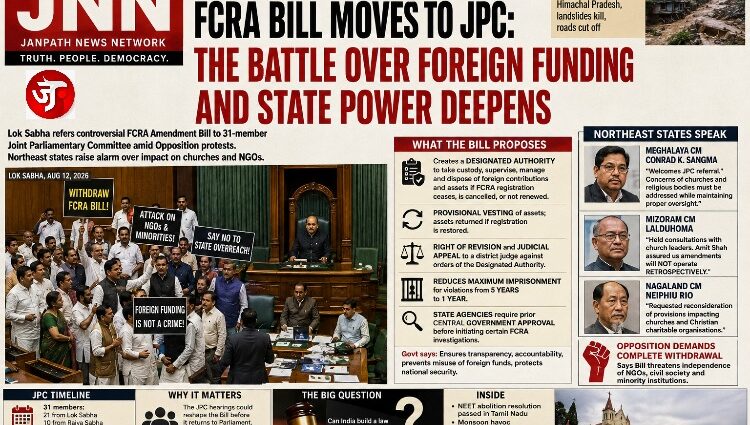
The Foreign Contribution (Regulation) Amendment Bill, 2026 has entered a new and potentially decisive phase, moving from a heated parliamentary confrontation into formal committee scrutiny after the Lok Sabha referred the controversial legislation to a 31-member Joint Parliamentary Committee on August 12.
The referral came on the penultimate day of the Monsoon Session, amid strong Opposition protests and sloganeering. Opposition parties have demanded that the Bill be withdrawn altogether, warning that its proposed provisions could place sweeping new powers over NGOs, civil-society organisations, charitable institutions and religious bodies in the hands of the Central government.
The government, however, has defended the legislation as an effort to strengthen transparency, accountability and national security while preventing the misuse of foreign contributions.
The JPC referral means the Bill will not simply move directly towards passage. The committee is expected to examine its provisions in detail, hear from government representatives and stakeholders, and submit its report to the Lok Sabha by the last day of the first week of the Winter Session of Parliament in 2026.
The committee will have 21 members from the Lok Sabha and 10 from the Rajya Sabha, with a quorum of one-third of its total membership.
The legislation was introduced in the Lok Sabha on March 25 by Minister of State for Home Affairs Nityanand Rai. It seeks to amend the Foreign Contribution (Regulation) Act, 2010, which governs the receipt and use of foreign contributions by NGOs, associations, educational institutions, religious organisations and other entities.
At the heart of the controversy is a proposed new mechanism governing the assets and foreign contributions of organisations whose FCRA registration is cancelled, surrendered, expires or is not renewed.
The Bill proposes the creation of a Designated Authority with powers to take custody of, supervise and manage foreign contributions and assets created from those contributions, with the possibility of their eventual disposal under specified circumstances.
Critics have raised concerns about the breadth of these powers, particularly the possibility that organisations could lose control over assets accumulated through years of charitable or institutional work following the loss of their FCRA registration.
The government has pushed back against the suggestion that the provision amounts to unrestricted confiscation. Its latest explanation describes the initial process as provisional vesting and says assets could be returned if an organisation’s registration is restored. The Bill also provides for revision and judicial appeal against orders of the Designated Authority, including an appeal to a district judge. Permanent vesting, according to the government’s explanation, would arise only if registration is not restored within the prescribed period.
The legislation also proposes a significant change in the criminal provisions of the FCRA. The maximum imprisonment for certain violations would be reduced from five years to one year. At the same time, state agencies would require prior Central government approval before initiating certain investigations under the Act.
Supporters argue that the amendments streamline enforcement and prevent misuse while making some penalties more proportionate. Critics, however, remain concerned about the extent to which the proposed framework could increase Central control over organisations operating in India’s civil-society space.
The controversy has become particularly intense in the Northeast, where churches and faith-based organisations play a significant role in education, healthcare and social welfare, particularly in remote and tribal communities.
Meghalaya Chief Minister Conrad K. Sangma has welcomed the JPC referral, saying concerns raised by churches and religious organisations should be properly examined while maintaining effective oversight of foreign funding.
In Mizoram, Chief Minister Lalduhoma had already held consultations with major church bodies and raised concerns with the Centre over provisions they considered unacceptable. He subsequently said Union Home Minister Amit Shah had assured him that the proposed amendments would not operate retrospectively, addressing one of the major concerns raised by the state.
Nagaland Chief Minister Neiphiu Rio has also sought reconsideration and detailed parliamentary scrutiny, particularly over the potential effect of the amendments on churches and Christian charitable organisations involved in education, healthcare and social welfare.
The interventions by the three northeastern states have given the controversy a significance beyond the usual government-Opposition confrontation in Parliament. The debate now involves state governments, religious institutions, civil-society organisations and communities that depend on foreign contributions for legitimate charitable and social programmes.
The Opposition continues to demand complete withdrawal of the Bill, arguing that the proposed powers could be used against NGOs, civil-society groups and minority institutions. The government rejects the allegation that the legislation is directed against any particular community and maintains that the amendments apply across the board.
The government says the central objective is to ensure that foreign contributions are used lawfully, transparently and for legitimate purposes, while protecting India’s national security interests.
The JPC will now have to examine both sides of the argument.
The central question is no longer simply whether Parliament will pass the FCRA Amendment Bill.
It is whether the committee can establish where legitimate regulatory oversight ends and excessive administrative power begins.
India clearly has a legitimate interest in knowing where foreign money enters the country, who receives it and how it is used. But India also has a vast network of NGOs, educational institutions, charitable organisations and religious bodies working in healthcare, education, disaster relief, poverty alleviation and community development.
The challenge is to regulate without suffocating.
The JPC therefore assumes unusual importance. Its hearings could provide an opportunity for the government to explain the safeguards built into the Bill, for Opposition parties to place their objections on record, and for NGOs, churches, state governments, legal experts and other stakeholders to challenge or support specific provisions.
The Northeast is likely to be particularly important in that process.
The concerns raised by Meghalaya, Mizoram and Nagaland have demonstrated that the Bill has implications far beyond Delhi’s political corridors. For organisations operating schools, hospitals, welfare programmes and community institutions, changes to the FCRA framework could have direct consequences for their ability to function.
At the same time, the government faces a different responsibility: ensuring that foreign funding cannot be diverted towards unlawful activity, financial irregularities or actions that threaten national security.
That is the balance the JPC must now confront.
The FCRA Bill has therefore not been defeated, nor has it been passed.
It has entered the parliamentary space where legislation is supposed to be tested, challenged and examined before it becomes law.
The coming months will determine whether the committee recommends substantial changes, additional safeguards or leaves the government’s framework largely intact.
What began as a fierce battle over a Bill has now become a much larger debate over foreign funding, civil society, religious institutions, national security and the limits of state power.
The shouting in Parliament may have temporarily moved elsewhere.
The real battle has only just entered the committee room.
JANPATH NEWS NETWORK (JNN)
Independent. Fearless. On the People’s Path.