
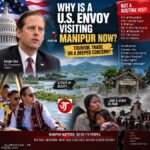






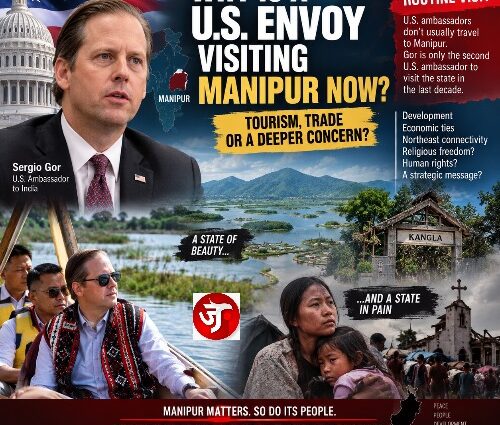
The visit of U.S. Ambassador to India Sergio Gor to Manipur deserves more attention than the photographs of Kangla Fort, Ema Keithel and a boat ride on Loktak Lake might suggest. Diplomatic visits are rarely arranged simply because an ambassador wants to admire a lake. There are tourism agencies for that.
Gor’s two-day visit to Manipur is significant precisely because U.S. ambassadors do not routinely travel to the state. He is only the second U.S. ambassador to India to visit Manipur in the past decade, following Kenneth Juster, who came in 2018 for the Sangai Festival.
And the circumstances surrounding Gor’s visit are dramatically different.
Manipur remains scarred by the ethnic conflict that erupted in 2023, with hundreds killed, thousands displaced and communities divided along deeply entrenched ethnic and religious lines. The visit therefore takes place against a background that Washington has been watching for years.
Officially, it is about engagement
Gor’s public agenda was diplomatic and economic. He met Chief Minister Yumnam Khemchand Singh and Governor Ajay Kumar Bhalla. He said he discussed expanding U.S.-India economic ties with the Chief Minister and the importance of continued U.S.-India engagement with the Governor. Tourism, development and the Northeast also featured prominently.
The Chief Minister invited Gor to the Manipur Sangai Festival, while Gor praised the state’s natural beauty and asked about tourist numbers.
But diplomacy is often conducted in two languages: what is said publicly and what is discussed privately.
The Christian dimension cannot simply be ignored
A major dimension of the Manipur conflict concerns the predominantly Christian Kuki-Zo tribal population, which has suffered extensive displacement and destruction during the violence.
That makes Gor’s presence particularly noteworthy. It would be premature to claim that Christian persecution was the reason for his visit, because neither Gor nor the U.S. Embassy has publicly identified religious freedom or persecution as the purpose of the trip.
But it would be equally simplistic to pretend that this context does not exist.
The United States has historically monitored religious freedom and communal violence in India, and Manipur’s conflict has generated international concern precisely because the violence has affected homes, villages, places of worship and entire communities.
Why Manipur? Why now?
There is another important clue.
Gor’s Manipur trip came immediately after a visit to Darjeeling, and shortly after his highly watched visit to Jammu and Kashmir. ThePrint noted that the Manipur visit followed his Kashmir trip, where he had described Jammu and Kashmir as an important part of India.
Taken together, these visits suggest a broader diplomatic interest in India’s geographically sensitive frontier regions.
The Northeast is India’s gateway towards Southeast Asia. Manipur borders Myanmar and occupies an important position in India’s wider connectivity strategy. In 2018, Ambassador Kenneth Juster explicitly described Manipur and the Northeast as important to U.S. efforts to deepen connectivity across South Asia.
So there are several overlapping layers: economic engagement, Northeast connectivity, tourism, India-U.S. strategic relations, and the unresolved human consequences of the Manipur conflict.
The most important question may be what was not said
Gor has not publicly announced any American mediation initiative in Manipur. In fact, the public messaging has been carefully framed around development, investment, tourism and U.S.-India relations.
Yet the previous U.S. ambassador, Eric Garcetti, took a much more explicit position during the 2023 violence. He called Manipur a human concern, rather than simply a strategic concern, and said the United States stood ready to assist if asked.
Three years later, a U.S. ambassador has physically returned to the state.
That does not prove Washington has decided to intervene.
But it does make the visit diplomatically significant.
The real reason may therefore not be why Sergio Gor went to see Loktak Lake. It is why Washington considered it important for its ambassador to personally enter a conflict-affected frontier state that has rarely received such high-level American diplomatic attention.
And until the contents of his private conversations become clearer, one question will inevitably remain hanging over the visit:
Was this simply an economic and diplomatic outreach to India’s Northeast, or was Washington also quietly taking the temperature of a conflict with a significant Christian dimension that has attracted international concern?
The evidence supports asking that question, but it does not yet support answering it as fact.
JANPATH NEWS NETWORK (JNN)
Independent. Fearless. On the People’s Path.